












NEWS
How long can beer stay in a fermenter?
How Long Can Beer Stay in a Fermenter?
How long can beer stay in a fermenter? There is no single number that fits every brewery, because the real answer depends on yeast condition, fermentation temperature, beer style, tank pressure, sanitation, and what happens after primary fermentation slows down. In practice, some beers are ready to move within a week or two, while others benefit from a longer stay for conditioning. The key point is not “how long is too long” in theory, but how long is safe and useful for the beer you are making.
For brewers, this matters more than it may seem at first glance. Leaving beer in the fermenter too briefly can mean incomplete attenuation, unstable flavor, excess diacetyl, or poor clarity. Leaving it too long can raise different concerns: yeast stress, autolysis risk, oxidation exposure during handling, hop character loss, or simply tying up valuable tank capacity.
Most standard ales can often remain in a healthy stainless steel fermenter for roughly 2 to 4 weeks without trouble if temperature control and hygiene are solid. Lagers, strong beers, and some specialty styles may stay longer, especially when maturation is part of the intended profile. But “can stay” and “should stay” are not always the same thing.
What actually limits time in the tank
A lot comes down to yeast. Healthy yeast can protect beer for a while by scavenging some oxygen and finishing cleanup of fermentation byproducts. Once yeast becomes stressed, compacted, or begins to break down, the benefit fades. In modern brewing, autolysis is less dramatic than older brewing textbooks sometimes suggest, especially in well-designed conical stainless steel vessels, but it is still not something to ignore on long holds.
Temperature is the next major factor. Warmer beer ages faster in the fermenter. A beer sitting warm after terminal gravity is reached will generally lose freshness sooner than one held cold under controlled conditions. Dry-hopped beers are a good example: they often should not sit unnecessarily long after the desired extraction window, because bright hop aroma can flatten out and vegetal notes may creep in.
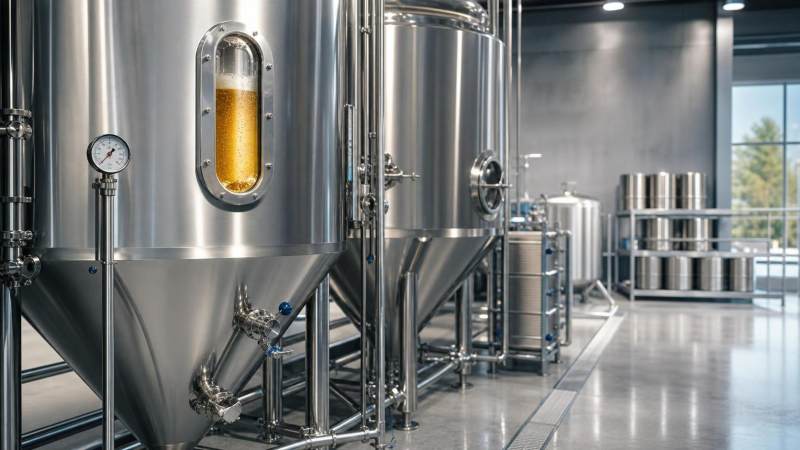
Then there is tank condition. A clean, passivated stainless steel fermenter with reliable seals, smooth internal surfaces, and stable temperature control gives brewers more confidence than an older tank with questionable gaskets or inconsistent cooling. This is one reason professional breweries invest carefully in vessel design, not just capacity.
A practical time frame by beer style
If you want a practical guide rather than a textbook answer, think in ranges:
- A standard ale may finish fermentation in several days, then need additional time for yeast cleanup and settling. Around 10 to 21 days in total is common.
- Lagers usually need more patience because fermentation is cooler and conditioning often takes longer.
- High-gravity beers can stay in tank longer, but only if yeast health and oxygen management were good from the start.
- Heavily dry-hopped beers often need tighter timing because freshness matters more than extended tank residence.
- Sour or mixed fermentation beers are their own category and should be judged by process design rather than standard ale rules.
These are not hard limits. They are working ranges brewers use while checking gravity stability, sensory profile, and package schedule.
Signs beer has stayed too long
The warning signs are usually sensory before they become obvious process failures. A meaty, rubbery, or sulfury edge can point to yeast breakdown. Hop-forward beers may taste dull. Malt profile can seem muddy rather than rounded. Clarity may not improve further even though tank time keeps extending. If the beer is technically finished but no longer getting better, it is probably sitting too long.
Another overlooked issue is scheduling. Breweries sometimes hold beer in fermentation tanks simply because bright tanks or packaging are not available. That is understandable, but it changes the question from brewing science to production planning. In many operations, the biggest cost of long fermenter residence is not ruined beer; it is reduced throughput.
Why fermenter design makes a real difference
When brewers ask how long beer can stay in a fermenter, they are also asking how much trust they can place in the vessel itself. Good stainless steel equipment helps by keeping the process stable: accurate cooling control, sanitary welds, smooth inner surfaces, dependable valves, proper cone geometry, and cleaning systems that do not leave hidden residue behind.
Shandong Weike Machinery Equipment Co.,Ltd has worked across brewing, winemaking, and broader beverage production with stainless steel vessels ranging from beer equipment and storage tanks to beverage tanks for cider, kombucha tea, soda water, coffee, and juice. That cross-industry experience matters because product stability often comes back to the same fundamentals: hygienic construction, controllable temperature, and equipment that is practical to clean and maintain over time.
Even outside brewing, the principle is similar. In sauce, jam, and other viscous food processing, holding product too long in the wrong tank can create scorching, sticking, uneven heat transfer, and cleaning headaches. That is why processors may choose purpose-built equipment such as Heating Mixing Tank with Scraper Agitator, which uses stainless steel construction, wall-scraping agitation, temperature control, and CIP-oriented hygienic design. It is a different application, but the lesson is familiar to brewers: product quality lasts longer when the vessel is matched to the process.
What brewers should check before deciding to transfer
A calendar date is never enough on its own. Before moving beer out of the fermenter, brewers usually want to confirm a few things:
- Gravity is stable, not just close to target.
- Diacetyl and other fermentation byproducts have been reduced to an acceptable level.
- Temperature has been managed for the intended cleanup or conditioning stage.
- Yeast and trub load are not creating off-flavor risk.
- The next vessel or packaging step is ready, so the transfer does not introduce avoidable oxygen pickup.
This sounds basic, but many problems blamed on “too much time in the fermenter” are really transfer timing or cellar coordination issues.
So, how long is too long?
If the fermenter is clean, sealed, temperature-controlled, and the beer is healthy, a few weeks is often perfectly workable for many styles. Once you stretch beyond that, the answer becomes more process-specific. Some beers improve with extra time. Some just occupy space and slowly lose their best character.
The better question for a working brewery is this: is the beer still developing in a positive direction, or is it only waiting? If it is only waiting, tank time is no longer helping. That is usually the moment to transfer, package, or redesign the production schedule so the fermenter is used for fermentation rather than storage.
In other words, beer can stay in a fermenter longer than many beginners fear, but not indefinitely and not without trade-offs. Good yeast management and good stainless steel equipment buy you time. Good judgment tells you when to stop using it.