












NEWS
What are beer fermentation tanks called?
What are beer fermentation tanks called?
Beer fermentation tanks are commonly called fermenters, unitanks, or conical fermenters. The right term depends on the tank’s shape, process role, and how the brewery is set up. In casual conversation, many brewers simply say “fermenter.” In equipment discussions, though, the distinction matters because tank design affects yeast performance, cleaning, pressure control, and whether the same vessel can handle both fermentation and maturation.
That is why this is more than a naming question. For a brewery, cidery, or broader beverage plant, the tank name usually signals how the vessel will be used on the production floor. A conical fermenter is not just a cone-bottom tank; it is a process choice. A unitank is not just a modern label; it often means fewer transfers, tighter oxygen control, and different cellar planning.
The main names you will hear in breweries
“Fermenter” is the broadest term. It can refer to almost any vessel where wort is inoculated with yeast and turned into beer. Small craft breweries, pilot systems, and larger commercial breweries all use the word.
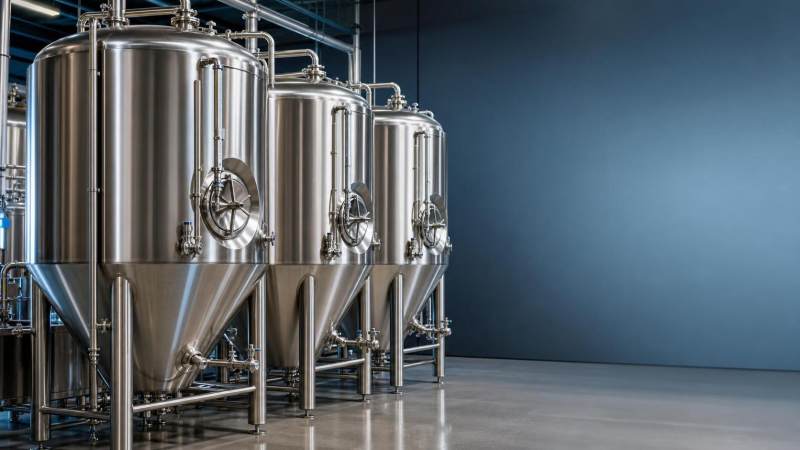
“Conical fermenter” usually refers to a cylindrical tank with a cone-shaped bottom. This is one of the most common designs in modern brewing because the cone helps collect yeast and trub, making dumping and harvesting easier. It also supports more consistent production when a brewery is handling multiple batches and needs predictable cleaning and turnaround.
“Unitank” means a vessel designed to complete more than one stage in the same tank, typically fermentation and conditioning, and in some operations even carbonation. Not every conical fermenter is used as a unitank, but many unitanks are conical. The practical difference comes down to pressure rating, cooling control, fittings, and the brewery’s SOPs.
You may also hear “FV,” short for fermentation vessel, or “CCV,” which often means cylindroconical vessel. In technical quotations, abbreviations like these are common, especially when discussing jacket zones, manways, CIP devices, sample valves, pressure relief components, or insulation details.
Why the tank type matters more than the name
A buyer who asks only for a “beer fermentation tank” may still receive very different equipment options. The real questions are about process: Will fermentation be open or closed? Do you need yeast harvesting? Will beer be conditioned in the same vessel? Is pressure fermentation required? How many brews per week will feed each tank?
For example, a brewpub with limited cellar space may prefer unitanks to reduce transfers and simplify tank allocation. A larger plant might separate fermentation and bright beer stages for scheduling flexibility. Neither approach is automatically better; it depends on throughput, beer styles, staffing, and cleaning discipline.
Tank geometry also affects more than appearance. Cone angle, internal finish, cooling jacket layout, and whether the vessel is built in SS304 or SS316 all influence hygiene, thermal performance, and long-term maintenance. Stainless steel selection, especially for beverage contact surfaces, should be matched to product characteristics, cleaning chemistry, and local compliance expectations rather than chosen by habit alone.
How breweries usually choose between fermenters and unitanks
In practice, breweries tend to compare vessels around a few non-negotiables:
- Working volume versus brew house output
- Cooling efficiency and temperature control zones
- Pressure capability for fermentation or carbonation
- CIP access and internal surface finish
- Bottom design for yeast discharge
- Future expansion and piping compatibility
This is where experienced equipment builders become useful. Shandong Weike Machinery Equipment Co.,Ltd, based in Jinan, Shandong province, operates a factory of over 15,000 square meters and works across brewing, winemaking, food, and beverage applications. That broader stainless steel vessel background matters because many production questions are not isolated to beer alone. Thermal control, sanitary welding, installation, commissioning, and long-term service are shared concerns across multiple liquid-processing industries.
It is also common for beverage manufacturers to produce more than one category in the same facility. A plant may run beer in one area and juice, kombucha, or fruit-based beverages in another. In those mixed-product environments, equipment planning often benefits from a supplier that understands both fermentation vessels and adjacent processing tanks, such as a fruit pulp mixing tank used for pulp, puree, jam, or viscous beverage preparation. The design priorities are different, but sanitary construction, CIP readiness, and temperature control remain central.
Common misunderstandings when sourcing fermentation tanks
One common mistake is assuming all stainless steel fermenters are interchangeable if the capacity is the same. A 1000L vessel can vary significantly in usable headspace, jacket arrangement, insulation quality, valve configuration, and whether it is truly suitable for the intended beer styles.
Another is focusing on tank body price without considering installation and commissioning. Fermentation tanks are part of a working system, not stand-alone containers. Pipe routing, glycol integration, platform access, venting, controls, and cleaning procedures usually determine whether the equipment performs smoothly after delivery.
There is also a frequent gap between nominal capacity and actual production planning. If a brewery wants vigorous fermentation, dry hopping room, and safe foaming allowance, the total tank volume needs to be matched carefully to batch size. This usually needs project-specific confirmation rather than a generic rule.
What to check before you decide
When evaluating beer fermentation tanks, it helps to ask for more than a brochure. Ask how the tank will be cleaned, what pressure range it is designed for, how the cooling zones are arranged, and what details are included for sampling, discharge, and yeast handling. If your plant also processes fruit beverages or other thick materials, the discussion may expand beyond brewing tanks into mixing and homogenizing equipment. In those cases, a sanitary vessel with wall-scraping agitation, jacketed heating or cooling, and customized volume from 500L to 5000L or above may be more relevant for that side of the line than a standard fermenter.
For mixed beverage facilities, the ability to source both brewery vessels and specialized process tanks from one manufacturer can simplify interface design and after-sales coordination. Shandong Weike Machinery Equipment Co.,Ltd emphasizes design, manufacture, installation, and commissioning of stainless steel equipment, with five years of after-sale service. That is not a minor detail when the project involves multiple vessel types and the real challenge is making them work together in daily production.
So, what are beer fermentation tanks called? The short answer is fermenters, conical fermenters, and unitanks. The better answer is this: the name points you in the right direction, but the right tank is defined by process requirements, not vocabulary. If you are comparing options, start with your beer styles, batch size, cellar workflow, pressure needs, cleaning method, and expansion plan. The correct term matters. The correct specification matters more.