












NEWS
How Load Cells Improve Ingredient Dosing in a Beverage Blending Tank
Load cells improve ingredient dosing by measuring the mass added to a beverage blending tank, rather than inferring it from liquid level or volume. This is particularly useful when water, syrups, and concentrates have different densities or arrive at different temperatures. However, accurate dosing depends on the complete installed system: a precise sensor cannot compensate for restrained tank supports, pipe forces, or poorly controlled valve closure.
The key distinction is between measuring tank weight accurately and delivering each ingredient accurately. A system may display a stable total batch weight yet struggle to dose a small flavor addition. Its suitability therefore depends on the smallest required addition, the allowable dosing error, and the operating conditions during filling—not simply the nominal tank capacity.
How tank weighing becomes an ingredient measurement
Load cells installed beneath the tank supports convert applied force into electrical signals. A weighing transmitter combines these signals, applies calibration, and sends the measured weight to the batch controller. For sequential dosing, the controller records the starting weight before an addition and calculates the ingredient mass from the increase:
Ingredient mass = final tank weight − starting tank weight
This approach avoids converting volume into mass using an assumed density. A recipe requiring 250 kg of syrup can be controlled directly as a mass addition, even if the syrup’s volume changes with temperature. The same weighing system can measure successive ingredients without placing a separate flowmeter in every supply line.
There are important limits. Tank weighing measures net mass change, not ingredient identity or composition. If syrup concentration varies, accurately adding 250 kg does not guarantee the same sugar content. Concentration measurements, supplier specifications, or recipe corrections remain necessary. Likewise, an outlet flow, leak, or concurrent addition from another source prevents the weight increase from representing one ingredient independently.
For reliable sequential dosing, the controller must confirm the correct ingredient route, isolate unintended flows, and establish a valid starting weight before opening the dosing valve.
The smallest addition determines whether the system is suitable
Tank capacity and displayed resolution are poor substitutes for a dosing-performance specification. The weighing system supports the empty vessel, agitator, fittings, and product. A small ingredient addition must be detected against that much larger load.
Consider a hypothetical system with a 5,000 kg weighing range and an installed measurement error of ±1 kg under specified conditions. That error represents only 0.02% of the range, but it equals 20% of a 5 kg addition. This is an illustrative comparison, not a predicted dosing result: differential weighing error also depends on repeatability, drift, and conditions between the starting and final readings.
The useful specification is an allowable error for each ingredient addition, expressed in kilograms or as a percentage of that addition, with operating conditions defined. A display increment of 0.1 kg does not establish that the system can reliably deliver within ±0.1 kg.
When minor ingredients fall below the tank scale’s practical measurement capability, a smaller weighing vessel, a loss-in-weight feeder, or a suitably validated metering system can handle them separately. A major-ingredient tank scale should not be expected to cover every recipe component merely because its display shows enough decimal places.
Mechanical installation can dominate the error budget
The vessel’s vertical load must pass through the weighing mounts without uncontrolled alternative load paths. Rigid process piping, tight restraints, and equipment touching adjacent structures can divert load away from the sensors or impose additional forces.
Pipework deserves particular attention. An inlet line can exert different forces when empty, pressurized, hot, or filled with product. Jacket connections can introduce temperature-dependent forces during heating and cooling. Flexible connections can reduce these effects, but they are not automatically force-free: hose stiffness, pressure, orientation, and movement all matter.
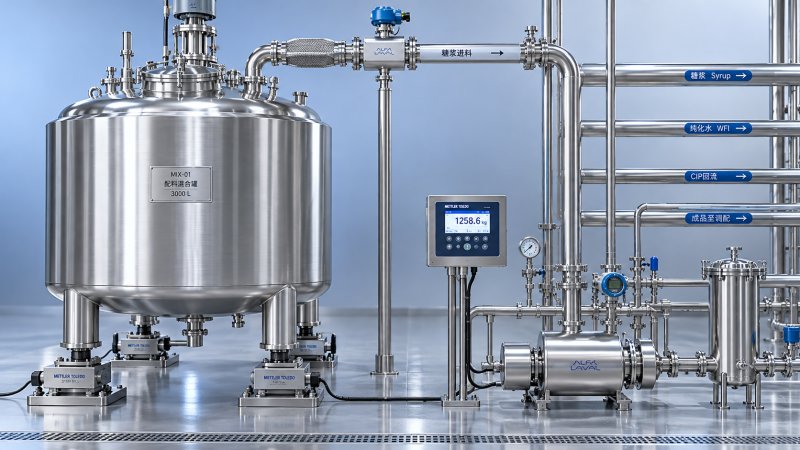
A suitable arrangement combines weighing mounts with engineered pipe flexibility, adequate clearances, and restraints that protect against lateral movement or uplift without interfering with normal weighing. Foundation stiffness and support alignment must also be checked. Uneven loading can overload an individual cell even when the total vessel weight remains below the combined rated capacity.
Load-cell capacity should therefore account for vessel tare, maximum contents, uneven load distribution, and credible dynamic loads. Excessively oversized cells can make small additions harder to resolve, but undersizing them risks overload. Mount selection and structural design must address both requirements.
The same issue applies to mechanically complex vessels. Equipment such as a shampoo mixing tank can combine jacket services, agitators, and high-shear equipment; those features illustrate why vessel-mounted machinery must be included in the weighing design. Their presence does not establish beverage suitability, which requires separate assessment of product-contact materials, cleanability, seals, and process requirements.
Agitation and valve behavior affect the dosing endpoint
Agitation creates fluctuating forces through liquid movement, shaft loading, and structural vibration. Filtering can stabilize the weight signal, but stronger filtering also delays the controller’s response. During a fast addition, that delay can allow extra ingredient to enter before the valve closes.
A practical control sequence uses a high delivery rate for most of the addition, then switches to a lower rate near the target. The controller closes the valve before the measured weight reaches the final target to account for material still entering the tank. This remaining quantity includes valve-closing flow and any liquid that drains from the downstream line.
Such compensation should be established under representative conditions. Syrup viscosity, supply pressure, pump speed, and line configuration can change the quantity delivered after the stop command. An adaptive correction can improve repeatability, but it needs bounded adjustment and fault handling rather than unrestricted compensation.
A stable endpoint reading is essential for confirming the delivered mass. Depending on the process, the sequence may slow or briefly stop agitation, allow settling, or use a validated dynamic weighing method. Stopping agitation is not suitable where settling, poor dispersion, or local ingredient concentration would compromise the batch.
The recipe should distinguish between a stop threshold and an acceptance tolerance. Reaching the threshold triggers valve closure; the final settled mass determines whether the addition is acceptable. An underdose may permit a controlled top-up. An overdose generally cannot be corrected by simply removing an equivalent mass of the mixed beverage.
Calibration must test the installed tank, not just the sensor
A load-cell certificate does not demonstrate installed dosing performance. OIML R 60 addresses metrological requirements for load cells, but component compliance alone does not establish the accuracy of a complete tank-weighing installation. Where measurements are used for regulated trade, applicable local requirements for the complete weighing instrument must also be assessed.
Commissioning should verify zero behavior, repeatability, response across the operating range, and sensitivity to load distribution. Calibration should use traceable reference masses or a documented substitution method with an appropriate uncertainty assessment. Using an unverified flowmeter or nominal liquid volume as the reference introduces uncertainty that must not be mistaken for tank-scale error.
Static calibration should be followed by dosing tests. These should include the smallest critical addition, high-rate fills, viscous ingredients, and relevant combinations of agitation, temperature, and line pressure. The results need to distinguish systematic dosing bias from run-to-run variation.
Cleaning also affects weighing reliability. Residual rinse water changes the starting inventory, while thermal changes and pipe movement can shift the apparent zero. Automatically taring the tank may hide these conditions rather than resolve them. The control sequence should require an appropriate drained and stable state, with limits on acceptable tare changes.
Specify performance at the ingredient level
A defensible acceptance requirement states the minimum addition, permitted final dosing error, recipe conditions, and required cycle time. It also defines how deviations are detected and recorded. Batch records should retain starting weight, final weight, target mass, delivered mass, tolerance status, and relevant alarms—not merely the final total weight.
Load cells are especially useful for sequential mass-based additions where the tank can be mechanically isolated and the feed can be controlled near its endpoint. Their benefit is not just replacing volume measurement: they provide a common measurement basis for recipe execution and batch reconciliation. That benefit is realized only when the installed vessel, dosing hardware, and control sequence demonstrate acceptable performance for the smallest critical ingredient.