












NEWS
What is a Brewery Tank Called? Complete Guide to Beer Fermentation Vessels
What is a brewery tank called? The short answer is: it depends on what the brewer is trying to do at that moment. In a working brewhouse, people rarely say just “beer tank” unless they are speaking casually. They say mash tun, lauter tun, kettle, whirlpool, fermenter, unitank, brite tank, or storage tank. Each vessel has a specific job, and mixing up those jobs usually creates process problems somewhere downstream.
That distinction matters not only for brewers, but also for beverage producers and equipment buyers. A tank that performs well for hot wort handling may be completely wrong for pressure fermentation. A vessel that looks fine on paper may become a cleaning headache, a temperature-control issue, or a production bottleneck once the brewery starts running full schedules.
The main brewery tanks and what they are called
At the hot side of brewing, the most common names are mash tun, lauter tun, brew kettle, and whirlpool tank.
The mash tun is where milled malt and hot water are mixed so enzymes can convert starch into fermentable sugar. In smaller systems, the mash tun and lauter tun may be combined into a mash/lauter tun. In larger setups, brewers often prefer separate vessels because it gives better control and keeps the brewhouse moving.
The lauter tun is used to separate sweet wort from the spent grain bed. This sounds straightforward, but anyone who has dealt with stuck mash knows vessel design matters: false bottom construction, rake geometry, runoff speed, and grain load all affect performance.
After lautering, the wort typically goes to a brew kettle for boiling, then to a whirlpool tank where trub and hop solids are separated before cooling. Some breweries combine kettle and whirlpool functions into one vessel to save space and cost. Others keep them separate because they want better throughput or cleaner wort before fermentation.
On the cold side, the most discussed vessel is the fermenter. This is the tank where yeast turns wort into beer. Many brewers today use conical stainless steel fermenters, and in practical conversation these may also be called fermentation tanks, beer fermenters, or cylindroconical tanks.
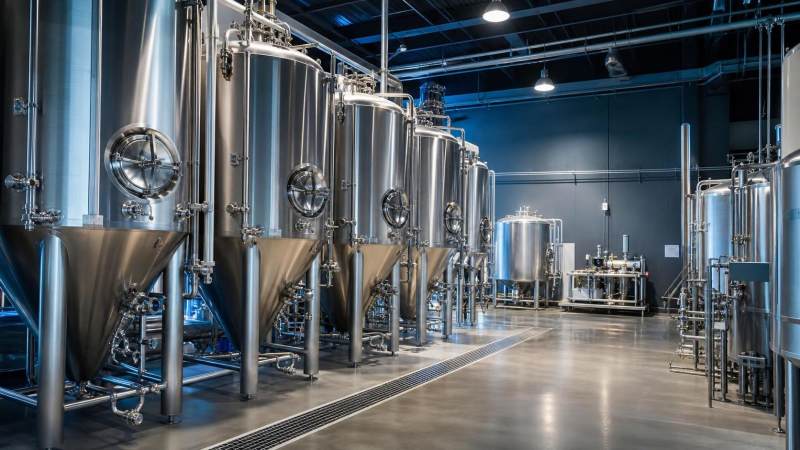
Fermenter, unitank, and brite tank are not the same thing
This is where confusion usually starts.
A fermenter is designed primarily for fermentation and yeast management. It needs reliable cooling, sanitary welds, proper cone angle for yeast collection, and pressure capability that matches the brewing process. Not every fermenter is intended for final carbonation or serving.
A unitank is a fermenter built to handle multiple stages in one vessel: fermentation, maturation, carbonation, and sometimes even direct serving in brewpub settings. Unitanks are popular because they reduce transfers, which lowers oxygen pickup and simplifies cleaning. But they are not always the best answer for every brewery. If one tank is tied up finishing and carbonating beer, it cannot take the next batch.
A brite tank, sometimes written bright tank, is used after fermentation for clarification, carbonation, and packaging preparation. Beer in a brite tank is generally cold, finished, and close to sale. If a brewery packages into cans, bottles, or kegs, the brite tank often becomes the final holding point before filling.
So if someone asks, “What is the beer fermentation vessel called?” the most accurate answer is usually fermenter or unitank, depending on the system design.
Why stainless steel tank design changes beer quality
In brewing, material choice is not just about durability. Stainless steel is preferred because it is sanitary, corrosion-resistant, and easier to clean consistently. That is why professional manufacturers serving breweries, wineries, and beverage plants generally focus on stainless steel vessels rather than mixed-material fabrication.
What matters in practice is not only the metal grade, but also the details: wall thickness, jacket layout, fittings, pressure rating, manway position, and how the tank fits into the cleaning routine. A vessel with poor drainability or awkward valve layout may look acceptable during installation but create daily inefficiencies for years.
Companies with broad fabrication experience across beer, wine, juice, kombucha, cider, and storage applications often see these crossover issues early. Shandong Weike Machinery Equipment Co.,Ltd, for example, manufactures a wide range of stainless steel vessels for brewing, winemaking, food, and beverage production, and that kind of multi-process background is useful when a client needs more than a standard fermenter drawing.
Choosing the right tank name is really choosing the right function
Buyers often start by asking for “a 1000L brewery tank,” but that is not enough to specify anything meaningful. A 1000L mash vessel and a 1000L pressure fermenter may share a nominal volume, yet they are built for very different thermal loads, fittings, and operating conditions.
For established regional breweries or contract brewing facilities, the real question is usually about workflow. Do you need faster brewhouse turnover? More fermentation capacity? Better cold conditioning? A cleaner packaging handoff? The answer determines whether you need another fermenter, a brite tank, or a more efficient hot-side layout.
That is why three-vessel systems remain common in medium-scale production. A setup built around a mash/lauter tun, kettle/whirlpool tank, heat exchanger, fermentation tanks, chiller, and control cabinet gives enough separation between critical stages without becoming overly complex. In some operations, a three vessels beer brewery equipment package is a practical balance between footprint, capacity, and process control.
A few specifications that actually matter in the field
When comparing fermentation vessels, buyers often focus on volume first. Volume matters, but not by itself. A 1000L batch capacity may produce roughly 264 gallons of beer, yet the more useful question is how many turns the brewery expects per week and how quickly the vessel can return to service.
For example, systems designed for 10–12 batches per week, with wort cooling in about 20 minutes and fermentation tanks operating in a 0–4°C control range, are built around production rhythm, not just tank size. Pressure capability also matters. A range of 1–4 bar is relevant if the vessel will be used for pressurized fermentation, carbonation, or transfer. Even wall thickness, such as 2.5–3.0mm, affects structural confidence and long-term use, though exact requirements still need to match tank diameter, height, and code expectations in the destination market.
This is one reason breweries upgrading from 500L single-line systems often discover that their next limitation is not kettle volume but fermentation scheduling, CIP time, and packaging coordination.
Common mistakes when people talk about brewery tanks
One mistake is using “fermenter” and “storage tank” as if they are interchangeable. They are not. Storage tanks may hold finished liquid, process water, or intermediates, but they are not automatically suitable for active fermentation.
Another is assuming a combined vessel always saves money. It can, especially in smaller breweries. But if the plant is pushing volume, combining functions can create hidden downtime. A unitank occupied with cold conditioning may delay the next brew more than expected.
The third is underestimating cleaning. Tanks with automated CIP compatibility, sensible spray coverage, and accessible fittings usually pay back that design effort quickly. In daily brewing, easy cleaning is not a luxury feature. It is part of consistent beer.
If you are naming the tank correctly, you are usually already thinking more clearly about the process. That is the real value behind the terminology. Whether the vessel is a mash tun, fermenter, unitank, or brite tank, the right name points to the right job. And in brewing, tanks that do the right job well are far more valuable than tanks that merely match a capacity number on a quote.