












NEWS
What is the recommended size for a beer fermentation tank?
What is the recommended size for a beer fermentation tank?
Choosing the right beer fermentation tank size is one of the most important decisions for any brewery. The recommended size for a beer fermentation tank depends on your batch volume, production goals, available space, and future expansion plans. From small craft brewing setups to large commercial operations, selecting the proper tank capacity can improve efficiency, product consistency, and long-term profitability.
There is no single “best” tank size for every brewery, and that is where many projects go wrong. Some buyers focus only on current brew length. Others oversize too early, which can create problems with cooling load, cleaning cycles, yeast handling, and cash flow. In practice, the right answer usually comes from balancing how much wort you produce per batch with how quickly you need that tank back in service.
Start with brew size, not just annual output
A fermentation tank is normally sized around the brewhouse output, but not as a strict one-to-one match. If your brewhouse produces 1,000 liters per batch, a 1,000-liter fermenter is usually too tight because you need headspace for foam, krausen, and process stability. Many breweries therefore choose a tank with working capacity above the nominal batch volume. The exact allowance varies by beer style and fermentation behavior, but leaving practical headspace is standard operating logic, not optional design padding.
For example, a brewery making one batch per day may decide between matching fermenters to each brew or using larger tanks to combine multiple brews. Both approaches are common. A single-batch tank gives flexibility for more SKUs. A two-batch or three-batch fermenter may reduce vessel count and floor congestion, but it can also complicate scheduling if production is uneven or if one flagship brand dominates tank occupancy.
That is why the recommended size is rarely about liters alone. It is about turnover time. A fermenter tied up for 14 to 21 days behaves very differently from one used for a faster ale cycle. Lager production, cold conditioning, and seasonal products all change the sizing logic.
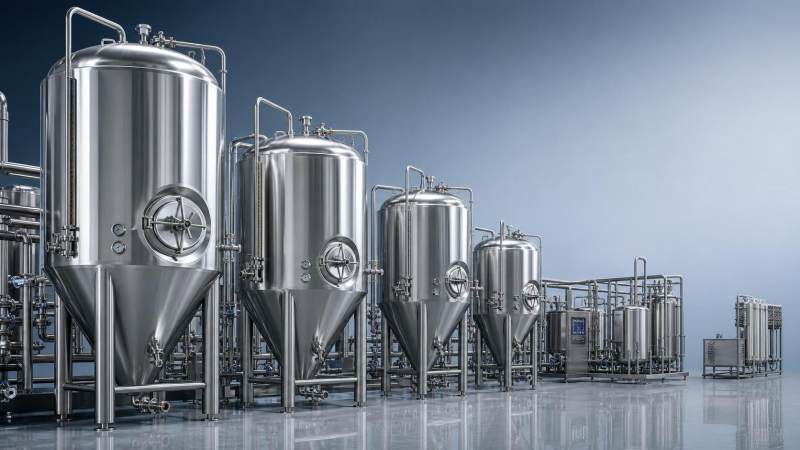
Typical sizing logic by brewery stage
Smaller breweries often benefit from fermenters sized at 1 to 2 times brewhouse volume. That keeps the system easier to manage and avoids locking too much beer into one vessel. Mid-sized operations may add a mix of unitank sizes rather than standardizing everything. That mix matters more than people expect. A cellar with only large tanks can become inefficient if demand shifts toward limited releases or lower-volume brands.
A practical setup might include several fermenters dedicated to core production and a few smaller vessels for seasonal or pilot work. This reduces the risk of using a large tank for a beer that sells slowly. Empty tank volume is not the only waste; underused cooling area, longer cleaning cycles, and unnecessary CIP water consumption also add cost over time.
What buyers often underestimate
The common mistake is choosing tank size in isolation from the rest of the packaging and storage flow. If fermentation capacity increases but bright beer tanks, kegging, bottling, or cold storage do not keep pace, the cellar becomes the least of your problems. Beer backs up downstream.
That is especially relevant for breweries serving keg-heavy channels. Once beer leaves the fermenter, the filling stage needs to protect carbonation and minimize oxygen pickup. In medium-sized breweries and beverage plants, equipment such as a double head keg filling machine can make more sense than simply adding more fermenters, because packaging bottlenecks often hide behind what looks like a capacity problem. Counter-pressure filling, adjustable dual heads, and precise volume control are not just convenience features; they help keep throughput stable when multiple keg sizes are in circulation.
Key factors that change the recommended tank size
Several variables can push the decision up or down:
- Fermentation time: longer cycles require more total vessel volume.
- Beer mix: high-turnover core beers and slow-moving specialty beers should not always share the same tank strategy.
- Cellar ceiling height and door width: large tanks that cannot be moved or installed cleanly create avoidable project risk.
- Utility capacity: cooling, glycol, steam, compressed air, and CIP all need to match vessel scale.
- Expansion plans: buying only for today often leads to crowded retrofits later.
Material and fabrication quality also matter. Stainless steel selection, weld finish, insulation, cone design, pressure rating, and cleaning access influence whether a tank performs well over years of use. For breweries exporting, diversifying products, or moving between beer and adjacent beverage categories like cider or kombucha, vessel design should be reviewed with the broader production plan in mind.
Why many breweries choose custom combinations
Standard sizes are useful, but custom combinations are often more practical than custom dimensions. In other words, the smartest project may not be one unusual tank; it may be a well-balanced group of standard fermenters and supporting vessels.
Shandong Weike Machinery Equipment Co.,Ltd, based in Jinan, Shandong, works with breweries, wineries, and beverage producers on stainless steel vessel design, manufacturing, installation, and commissioning. With a factory of more than 15,000 square meters, the company’s experience across beer equipment, wine tanks, mixing tanks, beverage tanks, alcohol tanks, and storage tanks reflects a reality many buyers discover late: fermentation tanks should be specified as part of a system, not as isolated hardware. That includes pipe routing, cleaning method, filling rhythm, and the possibility of later adding compatible downstream equipment.
The same thinking applies to keg operations. A sanitary filler built in SUS304 or SUS316L stainless steel, with features such as quick-connect adapters, PLC control, foam recovery, and CIP cleaning ports, may be a better operational investment than adding excess cellar volume. If a brewery runs 5L, 10L, 15L, 30L, and 50L keg formats, packaging flexibility becomes part of fermentation planning whether the production team likes it or not.
A simple way to judge if your planned size is reasonable
Ask three questions before approving the tank list.
Can your brewhouse fill the tank efficiently without creating awkward partial batches? Can your cooling and CIP systems support that tank volume during peak use? And once the beer is ready, can your packaging line move it out fast enough?
If any of those answers is weak, the recommended size may be technically possible but operationally wrong. That is a very different issue.
In many brewery projects, the best outcome is not the largest tank your budget can stretch to. It is the size that keeps production balanced, gives enough headspace for stable fermentation, fits the building, and still leaves room for future product changes. If you are comparing options, review the fermenter plan together with bright tanks, utilities, keg or package formats, and cleaning requirements. That usually reveals the right size much faster than looking at nominal volume alone.