












NEWS
Used Fermentation Tank Inspection: Hidden Costs for Winery Buyers
Used Fermentation Tank Inspection: Hidden Costs for Winery Buyers
A used fermentation tank may look like a smart way to stretch your winery’s equipment budget, but the purchase price rarely tells the whole story. Hidden weld defects, damaged cooling jackets, worn seals, and hard-to-clean surfaces can turn initial savings into repair bills, production delays, or sanitation risks. A thorough inspection should establish not just whether the vessel holds liquid, but what it will cost to make it production-ready.
The useful comparison is therefore not “used price versus new price.” It is the cost of an installed, cleanable, serviceable tank that fits your winemaking process—and can be ready before you need it.
Check process fit before paying for an inspection
A sound vessel can still be the wrong purchase. Confirm usable working volume rather than relying on nominal capacity. Fermentation needs headspace, and red-wine processing may require access for cap management, pomace removal, and cleaning that a former beverage storage tank cannot provide.
Ask for the original drawings, nameplate photographs, material records, previous contents, cleaning history, and details of repairs or modifications. Check shell dimensions, manway position, drain geometry, cooling-zone arrangement, and connection sizes against your cellar layout. An inexpensive tank that requires a new platform, relocated pipework, or a different pump can lose its advantage quickly.
Missing records do not automatically disqualify a used tank, but they shift verification costs to the buyer. Do not assume stainless grade, pressure rating, or chemical compatibility from appearance alone.
Inspect the surfaces that polishing can hide
Inspect the vessel clean and empty, with good lighting. Pay particular attention to weld seams, nozzle junctions, the lower shell, and the outlet. Pitting, crevices, rough repairs, or incomplete weld penetration can create places where residues persist. A bright exterior says little about these internal details.
Look for distortion around legs and lifting points, dents near jacket attachments, and evidence of grinding or patching. These findings need interpretation: a cosmetic dent is different from damage affecting stability, drainage, or a pressure boundary. Where defects are suspected, a qualified inspector can recommend appropriate thickness measurements or weld examination rather than treating visual inspection as conclusive.
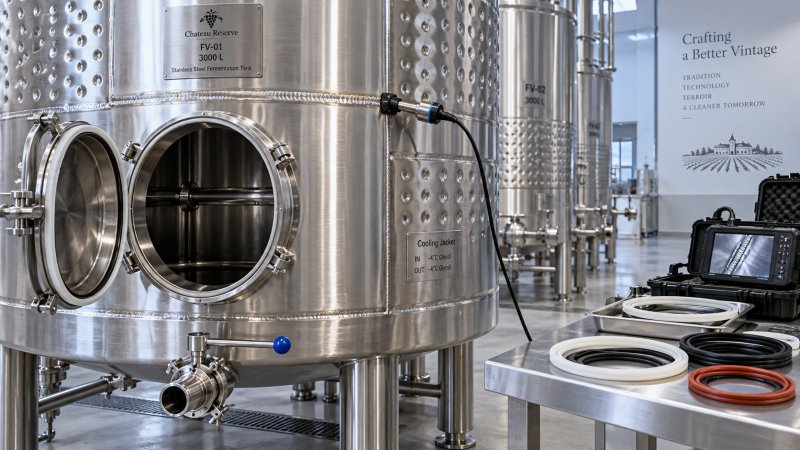
Repairs should include more than welding costs. Allow for access, surface finishing, any required passivation, verification testing, and cleaning validation. If the seller describes a repair as “minor,” ask for its location, method, and supporting records.
Prefer remote inspection where practical. Tank entry requires appropriate confined-space procedures; an empty fermentation vessel must not be assumed safe to enter.
Drainability matters as much as surface finish
Check whether rinse water drains fully in the intended installed position. A poorly located outlet, unsuitable bottom slope, or internal ledge can retain wine, lees, or cleaning solution. Those problems can add manual cleaning time every batch. Before accepting them, establish whether adjustment is possible or whether the geometry itself needs modification.
Treat the cooling jacket as a separate asset
A tank can hold wine while its jacket leaks, has restricted circulation, or provides insufficient cooling for the intended fermentation. Ask for documented jacket condition and design limits. Any leak or pressure test should follow an approved procedure established by qualified personnel; never choose a test pressure based on another tank’s specification.
Cooling suitability also depends on jacket coverage, coolant temperature, flow, and the winery’s available chiller capacity. A jacket concentrated below the normal fill level may suit one batch size but perform poorly at another. Confirm that valves, fittings, and control sensors are included and compatible with your glycol circuit.
Keep shell and jacket ratings separate. An atmospheric fermentation tank is not automatically suitable for pressurized transfers. Verify venting and any required pressure or vacuum protection for the intended operating and cleaning conditions.
Small components can create recurring costs
Manway gaskets, valve seats, sample valves, and spray devices are easy to overlook during a viewing. Ask whether replacement parts remain available, then obtain prices before committing. Nonstandard connections can require adapters that add expense and complicate cleaning.
- Check gasket condition and verify elastomer compatibility with wine and the intended cleaning chemicals.
- Operate accessible valves and inspect sealing surfaces for wear or trapped residue.
- Confirm that the cleaning device’s flow and pressure requirements match the available CIP system.
- Review internal obstructions and spray coverage; a spray ball alone does not establish cleanability.
Replacing consumables may be sensible preventive maintenance. Redesigning inaccessible product-contact areas is a different proposition, especially when fabrication and validation would consume the remaining time before harvest.
Build the cost comparison around a ready-to-use tank
Request separate estimates for inspection, refurbishment, dismantling, loading, transport, unloading, installation, and commissioning. Include access constraints: the vessel may fit the cellar floor plan but not the doorway or unloading route. Shipping arrangements should identify who is responsible for securing fittings, supporting the tank, and documenting its condition before dispatch.
Practical acquisition cost = purchase price + verification + repairs + logistics + installation + commissioning + an allowance for unresolved risks.
Then compare operating costs over the same ownership period. Extra cleaning labor, water, chemicals, energy, and unavailable spare parts can matter more than an initial discount. Keep confirmed expenses separate from uncertain exposure rather than presenting every possible risk as an inevitable bill.
Timing deserves its own line in the decision. A repairable tank delivered during harvest may be less useful than a more expensive vessel commissioned beforehand. Compare realistic readiness dates, not dispatch promises alone.
When a new vessel is the more defensible purchase
Used equipment is attractive when its history is documented, its configuration already fits, and required work is limited and priced. New equipment deserves closer consideration when major modifications, uncertain jacket condition, or missing technical records prevent a reliable total-cost estimate.
Shandong Weike Machinery Equipment Co.,Ltd operates a factory of over 15,000 square meters in Jinan, Shandong, and provides design, manufacture, installation, and commissioning of stainless steel vessels for wine, brewing, and beverage applications. When requesting a new-tank comparison, ask for drawings, product-contact materials, jacket design conditions, cleaning provisions, and an itemized scope. Clarify what the company’s stated five-year after-sales service covers; service support is not the same as a warranty.
For wineries also preparing fruit-based beverages, a separate fruit juice mixing tank may suit concentrate dilution and blending better than converting a used fermenter. Available options include SUS304 or SUS316L construction, jacketed temperature control, and CIP-compatible designs. Select agitation around actual viscosity and processing needs, and confirm the quoted configuration rather than assuming a mixing vessel is suitable for fermentation.
Before issuing a purchase order, turn inspection findings into written acceptance conditions: included components, required repairs, test records, delivery responsibilities, and readiness criteria. If a critical defect cannot be inspected or priced, the apparent saving is still an unknown—not yet a purchasing advantage.