












A fermentation tank can appear ready for inspection while still containing dangerous carbon dioxide levels or insufficient oxygen. An open hatch does not establish safe conditions.
For quality control teams and safety managers, entry requires a documented hazard assessment, effective isolation, verified atmospheric conditions, and rescue arrangements appropriate to the vessel.
The first decision is whether entry is necessary. Remote inspection and validated cleaning verification can reduce exposure while supporting maintenance, sanitation checks, and product quality.
When entry cannot be avoided, applicable workplace requirements and a site-specific procedure must determine who enters, under what conditions, and when work must stop immediately.
Does Your Fermentation Tank Require a Confined-Space Entry Permit?
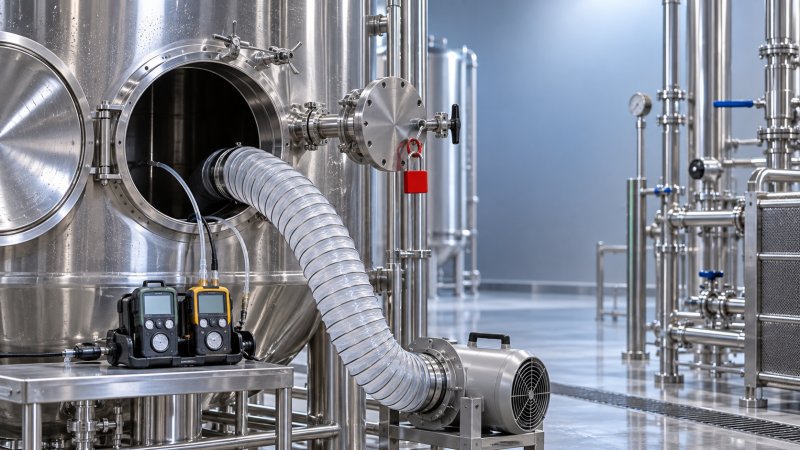
Under U.S. OSHA general-industry rules, a confined space allows bodily entry, has limited or restricted access, and is not designed for continuous occupancy by personnel.
Many fermentation vessels meet this definition. They may become permit-required spaces through hazardous atmospheres, engulfment hazards, trapping configurations, or other recognized serious hazards inside them.
A tank containing residual carbon dioxide, connected product lines, or an accessible agitator needs assessment before inspection. Being empty does not remove these potential hazards.
For OSHA purposes, entry occurs when any part of the body crosses the opening plane. Leaning through a manway to collect samples can therefore constitute entry.
Use OSHA 29 CFR 1910.146 as a U.S. general-industry reference. Other jurisdictions and construction activities may impose different requirements; confirm the framework applicable to your facility.
Why Can CO2 Remain Dangerous After Fermentation Ends?
Fermentation produces carbon dioxide, which can accumulate inside vessels and nearby low areas. Residual liquid, sediment, or ongoing biological activity may continue releasing gas afterward.
Carbon dioxide is colorless and odorless. Workers cannot judge exposure through smell, visual inspection, or whether the tank has stood open for several hours already.
CO2 presents both an oxygen-displacement hazard and its own physiological effects. An acceptable oxygen reading alone cannot demonstrate that carbon dioxide exposure is adequately controlled.
As a simplified example, replacing air with 4% CO2 leaves roughly 20% oxygen. That oxygen reading could look acceptable despite an extremely dangerous CO2 concentration.
Gas distribution also changes with airflow, temperature, vessel geometry, and worker movement. Treat expected layering as a reason for broader sampling, never as a reliable boundary.
Which Atmospheric Measurements Actually Support an Entry Decision?
Measure oxygen, carbon dioxide, flammable gases or vapors, and additional contaminants identified by the assessment. Cleaning agents and process residues may introduce hazards beyond fermentation.
A standard four-gas instrument often measures oxygen, combustibles, carbon monoxide, and hydrogen sulfide. Unless specifically configured, it may provide no direct carbon dioxide measurement capability.
Select a CO2 sensor with sufficient range, suitable sampling accessories, and documented performance for expected conditions. Follow manufacturer requirements for calibration, bump testing, and maintenance.
OSHA defines oxygen below 19.5% or above 23.5% as hazardous. Flammable gas above 10% of its lower flammable limit also constitutes a hazardous atmosphere under this standard.
For CO2, OSHA’s permissible exposure limit is 5,000 ppm over eight hours. NIOSH recommends 5,000 ppm over eight hours and 30,000 ppm over fifteen minutes.
NIOSH identifies 40,000 ppm as immediately dangerous to life or health. These values are exposure references, not universal authorization thresholds for entering a fermentation tank.
Document entry limits and alarm settings using applicable rules, exposure duration, instrument capability, and qualified safety assessment. Never adopt the IDLH value as an operating target.
How Should Teams Sample and Ventilate the Vessel?
Conduct initial testing from outside the vessel using remote sampling equipment. Check representative upper, middle, and lower locations, plus recesses and the intended working area.
Account for sampling hose length, pump flow, and sensor response time. Moving the probe too quickly can produce readings that misrepresent conditions at each location.
Where OSHA applies, test oxygen first, then combustible gases, then toxic contaminants. Certain combustible sensors depend on oxygen and may under-read in oxygen-deficient atmospheres there.
Supply clean air through properly positioned ventilation equipment. Arrange ducts to reach poorly swept areas and discharge contaminated air away from workers and occupied spaces.
Never ventilate with oxygen. Continue ventilation and atmospheric monitoring as the assessment requires; loss of airflow or unacceptable readings must trigger immediate exit and reassessment.
Do not assume forced ventilation automatically removes permit requirements. OSHA alternative procedures apply only when specified conditions are demonstrated, including that ventilation alone controls atmospheric hazards.
What Must Be Isolated Before Inspection or Maintenance?
Identify every connection that could introduce product, steam, cleaning chemicals, compressed gas, or other hazardous material. Include shared CIP circuits and automated filling sequences explicitly.
Apply the facility’s energy-control procedure to agitators, pumps, valves, heating systems, and relevant stored energy. Verify isolation effectiveness before authorizing personnel to enter the vessel.
For hazardous material lines, use appropriate positive isolation, such as blanking or disconnection, where required. Simply closing a valve may leave an unacceptable leakage pathway.
Depressurize, drain, cool, and address chemical residues before entry. Assess slippery surfaces, internal fittings, ladders, electrical equipment, and potential engulfment from remaining liquid or solids.
Assess inert-gas connections separately. Nitrogen blanketing may protect product quality while creating an oxygen-deficient atmosphere, including in vessels that have never been used for fermentation.
What Should the Permit, Attendant, and Rescue Plan Cover?
A permit should identify the vessel, purpose, authorized duration, entrants, attendant, supervisor, hazards, isolation measures, acceptable conditions, test results, communications, and required rescue provisions clearly.
Under OSHA permit procedures, the entry supervisor verifies required safeguards and authorizes entry. Maintain an attendant outside the space with duties compatible with monitoring entrants.
Define reliable communication and evacuation signals before work begins. Noise, vessel geometry, protective equipment, and poor radio reception can undermine arrangements that appear adequate outside.
Evaluate rescue capability against the actual vessel and hazards. Calling emergency services alone does not demonstrate that responders can perform timely, technically suitable confined-space rescue.
Use non-entry retrieval where required and feasible, unless it increases overall risk or would not help rescue. Manway geometry and internal obstructions affect equipment selection.
An attendant must not make an impulsive rescue entry. Entry rescue requires designated, trained, equipped personnel and procedures appropriate to the atmospheric and physical hazards.
How Can QC Teams Reduce Entry Without Weakening Verification?
Start with the inspection objective: confirming cleaning effectiveness, identifying corrosion, investigating deposits, or checking a fitting. Each objective may support a different external verification method.
Consider borescopes, inspection cameras, accessible sampling points, and validated rinse testing. These methods require defined acceptance criteria and may not replace every internal examination needed.
For example, a CIP spray device can support automated cleaning, but its presence does not prove full coverage, residue removal, or a safe atmosphere afterward.
Discuss inspection access and gas isolation during procurement with manufacturers such as Shandong Weike Machinery Equipment Co., Ltd. Design choices affect both verification and entry planning.
The company’s plant corn oil storage tank illustrates a related issue: nitrogen blanketing supports oxidation control, while CIP equipment supports cleaning. Neither feature establishes safe entry.
For any food or beverage vessel, request connection diagrams, isolation details, cleaning documentation, and access dimensions. These records help safety teams assess practical operating requirements.
What Is the Final Go-or-No-Go Decision?
Authorize fermentation tank entry only when the task, isolation, atmosphere, personnel, equipment, communications, and rescue arrangements meet documented requirements. Any unresolved critical condition means postpone entry.
After an alarm, ventilation failure, unexpected inflow, or changing conditions, evacuate and reassess before re-entry. Previous acceptable readings cannot justify continuing work through new hazards.
The strongest program connects QC objectives with safety controls: avoid unnecessary entry, verify actual conditions, and ensure every authorized inspection has a workable emergency response.