












NEWS
Integrating a Mixing Tank into a Powder-Based Beverage Production Line
A mixing tank fits a powder-based beverage line only when it can wet, disperse, and hydrate the recipe within the time available between downstream batches. Selecting vessel capacity first can leave a line with enough storage volume but insufficient mixing capability, excessive foam, or a transfer system that cannot maintain production flow.
The integration should therefore start with the formulation and a complete batch timeline. Powder addition, hydration, temperature adjustment, quality checks, discharge, and cleaning all occupy equipment time. The design must reconcile those activities with the requirements of the next process, whether that is pasteurization, homogenization, intermediate storage, or filling.
Define the recipe envelope before sizing the vessel
“Powder-based beverage” covers ingredients with very different behavior. Sugar may dissolve readily under suitable conditions, while cocoa requires dispersion and suspension. Protein powders can foam and need controlled hydration; hydrocolloids can form gel-coated lumps when their outer surface hydrates before liquid reaches the center. A tank designed around one easy-dissolving recipe does not establish suitability for the full product range.
The equipment specification should identify the most demanding formulation conditions:
- Minimum and maximum batch volumes, including initial liquid charge.
- Powder loading, addition rate, and the viscosity reached during processing.
- Required temperature range and any limits on ingredient heat exposure.
- Acceptable foam, entrained air, undispersed particles, and settling.
- Hydration time and the measurable endpoint for releasing a batch.
These conditions determine more than motor power. Low starting volumes must still cover the impeller adequately. Rising viscosity changes circulation and discharge behavior. Foam and the temporary volume increase during powder addition require headspace beyond the final beverage volume. Specify gross vessel volume and usable working volume separately.
Batch size must also fit the production schedule. As an illustrative calculation, a 2,000-liter usable batch with a complete 90-minute cycle provides an average output of about 1,333 liters per hour before additional downtime. It cannot continuously support a downstream demand of 2,000 liters per hour without another source of prepared product. A buffer tank can bridge interruptions, but it cannot correct a sustained capacity deficit.
Separate powder wetting from bulk mixing
An agitator that circulates a finished beverage successfully may still struggle to incorporate dry ingredients. Bulk circulation moves material through the vessel; wetting brings liquid into contact with powder surfaces; dispersion breaks apart agglomerates; hydration requires time under suitable conditions. Those functions should not be treated as interchangeable.
For readily soluble ingredients at modest loading, controlled addition into a well-circulated tank may be sufficient. Difficult-to-wet powders may justify an inline powder-induction system or a rotor-stator mixer. An anchor or scraper arrangement may be needed where viscosity limits circulation or wall heat transfer. Selection should follow formulation trials rather than a blanket requirement for high shear.
More shear is not always better. It can raise product temperature, increase air incorporation under unsuitable operating conditions, or change shear-sensitive structures. Where intensive dispersion is required, a useful arrangement is to apply it during powder incorporation, then reduce mixing intensity while hydration finishes.
Powder feed rate is part of that design. Feeding faster than the liquid can wet and carry powder away encourages floating rafts and lumps. Establish the addition sequence, feed-rate limits, liquid temperature, and mixer operating range together. Bag tipping also needs safe access and suitable dust control; combustible-dust risk should be assessed from the actual ingredients and handling conditions.
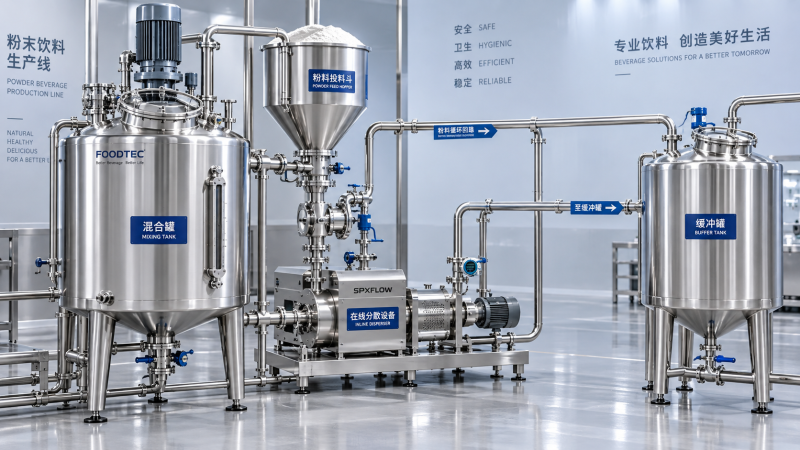
A typical process route is treated-water charging, controlled powder addition, recirculation through the selected dispersion device, hydration in the vessel, batch release, and transfer to downstream processing. The piping arrangement must distinguish recirculation from forward transfer so that incompletely processed beverage cannot bypass the required mixing stage.
Design transfer around the downstream process
The mixing tank outlet is an operational boundary, not merely a nozzle connection. The receiving equipment may require a stable inlet pressure, limited air content, a defined temperature, or a restricted particle size. Confirm those requirements before selecting the pump and transfer pipework.
Pump duty should reflect the beverage at its highest expected viscosity and the resistance of the full route, including valves, strainers, heat exchangers, and elevation changes. Check available suction conditions, particularly with warm liquids, low tank levels, or foaming products. A larger motor does not resolve inadequate suction conditions or air entering the line.
If downstream processing cannot stop between batches, a hygienic balance or buffer tank can decouple mixing from transfer. Its sizing should reflect the interruption it must cover and the production rate. It also introduces additional residence time, cleaning demand, and possible settling, so agitation or recirculation requirements must be assessed separately.
Reusing beverage equipment requires the same checks as purchasing new equipment. Packages such as Industrial beer brewing equipment include vessels and process utilities, but brewing capacity alone does not establish powder-mixing suitability. Impeller geometry, minimum operating level, powder-entry arrangements, drainage, and cleaning access still need application-specific review.
Make hygienic design and utility demand part of the layout
A vessel with cleaning-in-place ports is not automatically a cleanable installation. Cleaning solution must reach the agitator, shaft and seal area, powder inlet, instrument connections, and any shadowed surfaces. Product must drain from the tank and connected pipework without leaving unintended pockets.
Protein, fat, and hydrocolloid residues can require different cleaning conditions from simple sugar solutions. Define the cleaning sequence against the actual soils, including chemical concentration, temperature, circulation conditions, and contact time. Confirm cleaning-device requirements and return capacity with the supplier, then verify coverage and cleaning performance during commissioning.
Powder-induction equipment deserves particular attention because partially wetted deposits can remain in feed throats or interfaces outside the main liquid circuit. Dry powder handling and wet-process cleaning also need a clear boundary to prevent moisture entering areas intended to remain dry.
Utilities should be assessed at simultaneous demand, not only at each machine’s individual rating. Heating, cooling, mixing, and cleaning may overlap across the line. Confirm electrical capacity, hot-water or steam supply, cooling duty, compressed air where needed, and drainage. Include access for seal replacement, mixer removal, instrument servicing, and safe powder loading in the installation drawing.
Specify control behavior at equipment interfaces
Automating agitator speed alone leaves important process risks uncontrolled. The sequence should verify an adequate liquid charge before powder addition, maintain the required circulation conditions, enforce temperature limits, and prevent discharge until the batch meets its release criteria.
Useful interlocks include low-level mixer protection, recirculation-flow confirmation before powder induction, high-temperature protection, and verified receiving capacity before transfer. Product and cleaning routes must also be controlled to prevent unintended connections. Valve-position feedback should be specified where an incorrect route creates a meaningful contamination or process risk.
Instrumentation must suit the formulation. Refractometer readings can support concentration control in suitable dissolved-solids systems, but suspended ingredients complicate interpretation. Conductivity is not a universal concentration measurement. Some recipes require sampled checks of viscosity, pH, dispersion, or solids content before release.
Freeze supplier responsibilities in a shared interface document covering nozzle locations, connection types, pressure and temperature limits, utility duties, control signals, and responsibility for pumps, valves, pipework, and software. This prevents gaps between a tank supplier’s scope and the line integrator’s scope from becoming installation delays.
Commission with product, not just water
Water testing can demonstrate leak tightness, routing, instrument response, and basic mechanical operation. It cannot prove powder incorporation, foam control, hydration, or discharge performance at production viscosity.
Acceptance trials should cover the formulations that impose different constraints: difficult wetting, high viscosity, foam sensitivity, and minimum operating volume. Agree on measurable acceptance criteria before testing, including total cycle time, dispersion quality, concentration uniformity, temperature control, discharge residuals, and cleaning performance.
Test the complete sequence through downstream transfer and cleaning, including interruption recovery. A stopped powder feed, loss of recirculation, or unavailable receiving tank must leave the process in a defined state. Mixing is not a microbial kill step; hydration temperatures, holding times, and any subsequent treatment must remain consistent with the validated food-safety process.
Release the installation for production only when it demonstrates repeatable preparation, acceptable transfer behavior, and effective cleaning within the agreed schedule. Vessel capacity is then one verified element of line performance—not a substitute for it.