












NEWS
Mixing Tank CIP Validation: Finding Residue Around Baffles and Seals
A mixing tank can pass a final rinse check while retaining beverage residue behind a baffle or inside a seal groove. Clear rinse water, acceptable conductivity, and a completed CIP cycle provide useful process evidence, but they cannot establish that every product-contact surface is clean. For quality and safety teams, the decisive question is whether the cleaning procedure removes the relevant soil from the least accessible locations under defined operating conditions.
Validation should therefore connect three things: the locations most likely to retain residue, sampling methods capable of detecting that residue, and acceptance criteria tied to the next production run. If a seal interface receives no cleaning solution, extending the cycle may accomplish little. If a baffle creates a spray shadow, a satisfactory sample from the open tank wall does not resolve the risk.
Start with the residue and the geometry
The cleaning challenge depends on what the vessel processes. Sugar-rich beverage residues may dissolve readily when fresh but become harder to remove after drying. Fruit pulp can lodge at attachment points. Protein-containing drinks can leave deposits whose behavior changes with heat exposure. Brewing and fermentation residues introduce another concern: retained organic material can support microbial persistence between batches.
Select the validation challenge using the products and operating conditions the tank will actually encounter. Consider the most difficult formulation, the longest permitted delay before cleaning, and any heating step that changes the soil. A challenge based only on an easy-to-clean product gives limited support for a wider product range. Combining every extreme into an unrealistic test, however, can obscure which operating conditions the procedure is intended to cover.
Map the vessel before choosing sampling points. Drawings help identify potential traps, but inspection should establish the installed condition, including welds, clearances, gasket seating, and modifications. Priority locations include:
- The rear face of each baffle, especially near the wall and beneath support brackets.
- Baffle welds and attachment points where deposits can collect or cleaning flow may be restricted.
- Agitator shaft seals and accessible product-contact seal grooves.
- Manway gaskets, sample valves, outlet valve seats, and probe connections.
- Low points where the tank retains liquid after draining.
Distinguish exposed surfaces from enclosed interfaces. A baffle face may be accessible to spray and inspection; a compressed gasket contact surface may receive little or no cleaning flow. Establish whether each interface is designed for CIP, requires an actuated cleaning sequence, or needs removal for manual cleaning. The validation protocol must reflect that distinction.
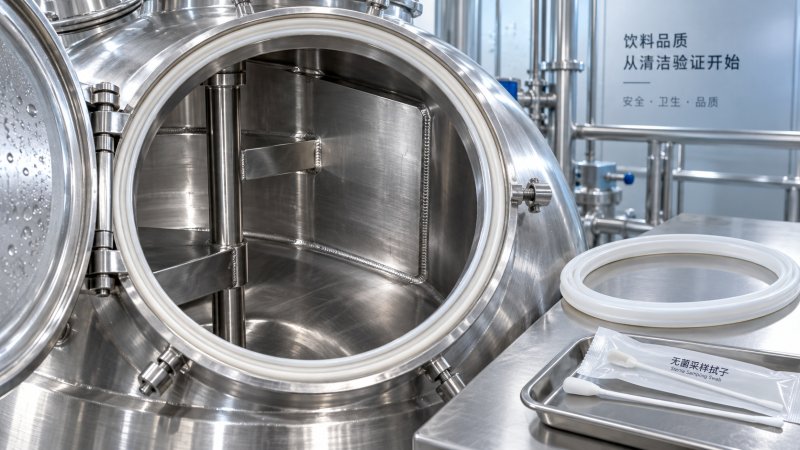
Inspection also needs a safe access plan. Use external viewing, suitable inspection equipment, or controlled disassembly where practical. Any vessel entry must follow the site's applicable confined-space procedures, and inspection around an agitator requires isolation of hazardous energy.
Separate cleaning coverage from cleaning effectiveness
A coverage test can reveal areas that cleaning liquid does not reach adequately. A fluorescent tracer, such as riboflavin used in an appropriate procedure, can help identify spray shadows behind baffles and around fittings. Its value is diagnostic: it shows distribution and removal of the tracer under the test conditions. It does not independently demonstrate removal of a dried beverage deposit or control of microorganisms.
Run coverage assessment with the installed spray device, internal fittings, and relevant operating configuration. Check supply pressure and flow against the device requirements, and establish whether the rotary device operates correctly. Where agitator movement forms part of cleaning, define its sequence and speed. Record drainage behavior as well as wetting; pooled liquid can retain soil or dilute the next cleaning stage.
Large vessels make this distinction particularly useful. For example, 10000L milk tanks with rotary spray balls and low-speed paddle stirrers illustrate the need to evaluate spray distribution around internal components. Stainless steel construction and an installed CIP device provide design features to assess; cleaning validation still depends on the assembled vessel, the soil, and the actual cycle.
If coverage is satisfactory but residue remains, investigate cleaning chemistry and operating conditions. Confirm detergent concentration, exposure time, temperature at relevant locations, and the sequence of rinsing and washing. A supply-line temperature alone may not describe conditions at a remote surface. Review whether the chosen chemistry suits the deposit and remains compatible with seals and other wetted materials.
Change identified variables in a controlled way. Longer exposure may help a deposit that receives adequate cleaning solution. Persistent residue in a shielded pocket may require a change to the spray arrangement, component geometry, or cleaning access. Increasing chemical strength without understanding the cause can add material damage and rinsing problems.
Use sampling that can answer the failure question
Direct surface sampling is particularly valuable when the concern is localized residue. Define each swab location precisely, using photographs or marked drawings, and specify the sampled area where practical. Include the rear of baffles and relevant seal interfaces rather than substituting a nearby, easily reached surface. For irregular grooves, document the sampling technique so results remain interpretable between operators.
Rinse samples can support the assessment, especially where direct access is limited. Their weakness is dilution and uncertain recovery: residue in a stagnant pocket may contribute little to a large rinse volume. A satisfactory return-line result should therefore be interpreted alongside targeted surface evidence. If a critical location cannot be sampled directly, document how the alternative method can detect contamination there.
Choose the analytical method to match the hazard or soil:
- Visual inspection identifies films, particles, discoloration, and pooled liquid, subject to lighting and access limitations.
- ATP testing provides a rapid indication of biological material, but results depend on the sampling system and possible chemical interference. It does not establish the absence of pathogens or a specific allergen.
- Protein or allergen-specific testing can support relevant product-changeover assessments when the method is suitable for the residue and surface.
- Microbiological sampling evaluates recoverable organisms under the selected method and sampling conditions.
- Chemical analysis can target product markers or cleaning-agent residues where carryover is the concern.
Sampling recovery matters as much as instrument sensitivity. Assess whether the swab and extraction procedure recover the target from stainless steel and the relevant seal material. Establish whether residual detergent or sanitizer interferes with detection; microbiological methods may require suitable neutralization. Include appropriate controls to distinguish a clean surface from a failed recovery or inhibited assay.
Define sampling timing. Evidence of soil removal is best assessed at a stage where subsequent sanitization does not obscure the question. Microbiological acceptance may require assessment after sanitization or after the permitted clean holding period. These measurements address different outcomes and should be identified separately in the protocol.
Define acceptance before the trial—and investigate failures locally
There is no universal swab limit that proves every beverage mixing tank is clean. Set acceptance criteria before execution, based on product hazards, potential carryover, analytical capability, and applicable regulatory or customer requirements. An ATP threshold from another instrument or site should not be adopted without establishing its suitability.
A defensible protocol combines specified visual conditions with relevant analytical limits and required cycle parameters. For allergen changeovers, link the method's detection capability and sampling coverage to the carryover assessment. For chemical residues, establish what the selected rinse measurement can demonstrate. Conductivity may help confirm removal of conductive cleaning chemicals, but it cannot establish removal of every organic residue.
Equipment conformity and site cleaning validation also have different scopes. Hygienic design guidance, including relevant EHEDG guidance or applicable 3-A requirements, can inform assessment of cleanability. Any certification claim should be checked for its equipment scope. It does not replace evidence that a particular beverage soil is removed by the site's operating procedure.
When a baffle or seal sample fails, retain its location-specific significance. Averaging it with satisfactory samples elsewhere conceals the problem. Investigate the deposit, component condition, cleaning access, sampling performance, and recorded cycle parameters. Correct the identified cause, then repeat the affected assessment and evaluate whether wider validation is necessary.
The final record should define the products, soil conditions, equipment configuration, cleaning parameters, sampling locations, methods, limits, deviations, and results that support approval. Repeated successful execution should demonstrate consistency, with the extent justified by risk and variability. Changes to seals, baffles, spray devices, formulations, or cleaning recipes should trigger an assessment of whether that evidence still applies. When residue repeatedly returns at the same interface, that location deserves an engineering or maintenance decision before the cleaning procedure is accepted.