












The quoted price of a mixing tank is only the starting point. Procurement teams should compare the complete installed system and its operating costs.
Agitator selection, sanitary finishes, temperature control, automation, freight, installation, and cleaning requirements determine whether an attractive quotation becomes a practical investment or an expensive compromise.
A tank designed for juice blending may need different specifications from one handling beer, wine, or kombucha. Those differences affect capital spending and ongoing expenses.
The strongest purchasing decision starts with a defined process, a clear supply boundary, and measurable acceptance criteria. These make supplier quotations comparable and expose missing costs.
What Must a Mixing Tank Actually Deliver?
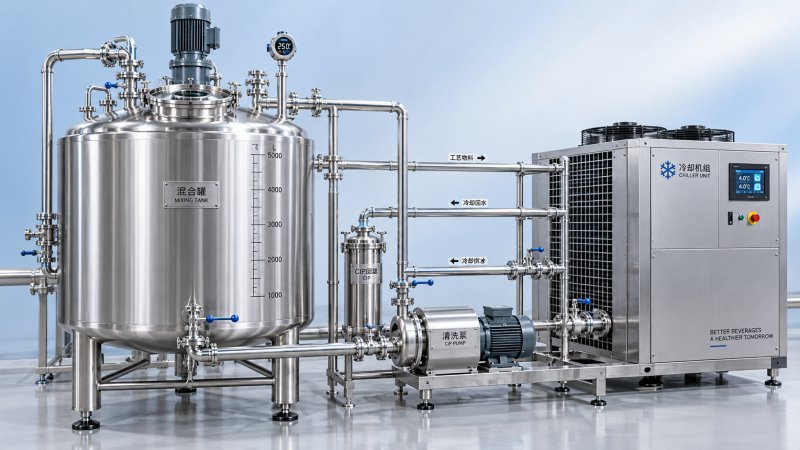
Before comparing prices, define the beverage, working volume, batch frequency, viscosity range, solids content, and required mixing result. Nominal tank capacity alone cannot establish suitability.
A vessel advertised as 5,000 liters may provide less usable capacity when your process requires headspace. Ask suppliers to distinguish total volume from recommended working volume.
For juice, specify whether the task involves blending liquids, suspending pulp, or dissolving powders. Each duty can require different impellers, motor sizing, and operating conditions.
For beer or wine blending, oxygen pickup may be a critical constraint. Clarify whether the process requires a closed vessel, controlled gas supply, or particular seals.
Give suppliers an acceptance target, such as blend uniformity within an agreed time. Define sampling methods and representative products so performance claims can be verified.
Why Can Agitator Selection Change the Budget So Much?
The agitator often explains substantial differences between mixing tank quotations. Its cost depends on impeller geometry, shaft length, gearbox, seals, speed control, and mounting requirements.
A low viscosity beverage may need a relatively straightforward blending arrangement. Concentrates, syrups, or suspended ingredients can require greater torque or a different mixing configuration.
Variable speed control adds purchase cost but can support several recipes and reduce unnecessary agitation. Its value depends on the actual range of production duties.
Avoid selecting by motor power alone. Ask suppliers to explain impeller diameter, operating speed, torque, and expected mixing time at both minimum and maximum working volumes.
Maintenance access also matters. Confirm how seals, bearings, and the motor can be serviced, and whether lifting equipment or additional overhead clearance will be required.
Which Material and Sanitary Details Affect Lifetime Cost?
Stainless steel grade influences purchase price, but suitability depends on the beverage and cleaning chemicals. Specify concentrations, temperatures, contact times, and relevant chloride exposure before selection.
Type 304 stainless steel is used in many beverage applications. More demanding conditions may justify another grade, subject to a documented assessment of corrosion risks.
Surface finish, weld quality, drainability, and internal fittings affect cleaning performance. Ask for a defined finish specification and inspection evidence instead of accepting broad sanitary claims.
Compare valve types, gasket materials, sample ports, and instrument connections. Small components can create recurring replacement expenses or complicate cleaning when they are poorly specified.
Request material certificates and agreed weld documentation where needed. Include these requirements in the quotation because additional documentation and inspection can change both cost and delivery.
Does the Cooling Jacket Include a Complete Temperature Control System?
A cooling jacket is only one part of temperature control. Your budget may also need a chiller, circulation pump, pipework, insulation, control valves, and sensors.
Ask suppliers to size the system against your actual duty: holding temperature, cooling incoming product, or removing process heat. These are different engineering requirements and costs.
Specify the starting temperature, target temperature, allowable cooling time, utility conditions, and ambient environment. Without these inputs, apparently similar jacket quotations may represent different capabilities.
Insulation can reduce heat gain and operating costs, particularly during long holding periods. Evaluate its benefit against production schedules, local conditions, and available refrigeration capacity.
Confirm who supplies and connects each component. A useful quotation identifies the cooling utility requirements and states whether commissioning includes verification of the agreed temperature performance.
What Can a Wine Storage Tank Specification Tell Buyers?
A storage tank specification helps illustrate how vessel accessories expand scope. It also shows why procurement teams must distinguish storage features from confirmed mixing performance.
For example, Shandong Weike Machinery Equipment Co., Ltd offers 5000L wine storage tanks with front manhole, specified in stainless steel 304 with 2 mm plate thickness.
The listed dimensions are 1,900 mm diameter and 3,000 mm total height. These figures help buyers assess floor space, delivery access, and installation clearance requirements.
Listed features include a cooling jacket, rotary CIP spray ball, RTD probe, sample valve, butterfly valves, and separate wine outlet and drain outlet assembly connections.
These accessories affect utility connections, cleaning arrangements, instrumentation, and maintenance planning. Their inclusion does not establish that an agitator or complete refrigeration package is supplied.
Confirm the selected configuration, usable capacity, and design limits before ordering. Plate thickness alone does not establish suitability for pressure, vacuum, transport, or added agitator loads.
How Much Will Cleaning and Changeovers Cost?
Cleaning costs include water, chemicals, heating, wastewater handling, labor, and production time. A cheaper vessel can become costly if every recipe change requires extended cleaning.
A rotary spray ball does not by itself guarantee effective CIP. Performance depends on device coverage, supply pressure, flow, cleaning chemistry, temperature, and cycle duration.
Ask the supplier for cleaning utility requirements and drainage details. Confirm whether the CIP supply equipment, return arrangement, and controls are included or purchased separately.
For facilities handling multiple flavors or allergens, assess changeover requirements early. Product residues and difficult access points can increase cleaning effort and reduce available production hours.
A front manhole can improve inspection and maintenance access, but entering a vessel requires appropriate confined space procedures. Routine cleaning should follow the validated cleaning method.
Which Freight, Installation, and Automation Costs Are Often Missed?
Freight quotations should identify packaging, shipment dimensions, insurance, delivery terms, and unloading responsibility. Import duties and local transport may remain outside the supplier’s quoted price.
Installation can require rigging, foundation work, electrical supply, platforms, product piping, and utility connections. Check doorways, ceiling height, and service access before approving vessel dimensions.
Automation costs depend on scope: basic speed adjustment differs from recipe management, dosing integration, batch records, or coordination with an existing production control system onsite.
Specify instruments, calibration records, alarms, and software access requirements. Clarify whether installation, operator training, travel expenses, and commissioning are included in the supplier’s proposed scope.
Spare parts availability also affects ownership cost. Request prices and lead times for seals, gaskets, valves, and drive components, together with written warranty and service terms.
How Should Procurement Compare Competing Quotations?
Build a comparison around the same process specification and supply boundary. Separate the vessel price from options, installation allowances, recurring expenses, and production capacity assumptions.
Use a common evaluation period to estimate ownership cost: installed capital cost plus energy, cleaning, maintenance, and expected downtime costs over the chosen operating period.
Keep assumptions visible. Electricity tariffs, batch frequency, cleaning cycles, and maintenance intervals should come from your facility or supplier evidence, rather than unsupported generic estimates.
The best mixing tank purchase meets the process requirement with a complete, verifiable scope. Choose on total operating value, supported by clear responsibilities and measurable performance.