












NEWS
Floating Lid Wine Tanks vs. Fixed-Top Tanks for Small Winery Storage
Floating lid wine tanks are the stronger fit when a small winery must store changing volumes in the same vessel. Fixed-top tanks are better suited to stable fill levels and a controlled inert-gas system. The deciding factor is not simply tank capacity: it is how much wine remains after transfers, how long it stays there, and how reliably the winery can maintain seals or manage headspace gas.
Neither design guarantees protection from oxidation. A floating lid reduces the gas space above the wine but introduces a movable perimeter seal. A fixed top provides a permanent enclosure but leaves headspace that must be managed whenever wine is removed. Selection should therefore follow the storage workflow rather than a general preference for one construction.
Start with the lowest working volume, not the largest batch
A tank sized for a harvest lot may spend much of the year partly empty. Racking losses, blending adjustments, sampling, and staged bottling all change the relationship between nominal capacity and actual stored volume. For storage selection, the lowest expected fill level can matter more than the maximum batch size.
Consider a nominal 2,000-liter vessel holding 1,200 liters after a transfer. A fixed-top configuration leaves approximately 800 liters of headspace, subject to the vessel’s actual geometry. That space is not necessarily filled with air if it has been properly purged, but its composition must be controlled. Introducing inert gas without an effective displacement procedure does not establish a known low-oxygen atmosphere.
A floating lid can be repositioned near the wine surface, reducing that headspace without transferring the wine to a smaller tank. However, the useful operating range depends on the lid mechanism, internal fittings, tank geometry, and minimum permitted position. “Variable capacity” should be supported by an operating drawing, not inferred from the tank’s rated volume.
The oxygen-control mechanisms are fundamentally different
In a common floating-lid design, an inflatable gasket seals the lid against the tank wall. The lid is positioned at the appropriate height, then the gasket is inflated according to the manufacturer’s instructions. The seal depends on gasket condition, correct inflation, wall cleanliness, and proper lid alignment.
The term “floating” should not be interpreted as automatic level tracking. An inflated perimeter gasket can hold the lid in place. After wine is withdrawn, the lid may need to be deflated, lowered, and resealed under a defined procedure. Leaving it at its previous height recreates headspace and defeats much of the design’s storage advantage.
Fixed-top tanks instead depend on sound welds, sealed access points, and controlled gas exchange. As wine is withdrawn, replacement gas must enter; during filling or thermal expansion, gas must escape. Uncontrolled air admission undermines oxygen protection, while an obstructed vent can expose the vessel to damaging pressure or vacuum.
Most atmospheric wine tanks are not pressure vessels. A fixed roof, gas connection, or pressure/vacuum relief valve does not establish a pressure rating. Gas supply regulation, relief settings, and withdrawal rates must match the vessel’s documented limits. Floating-lid tanks likewise require suitable venting and should not be pressurized unless explicitly designed for it.
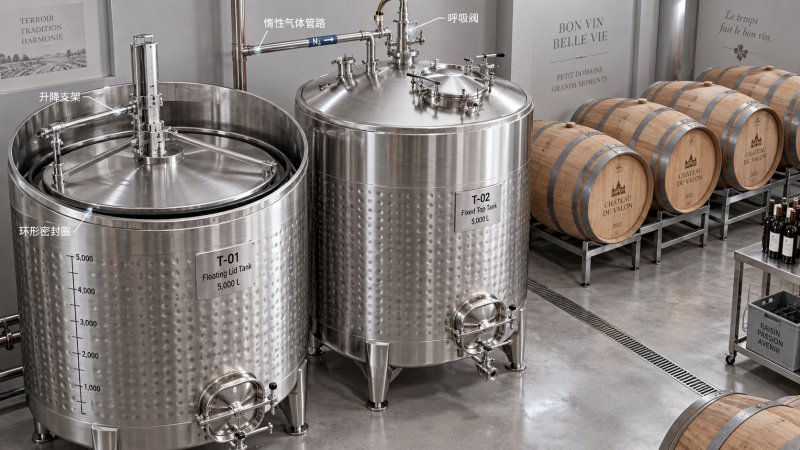
For either configuration, assess oxygen protection at the process level. Dissolved oxygen measurements around transfers and headspace oxygen measurements where applicable provide more useful evidence than appearance alone. A clean-looking gasket is not proof of gas tightness, and the presence of a nitrogen or argon connection is not proof of successful purging.
Match the vessel to the frequency of intervention
A floating lid is attractive for lots reduced through occasional blending or bottling withdrawals, especially where maintaining several smaller fixed-top tanks would consume scarce floor space. The trade-off is hands-on work each time the level changes: positioning the lid, checking the seal, and confirming that the venting arrangement remains functional.
Where withdrawals are frequent and handling can be automated, a fixed-top tank with properly engineered inert-gas admission may provide a more repeatable workflow. Its suitability depends on gas availability, regulator performance, operating procedures, and control of the resulting headspace—not merely on the permanent roof.
Storage duration changes the assessment. A short holding period between transfers places different demands on a seal than extended maturation. Floating lids can support longer storage, but gasket inspection, inflation checks, and spare-part availability become more important. Fixed tops reduce dependence on a large movable perimeter seal, yet long storage still requires attention to manway gaskets, valves, vents, and gas conditions.
Cleaning access can outweigh nominal CIP capability
Floating-lid tanks offer open-top access once the lid is removed, allowing direct inspection of the internal wall and wine-contact surfaces. Their cleaning burden includes the lid underside, gasket channel, inflatable seal, and any lifting components exposed to product or cleaning residues. Safe lid handling and a hygienic place to support the removed assembly are part of the installation requirement.
A fixed-top tank can support a more enclosed clean-in-place process, but a spray device does not by itself demonstrate complete cleaning. Spray coverage, flow and pressure, detergent conditions, drainability, and shadowed areas around fittings must be assessed together. Manways and valve assemblies may still require separate cleaning or disassembly.
Supplier documentation for red wine fermentation tanks with cooling jacket , for example, lists a conical top, rotary spray ball, top and side access openings, and a sloping flat bottom. These features are relevant to evaluating a fixed-top vessel for subsequent storage. They do not establish validated cleaning coverage, oxygen-control performance, or a pressure rating; those require separate evidence.
Inspect both designs for accessible welds, smooth product-contact transitions, drainable outlets, and avoidable residue traps. An inflatable gasket also needs documented compatibility with wine and the intended cleaning chemicals. Replacement intervals should follow condition and manufacturer guidance rather than an assumed universal service life.
Check temperature control at partial fill
Changing volume affects cooling performance as well as headspace. When wine sits below part of a cooling jacket, the effective heat-transfer area is reduced. A temperature probe above the liquid level cannot represent bulk wine temperature reliably. These limitations apply to both lid configurations.
For a floating-lid vessel intended to operate across a wide volume range, request jacket-zone elevations and probe positions on the fabrication drawing. Confirm which zones can be isolated at low fill levels and whether the control sensor remains immersed. Fermentation cooling capacity should not be accepted as proof of suitable control during low-volume storage.
Stainless steel grade and sheet thickness also require context. Grade 304 can be suitable for wine service, but material designation alone says little about fabrication quality or compatibility with cleaning conditions. Likewise, a stated 2 mm wall thickness does not establish structural adequacy across different diameters, heights, support arrangements, and pressure or vacuum conditions.
Compare installed operating cost, including the failure points
Purchase price is only part of the comparison. Floating-lid systems require gasket replacements, inflation equipment, suitable lifting arrangements, and labor for repositioning. Fixed-top systems require gas supply equipment, regulators, suitable venting, and a reliable replenishment process. Gas use depends on headspace, purge technique, transfer frequency, and leakage; it cannot be estimated from tank capacity alone.
Before accepting either design, request evidence tied to its specific operating risks:
- Floating lid: minimum and maximum operating levels, gasket material, inflation limits, lid-handling procedure, leak-check method, and replacement-seal availability.
- Fixed top: allowable pressure and vacuum, relief-device specifications, gas-admission arrangement, purge procedure, and cleaning coverage requirements.
- Both: fabrication drawings, material documentation, weld and surface-finish requirements, drainability, and temperature-control performance at expected fill levels.
Site constraints can change the preferred option. A floating lid needs clearance and safe handling space above the vessel. A tall fixed-top tank needs access to fittings and manways. Both require suitable foundations, drainage, and maintenance access. Inert-gas use also requires ventilation and an assessment of oxygen-deficiency hazards.
The practical choice is the vessel whose weak point the winery can consistently control. Where volumes change substantially and lid adjustment can be performed reliably, floating lids provide useful storage flexibility. Where volumes remain stable and gas management is dependable, fixed tops offer an enclosed workflow without repeated lid handling. A mixed installation can be justified when variable residual lots and stable bulk lots have genuinely different storage requirements.