












Wine storage volumes rarely stay constant. Fermentation losses, racking, sampling, and bottling can leave extra headspace in a tank, increasing the risk of unwanted oxygen exposure.
Floating lid wine tanks address this challenge with an adjustable lid positioned near the wine surface and an inflatable perimeter seal that helps limit air contact.
For winemakers comparing storage options, this flexibility is useful when batch sizes change. However, protection depends on correct lid placement, seal condition, and routine operating checks.
Understanding how the system works helps you assess its benefits and limitations, choose suitable equipment, and manage changing volumes without assuming the tank is completely airtight.
How Does a Floating Lid Accommodate Different Wine Volumes?
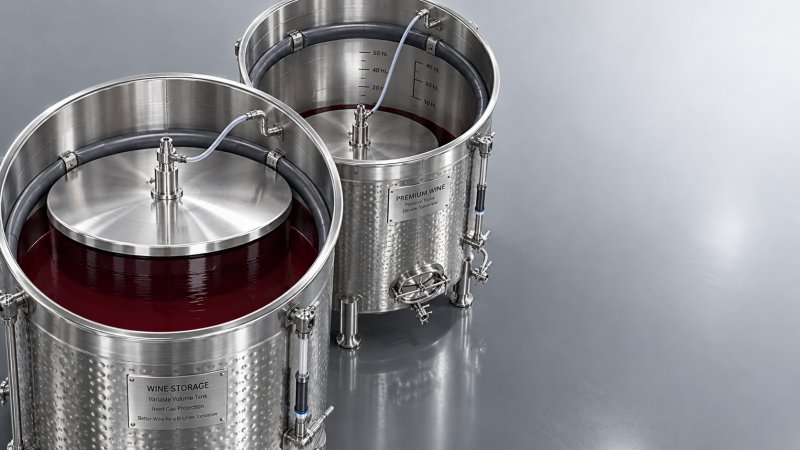
A floating lid tank, often called a variable capacity wine tank, uses a movable lid inside a cylindrical vessel instead of a permanently fixed roof.
The lid is positioned close to the wine surface. An inflatable gasket around its edge presses against the tank wall, forming a seal at that height.
When the stored volume changes, the operator releases the gasket pressure, adjusts the lid position, and reinflates the seal according to the equipment manufacturer's instructions.
The word “floating” can be misleading: once the gasket grips the wall, the lid generally needs adjustment rather than automatically tracking every change in liquid level.
For example, after racking a 1,000 liter batch down to 750 liters, lowering the lid reduces the air space that would remain beneath a fixed roof.
This flexibility lets one vessel accommodate several batch sizes within its usable range. Minimum operating volume still depends on lid travel, fittings, and tank geometry.
How Much Protection Against Oxygen Can You Expect?
Reducing headspace limits the amount of air immediately above the wine. This can help manage oxidation risk during storage, especially when partially filled tanks are unavoidable.
However, floating lid wine tanks do not eliminate oxygen exposure. Oxygen can enter during transfers, sampling, lid handling, or through a damaged or poorly seated gasket.
Dissolved oxygen already introduced during pumping also remains relevant. Lowering the lid cannot remove it, so careful transfer practices are still necessary for sensitive wines.
A small residual air pocket may remain beneath the lid. Where appropriate, a controlled inert gas procedure can provide additional protection, following equipment and cellar guidance.
Storage decisions should also account for wine condition, temperature, sanitation, and the winery's sulfur dioxide management program. Headspace reduction is one part of that system.
For prolonged storage or particularly oxygen sensitive wines, compare the sealing arrangement and monitoring requirements against a closed tank with properly managed inert gas protection.
What Should You Do After Racking, Sampling, or Partial Bottling?
Whenever wine is removed, check whether the lid remains correctly positioned. A sealed lid left above a falling liquid level creates the headspace you intended to avoid.
Before moving the lid, inspect the lifting arrangement and release the inflatable gasket as instructed. Trying to move an inflated seal can damage its contact surfaces.
Lower the lid carefully toward the new wine level, avoiding unnecessary splashing. Follow the specified procedure for venting trapped air and establishing the intended lid position.
Reinflate the gasket to the manufacturer's specified pressure. A higher setting does not necessarily improve sealing and may overstress the gasket or associated inflation components.
Record the adjustment and check that seal pressure remains stable. Investigate repeated pressure loss rather than repeatedly adding air without finding the source of leakage.
During bottling or frequent withdrawals, plan how lid adjustments will fit into operations. Repeated opening and repositioning can increase labor demands and opportunities for oxygen pickup.
Which Details Determine Whether the Seal Works Reliably?
The gasket must suit the wine, cleaning chemicals, and operating temperatures. Ask the supplier for material specifications, compatibility guidance, and replacement availability before choosing a tank.
Tank roundness and wall condition also matter. Dents, uneven weld areas, or deposits along the sealing path can prevent consistent contact between the gasket and vessel.
Inspect the inflation hose, connections, pump, and pressure gauge where fitted. A leak in these components can reduce sealing pressure even when the gasket appears intact.
Temperature changes can affect gasket behavior and inflation pressure. Include seal checks in routine cellar inspections, particularly when storage conditions change significantly between day and night.
Keep wine residues away from the gasket contact area. Deposits can interfere with sealing and create sanitation problems that become harder to detect beneath the lid.
Ask how the supplier verifies seal performance across the lid's operating range. A demonstration at one height does not establish reliable performance throughout the vessel.
When Is a Floating Lid Tank a Good Fit?
These tanks are useful for wineries handling seasonal production changes, experimental lots, blending adjustments, or batches that shrink after clarification, racking, and partial packaging runs.
They can reduce the need to transfer wine into progressively smaller vessels. Fewer transfers may simplify scheduling and reduce handling, provided storage and sanitation remain controlled.
The tradeoff is operator involvement. A winery with frequent volume changes should consider the time required for lid adjustments, pressure checks, cleaning, and gasket replacement.
Active fermentation requires additional consideration because carbon dioxide must escape safely. Confirm the manufacturer's permitted operating configuration, venting arrangement, and suitability for the intended fermentation stage.
Do not assume an inflatable gasket makes the vessel pressure rated. Pressurized transfers or gas additions require explicit equipment approval and suitable pressure and vacuum protection.
A closed tank may suit applications requiring controlled pressure, long unattended storage, or specific gas management. Choose according to the process rather than tank capacity alone.
What Should You Check Before Ordering a Stainless Steel Tank?
Start with your typical batch size, smallest expected storage volume, and largest fill. Confirm usable capacity and lid travel instead of relying only on nominal volume.
Review the lid lifting mechanism, access clearance, and operator reach. Larger lids need suitable handling equipment and enough overhead space for safe removal and cleaning.
Check outlet placement, drainage, sampling access, and internal cleanability. These details influence wine recovery, sediment handling, and whether routine cleaning reaches every product contact surface.
Select stainless steel grade and surface finish for the actual service conditions. Wine chemistry, cleaning agents, water quality, and fabrication quality all affect long term suitability.
If temperature control matters, assess jacket coverage at lower fill levels. A cooling jacket's performance depends partly on how much wine contacts the cooled wall.
Shandong Weike Machinery Equipment Co.,Ltd manufactures stainless steel vessels for wine and other beverages. Request drawings, gasket specifications, operating instructions, and warranty terms for your configuration.
How Does This Compare With Large Spirit Storage Equipment?
Different beverages can require different tank configurations. A large spirit storage vessel should not be assumed to offer variable capacity operation simply because it stores alcohol.
For broader cellar planning, the supplier's 20000L tequila mezcal spirit tanks provide a separate equipment reference for large volume storage, blending, and temperature control discussions.
The supplied listing describes a 20,000 liter vessel with sampling and discharge fittings, a cooling jacket, and temperature instrumentation. Confirm the specifications for any proposed build.
Its material and top configuration descriptions require clarification, and an adjustable floating lid is not established. Ask separately about sealing, automation, cleaning systems, and safety provisions.
Making the Right Choice for Changing Wine Volumes
Floating lid wine tanks offer practical flexibility when stored quantities fluctuate. Their main value is reducing headspace without requiring a separate vessel for every batch size.
That benefit depends on correct repositioning, reliable gasket pressure, clean sealing surfaces, and appropriate wine handling. The lid supports oxygen management rather than replacing it.
Before buying, confirm the usable volume range, inspect the sealing system, and assess adjustment workload. Choose the configuration your team can operate consistently throughout storage.