












NEWS
Buying Floating Lid Wine Tanks: Seal Quality, Welds, and Spare Parts
Buying Floating Lid Wine Tanks: Seal Quality, Welds, and Spare Parts
When sourcing floating lid wine tanks, purchase price is only part of the decision. Seal integrity, weld finish, and spare-parts availability affect oxidation control, cleaning efficiency, and operating costs. The challenge is identifying equipment that meets winery requirements without creating avoidable maintenance risks. A useful comparison starts with how the tank will be used, then checks whether the lid, fabrication quality, and service support match that duty.
Consider a tank holding finished wine while smaller volumes are transferred for bottling. Its working volume changes repeatedly, so the lid must be repositioned and resealed reliably. That is a different requirement from a vessel used mainly for active fermentation. Buying both from the same specification sheet can leave important details unresolved.
Start with the operating limits, not the capacity label
A floating lid reduces the exposed headspace above wine, but it does not make oxidation impossible. Transfers, sampling, seal condition, and handling still matter. Ask the supplier to identify the usable lid travel range, minimum practical fill level, and procedure for lowering the lid after a draw-off. Nominal capacity alone will not answer these questions.
Do not assume a variable-capacity tank is pressure-rated. Confirm permitted operating conditions and venting arrangements, particularly if fermentation may continue under the lid. Inflation pressure for the lid gasket is not an allowable vessel pressure. Operators need that distinction stated clearly in the manual.
For red-wine fermentation, check how cap management, solids discharge, and cleaning access will work. For finished-wine storage, frequent lid adjustment and seal monitoring may carry more weight. A larger tank is not automatically better value if its lid is awkward to handle or its working height exceeds the winery’s available lifting clearance.
Evaluate the seal as a complete assembly
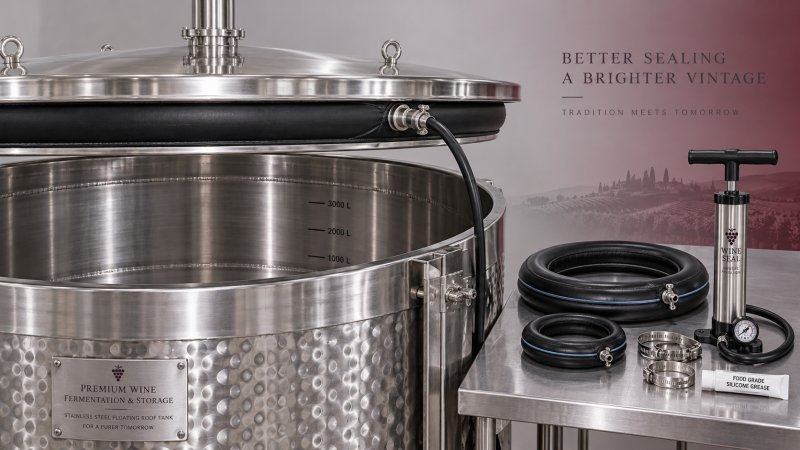
Many floating lids use an inflatable perimeter gasket. The gasket deserves attention, but so do the inflation hose, connector, pump, gauge, and lid geometry. A good replacement seal cannot compensate for a distorted shell or a lid that sits unevenly.
Request the gasket material specification and food-contact documentation applicable to the destination market. “Food grade” without supporting documentation is not enough. Compatibility should cover wine, the winery’s cleaning chemicals, their concentrations, and cleaning temperatures. Resistance to one cleaning regime does not establish suitability for another.
Before shipment, agree on a demonstration that includes positioning the lid at several working heights, inflating the seal according to the manufacturer’s instructions, and checking pressure retention under defined conditions. Record the test duration, temperature conditions, and acceptance criteria rather than relying on a photograph of an inflated gasket. This checks assembly integrity; it does not prove oxygen impermeability.
Ask to see the gasket joint and inflation connection in close-up. Also confirm how the seal is removed, cleaned, inspected, and refitted. If routine replacement requires an unfamiliar adhesive or a special tool, that belongs in the quotation—not in a maintenance surprise later.
Look inside the tank before judging the welds
Exterior polish is easy to photograph. Product-contact welds are more revealing. Inspect internal seams, outlet connections, the bottom junction, and any fittings that interrupt the wetted surface. Look for cracks, pits, undercut, crevices, and rough transitions where wine residue can remain after cleaning.
Ask for fabrication and finishing details, including how weld discoloration is removed and stainless surfaces are treated after welding. If the quotation specifies an internal surface-roughness value, request the measurement method and inspection locations. A vague promise of a “mirror finish” is less useful than a defined, verifiable acceptance requirement.
Shell roundness also matters because the seal must contact the circumference consistently. Agree on dimensional checks relevant to lid fit. For larger vessels, transport bracing and handling instructions deserve attention: damage during unloading can affect lid movement even when the tank still holds liquid.
Check drainage in the intended installed position. A bottom outlet does not guarantee complete emptying if the slope, valve arrangement, or installation level leaves a pocket. Likewise, a rotary spray ball does not establish cleaning coverage by itself. Ask how the lid underside, gasket contact area, and outlet recesses will be cleaned; tank entry requires separate confined-space controls.
Keep floating-lid and fixed-top quotations separate
A jacketed fermentation vessel may be the better choice when temperature control and fermentation access dominate the specification. For comparison, the stainless steel wine fermentation vessel is listed in capacities from 1,000 to 20,000 L, with 304 stainless steel, a stated 2 mm plate thickness, cooling jacket, RTD probe, rotary CIP spray ball, and sloping flat bottom.
Its listed conical top and top manhole describe a different configuration from an open-top floating-lid tank. Do not assume the quoted vessel includes a floating lid. Confirm the drawing and exact scope. Plate thickness alone also does not establish structural suitability; dimensions, supports, jacket design, and operating loads require review.
Make spare-parts support part of the purchase order
A replacement gasket identified only as “for a 5,000 L tank” is not adequately specified. Capacity does not uniquely identify diameter, gasket profile, connector type, or lid revision. Request an illustrated parts list tied to the tank serial number and approved drawing.
- Record part numbers and dimensions for the gasket, inflation hose, pump, gauge, and connectors.
- Obtain replacement prices, dispatch locations, and expected lead times before ordering.
- Clarify whether seals are stocked or made to order, including recommended storage conditions.
- Identify locally replaceable fittings and any proprietary components.
- Separate warranty coverage from consumable replacement and paid technical support.
Shandong Weike Machinery Equipment Co.,Ltd, based in Jinan, reports a factory exceeding 15,000 square meters and offers stainless vessel design, manufacture, installation, and commissioning across wine, brewing, and beverage applications. Its stated five-year after-sales service is worth discussing, but the contract should define what that support includes. Service availability is not automatically a five-year parts warranty.
Before releasing the order for floating lid wine tanks, attach the approved drawing, seal specification, inspection requirements, spare-parts schedule, and operating instructions to the purchase agreement. If the winery cannot identify and source a replacement seal without another round of measurements, the procurement work is not finished.