












NEWS
Open or Closed Fermentation Tank: Which Fits Your Red Wine Process?
During a busy red wine harvest, the difference between an open and closed fermentation tank becomes practical very quickly. Can the team reach the cap safely? Will the cooling system keep pace with fermentation? How easily can skins be removed when the wine is ready for pressing? These questions matter more than whether a vessel looks familiar on the cellar floor.
Open-top tanks provide direct access for punch-downs and cap inspection. Closed tanks offer more options for managing headspace and integrating pump-over systems. Neither design automatically produces better wine. For technical evaluators, the right choice connects extraction goals, batch size, labor availability, and sanitation with a tank specification that supports the actual cellar workflow.
Define “open” and “closed” before comparing quotations
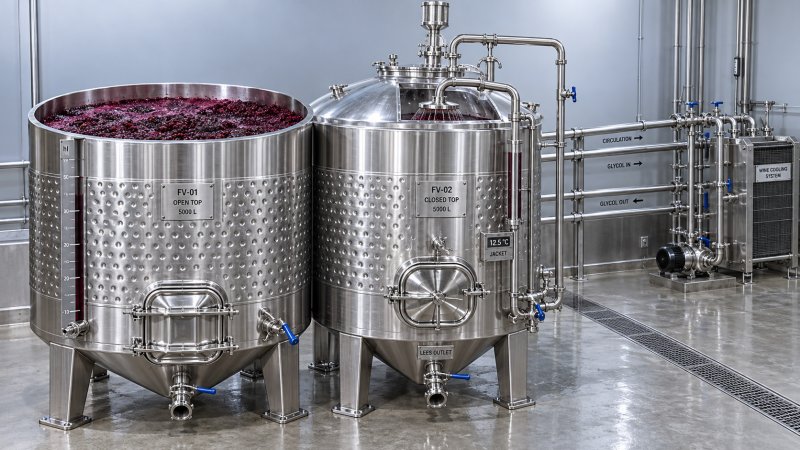
An open fermentation tank has an accessible top during fermentation, although it may have a removable cover for protection or other operating stages. A closed tank has an enclosed upper section with access through manways and dedicated fittings. It still requires a correctly designed route for fermentation gas to escape.
Closed does not mean pressure-rated. Many wine tanks operate at atmospheric pressure. Any intended pressure or vacuum duty must be explicitly specified, along with suitable protective devices. A sealed lid and a relief valve alone do not establish that a tank is safe for pressurized operation.
Some vessels can operate in both configurations. This flexibility is useful only when the cover, access arrangement, venting, cleaning system, and operating procedures are designed for both modes.
Let cap management drive the first decision
Red wine fermentation creates a floating cap of grape skins and solids. Keeping that cap appropriately wetted and managing extraction are central operating tasks, not optional tank accessories.
When open access earns its place
An open-top tank suits teams that want frequent visual inspection and direct punch-down access. For smaller lots or wines requiring closely observed extraction, that access can help the winemaker adjust intervention as fermentation develops.
However, “easy access” must be assessed against actual geometry. A deep tank with a narrow opening may be awkward to work even though it is technically open. Check working height, platform design, punch-down reach, tool clearance, and the effort required to break the cap. Mechanical punch-down equipment also needs structural support and safe operating clearances.
When a closed workflow makes more sense
Closed tanks often fit pump-over-based production, especially where fixed piping and automation reduce manual handling. Evaluate the complete circulation path: withdrawal point, solids handling, pump characteristics, return position, and distribution across the cap.
A pump-over connection alone is not a cap-management system. Poor distribution can leave parts of the cap dry, while excessive pumping or unsuitable equipment may create unwanted mechanical extraction. Some closed tanks also accommodate punch-down devices, so compare the proposed mechanism rather than assuming the top design determines every operating option.
Oxygen exposure is an operating variable, not a verdict
Open fermentation is sometimes described as inherently oxidative, and closed fermentation as oxygen-free. Both descriptions are too simple. Active fermentation generates carbon dioxide, but gas production does not guarantee reliable exclusion of air from an open vessel. Exposure also changes during cap work, sampling, and the slowdown toward fermentation completion.
A closed fermentation tank provides more opportunities to control headspace and gas additions. Yet opening manways or running an aerating pump-over can still introduce oxygen. Conversely, an open tank operated with appropriate covers and disciplined handling may suit the intended wine style.
The useful specification is therefore an oxygen-management plan: when exposure is desirable, when it should be limited, and how the cellar will manage the transition out of active fermentation. If the wine will remain in the vessel afterward, closure quality, headspace volume, and inert-gas connections deserve additional attention.
Cooling performance matters more than lid style
Both open and closed stainless steel tanks can use cooling jackets. The important question is whether the jacket and utility supply can manage the expected fermentation heat under harvest conditions.
Ask suppliers to assess cooling against your working volume, incoming fruit temperature, fermentation program, available coolant temperature, and simultaneous cellar demand. Jacket coverage also matters when the same vessel handles smaller batches: cooling surfaces above the liquid level contribute little to liquid cooling.
- Temperature measurement: Specify probe locations and consider whether one measurement adequately represents the fermenting mass.
- Control response: Review sensor placement, valve operation, and the proposed control sequence.
- Tank geometry: Assess height-to-diameter ratio alongside cap depth, access, and cooling distribution.
- Working capacity: Distinguish nominal tank volume from usable red wine fermentation volume, allowing for cap rise, foam, and operating headspace.
Grape variety influences the extraction strategy, but it should not become a shortcut to vessel selection. Fruit condition, desired wine style, and the team's cap-management routine are often more useful specification inputs than the variety name alone.
Inspect what happens between batches
A tank that ferments well but takes too long to empty and clean can become a harvest bottleneck. Review the pomace discharge arrangement, door dimensions, drainage, internal weld finish, and access to valves and seals.
Open tanks make inspection straightforward, but accessible surfaces still need a validated cleaning and sanitation procedure. Closed tanks may support clean-in-place systems; however, spray devices must reach the relevant surfaces, including manways, fittings, and areas exposed to skins and seeds. Installing a spray ball does not by itself demonstrate cleaning coverage.
Safety belongs in this review. Carbon dioxide can accumulate around either tank type, and tank entry requires appropriate confined-space controls. Raised platforms, punch-down mechanisms, and solids discharge introduce separate risks that should be addressed in layout and operating procedures.
Use cross-industry specifications carefully
Equipment built for other fermentations can reveal useful design options without being a direct substitute for a wine tank. For example, Shandong Weike Machinery Equipment Co.,Ltd offers 2000L tequila open top fermentation tanks for agave-mash applications. The supplied specification describes 316L stainless steel, temperature-control components, agitation options, sampling ports, and drainage fittings.
Those features provide starting points for technical discussion, not proof of red wine suitability. The listed 28–32°C operating range relates to the stated application; red wine temperature requirements should follow the winemaking program. Mechanical or pneumatic agitation also needs separate assessment for grape skins, seeds, and extraction goals.
Likewise, an open-top description alongside airtight seals and pressure-relief fittings calls for clarification: which components are sealed, when is the cover fitted, and what pressure or vacuum limits apply? For wine service, confirm the material grade, cap-management arrangement, pomace outlet, and usable batch volume rather than transferring the specification unchanged.
Make the final choice around a harvest workflow
Favor open-top fermentation when direct cap access, hands-on decisions, and flexible lot management outweigh the need for enclosed handling. Favor closed fermentation when controlled headspace, integrated pump-overs, and reduced manual intervention are priorities. A mixed cellar may justify both.
Before purchase, ask the supplier to walk through filling, fermentation, cap management, sampling, draining, pomace removal, and cleaning using your intended batch size. Shandong Weike's stainless steel vessel design, manufacturing, installation, and commissioning capabilities are relevant to that discussion; the quotation should translate them into documented, application-specific requirements.
The best fermentation tank is not simply open or closed. It is the vessel your team can operate safely, clean thoroughly, and use consistently to make the red wine you intend.