












NEWS
Batch Blending Tank or Inline Blender for Multi-Flavor Beverage Lines?
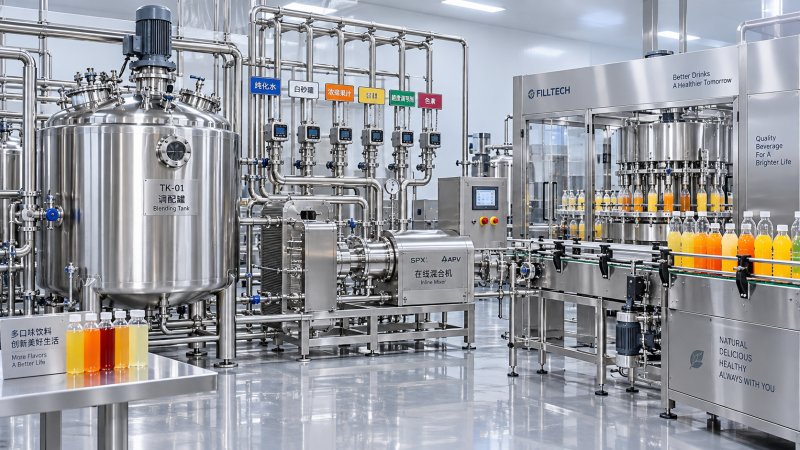
A multi-flavor beverage line can lose more production time to recipe changes than to mixing itself. When short runs share the same equipment, residual flavor, delayed ingredient dissolution, and repeated cleaning can reduce usable output. Choose a batch blending tank when recipes need holding time, staged additions, or release testing before filling; favor an inline blender when prepared liquid ingredients support long, stable production runs.
The decision changes when a line combines high-volume core flavors with seasonal or specialty drinks. Inline blending may serve the core products efficiently, while batch preparation handles difficult ingredients and smaller orders. Compare the complete process—from ingredient preparation to filler interruptions—not just the rated throughput of each mixer.
Start with the production schedule, not vessel capacity
Build a production profile showing run size by flavor, required filling rate, changeover frequency, and available cleaning windows. Include the smallest commercial batch and the longest uninterrupted campaign. An average daily volume can conceal a schedule dominated by short runs, where startup and cleaning consume a large share of operating time.
A batch system separates preparation from filling. Operators can charge ingredients, mix, sample, adjust, and release the batch before transfer. However, one vessel cannot always prepare the next recipe while supplying the filler. Parallel tanks or a separate holding vessel may be needed to avoid gaps.
Inline systems proportion ingredient streams continuously and mix them as they pass through the equipment. Their practical capacity depends on reliable ingredient supply and the operating range of pumps, meters, and controls. A system that performs well at nominal output may struggle during low-speed filling or frequent stops.
Ingredient behavior can rule out a simple configuration
Clear beverages made from water and fully dissolved concentrates are strong candidates for inline blending. The main task is accurate proportioning followed by adequate mixing. Juice drinks containing pulp, dairy-based beverages, and recipes using gums introduce different demands: suspension, hydration, viscosity management, and protection against excessive shear.
A conventional tank agitator does not automatically solve these demands. Powder wetting may require a powder induction device or high-shear mixer; gums may need a defined hydration sequence. Agitator geometry, speed, baffles, and liquid depth should be evaluated at both minimum and maximum working volumes.
Inline blending also does not eliminate preparation vessels. Syrups and stabilizer solutions may still require upstream tanks before metering. Account for these vessels, their cleaning circuits, and preparation labor when comparing footprint and capital cost.
For carbonated beverages, define where carbonation occurs. Mixing, pumping, and buffering after carbonation require suitable pressure control to limit gas breakout and foaming. A vessel suitable for an atmospheric beverage is not automatically suitable for pressurized service.
Compare accuracy during transitions, not only steady operation
Batch dosing can use load cells, flowmeters, or weighed additions. Its accuracy depends on instrument resolution, calibration, piping forces on the vessel, and residual material left in transfer lines. Small additions deserve particular attention: a weighing arrangement suitable for bulk water may not adequately resolve a low-dose flavor ingredient.
Inline accuracy depends on coordinated ingredient flows. Check meter suitability for viscosity, conductivity, entrained air, and solids, then evaluate the full turndown range. Ingredients with very different flow rates may need separate dosing arrangements rather than oversized meters operating near their lower limit.
- At startup: establish where product goes before all ingredient ratios stabilize.
- During speed changes: verify that ingredient streams respond together rather than producing temporary concentration errors.
- After a stop: define how trapped product is handled and when filling can resume.
- At release: confirm which measurements distinguish an acceptable recipe from an incorrect blend.
Brix can indicate soluble solids, but it cannot independently confirm every ingredient ratio. Similar-Brix concentrates may have different acidity or flavor strength. Use a recipe-specific verification plan, with appropriate laboratory checks or online measurements, rather than treating one sensor as complete quality assurance.
Measure changeover losses across the whole product path
A tank-based process can retain product at the vessel outlet, pump, valves, and transfer line. An inline process can leave an interface mixture as one flavor displaces another. Neither arrangement is inherently low-loss: piping length, drainability, transition strategy, and the allowable destination for displaced product determine the outcome.
Map all shared wetted components from ingredient connections to the filler. Strong flavors, colors, and allergens can drive cleaning requirements even when the next beverage looks similar. Product sequencing may reduce some changeovers, but it cannot replace validated cleaning where cross-contact controls are required.
For a blending tank, assess spray-device coverage, agitator seals, sample valves, and outlet geometry. For an inline skid, examine meter bodies, injection points, valve cavities, and bypass loops. Specify CIP flow, temperature, chemical concentration, and duration for the actual soils and circuit; a stated “CIP system” alone does not demonstrate cleanability.
Use cooled holding only where the recipe needs it
Temperature-sensitive dairy beverage bases may require refrigerated holding upstream of final blending. The listed milk cooling tanks offer closed cooling, automatic temperature adjustment, agitation, and CIP cleaning, with stated capacities from 1,000 L to 10,000 L and 304/316L sanitary stainless steel construction. These features may support chilled base storage before batch or inline processing.
That is a holding function, not proof of suitability for every blending duty. Confirm cooling capacity at the intended inlet temperature, ambient conditions, and required cooling time. Also verify working volume, agitation performance, and cleaning access. Low-temperature storage does not replace validated hygiene controls or any required heat treatment, and the supplied information does not establish powder-hydration or pressurized-blending capability.
Set acceptance tests before choosing the equipment
Ask suppliers to demonstrate the limiting operating conditions, not only an easy recipe at full output. Use representative formulations and agree on measurable acceptance criteria before testing.
- Test the hardest formulation. Check dissolution, hydration, suspension, foam, and consistency using the intended addition sequence.
- Test both operating extremes. For tanks, assess minimum and maximum working volumes; for inline systems, assess minimum and maximum flow rates.
- Run a flavor change and a filler stop. Record transition product, residual hold-up, restart behavior, and the time until acceptable product reaches filling.
- Verify cleaning and release. Agree on inspection locations, carryover checks, sampling methods, and records needed to authorize production.
Compare cost per saleable volume, including preparation labor, off-spec product, cleaning utilities, and filler idle time. Batch cycle time should include charging, mixing, testing, discharge, and cleaning—not agitation alone.
When most recipes need adjustment or substantial residence time, select batch blending and size the vessel arrangement around the filling schedule. When prepared liquid feeds and long campaigns dominate, evaluate inline blending with a defined stop-and-restart strategy. For mixed demand, a hybrid arrangement—batch preparation of difficult ingredients followed by inline dilution or final proportioning—can address both duties, provided its additional transfers and cleaning circuits are included in the evaluation.