












NEWS
Blending Tank Sampling: Checking Brix Uniformity Before Bottling
A single Brix reading can hide uneven mixing in a blending tank. The sample beside the outlet may meet the recipe target while a denser layer elsewhere remains above specification. Once bottling starts, that difference can become inconsistent sweetness, labeling concerns, or a batch that requires investigation.
For quality control and safety teams, the practical question is not simply “What is the Brix?” It is “Do representative samples demonstrate uniformity, and is the measurement suitable for this beverage?” A defensible check combines a sampling plan, controlled measurement conditions, and acceptance limits established before testing.
What Brix can—and cannot—confirm
Degrees Brix describes the mass percentage of sucrose in a sucrose-water solution. In juice and other complex beverages, a refractometer generally reports a sucrose-equivalent soluble-solids reading. Acids, other sugars, and dissolved ingredients affect that result. It is useful for process control, but it is not automatically a direct measurement of sugar content.
This distinction matters particularly in cider, wine, and fermented drinks. Alcohol changes refractive index, so an uncorrected reading after fermentation should be treated as apparent Brix, not residual sugar. Use a validated correction or an appropriate analytical method when actual sugar concentration determines compliance or product release.
Brix comparisons can still help identify uneven blending in a consistent beverage matrix. However, two samples with the same reading could contain different proportions of alcohol, acid, or other ingredients. When those components are critical, verify them separately rather than assuming Brix proves complete compositional uniformity.
Build the blending tank sampling plan around the risks
A convenient sampling valve does not necessarily provide a representative tank sample. Concentrated syrup can settle, additions may remain near the surface, and poor circulation can leave zones outside the main mixing path. Fill level, viscosity, temperature, and tank geometry all influence where differences may persist.
During process validation, map the tank more extensively than you would during routine release. Use that work to identify informative sampling locations and establish mixing conditions for the intended operating range.
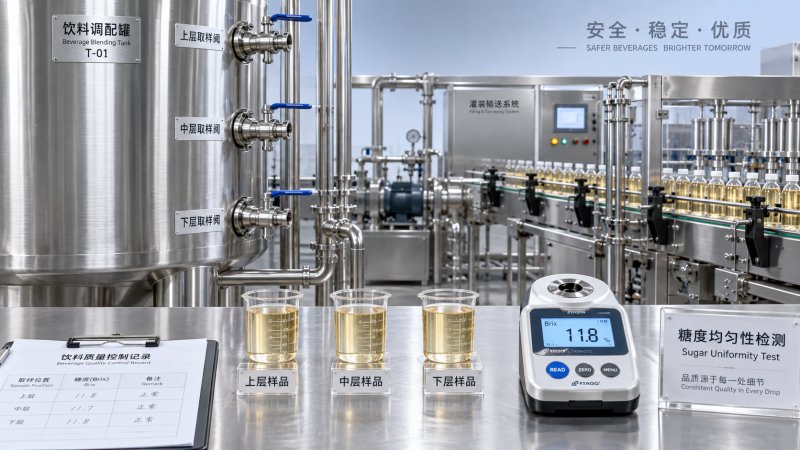
For routine checks, upper, middle, and lower samples are a useful starting concept—not a universal standard. The number and location of samples should follow validated process risks. A single-port tank may require a hygienic depth sampler or an engineered multi-level arrangement; repeated draws from the same valve do not establish vertical uniformity.
Specify sampling timing, too. Results obtained during agitation are not interchangeable with results after a prolonged rest. If the actual process includes a delay between blending and bottling, assess whether uniformity persists through that delay.
A sampling sequence that protects the result
Confirm the batch condition before collecting anything
Check that all ingredients have been added, the recorded batch quantity is correct, and the validated mixing or recirculation cycle is complete. Record fill level, product temperature, mixing settings, and elapsed time since mixing stopped. These details help explain a failed result without relying on operator memory.
Do not increase agitation blindly. Excessive mixing can introduce oxygen, cause foaming, or damage product characteristics. Cider and other oxygen-sensitive beverages need a mixing strategy that balances homogeneity with quality protection.
Control the sampling point
Prepare valves and sampling equipment according to the site's sanitation procedure. Purge retained liquid using a validated volume or endpoint so that the sample reflects the vessel rather than yesterday's residue or stagnant valve contents. Avoid prescribing one purge volume for every valve design.
Collect separate, clearly labeled samples from each location within a defined time window. Do not combine them before analysis: a composite can average away the very difference the check is intended to detect.
Keep sample containers clean, compatible, and covered where appropriate. Sampling must not require entering the tank or bypassing guards. Follow site procedures for moving machinery, hot liquids, chemical exposure, and any pressurized connections.
Make the measurement repeatable
Verify the refractometer according to its manufacturer's instructions and the site's quality procedure. A water zero check is useful, but it does not replace periodic verification with a suitable reference near the working range. Document instrument identification and verification status.
Allow samples and the instrument to reach suitable, stable measurement conditions. Automatic temperature compensation does not correct every matrix effect or eliminate errors from a hot sample cooling on the prism. Record temperature and remain within the instrument's specified operating limits.
Use a validated preparation method for cloudy, pulpy, or carbonated products. Bubbles can disrupt readings; uncontrolled degassing can change the sample through evaporation. Filtering may also alter what is measured. Apply the same preparation to every location and document it.
Clean and dry the prism between samples. Take replicate readings using fresh aliquots where practical. If replicates disagree beyond the method's established repeatability, resolve the measurement problem before judging tank uniformity.
Judge the spread, not just the average
A release decision needs two distinct checks: whether the batch meets its target specification and whether location-to-location differences meet the uniformity criterion. A correct average does not rescue an unacceptable spread.
A simple comparison is maximum location mean minus minimum location mean, expressed in degrees Brix. Use replicate means only after confirming acceptable repeatability, and retain the individual results in the batch record.
There is no universal Brix tolerance for every beverage or blending tank. Establish limits through process validation, considering product requirements, instrument performance, method uncertainty, and the consequences of variation. A limit narrower than the method can reliably distinguish is not a meaningful control.
Illustrative example: location means of 11.8, 12.0, and 12.3 °Bx produce a spread of 0.5 °Bx. Whether that passes depends on the approved limits and method capability; these values are not a recommended specification.
If the spread fails, hold the batch. Check sampling integrity and instrument performance, then investigate ingredient additions, circulation paths, and mixing conditions. Apply approved corrective action and repeat the full relevant sampling set. Retesting only the previously failing location can miss a shifted concentration gradient.
Tank features support control—but do not prove uniformity
Sampling access, cleanable valves, appropriate circulation connections, and temperature control make a verification program easier to execute. When specifying equipment, ask where samples can be taken at minimum and maximum operating volumes, and whether those points can be cleaned and inspected effectively.
For cider operations, Shandong Weike Machinery Equipment Co.,Ltd offers the Cider Variable Volume Tank for applications including blending, maturation, and storage. Available configurations include sampling valves, CIP ports, and optional dimpled cooling jackets, with AISI304 or AISI316L construction and a specified internal finish of Ra ≤0.8 μm.
Its adjustable floating lid is intended to reduce headspace and oxygen contact as working volume changes. That feature does not establish mixing performance or guarantee freedom from spoilage. Confirm the selected lid arrangement, sampling access, and mixing or recirculation system are compatible with the intended process; cooling and hygienic construction also require site validation.
Keep the bottling release decision broader than Brix
Brix uniformity is a quality control check, not a microbial safety test. It cannot confirm sanitation effectiveness, pathogen control, package integrity, or fermentation stability. Depending on the beverage, release may also require pH, acidity, alcohol, microbiological, dissolved oxygen, or carbonation checks.
The final record should connect the batch identity, sampling locations, timing, temperatures, instrument checks, individual readings, acceptance criteria, and any corrective action to an authorized release decision. That traceability turns a few measurements into usable evidence—and gives the bottling team a sound basis for proceeding.