












NEWS
The Ultimate Guide to Industrial Edible Oil Tanks: Design, Manufacturing, and Processing Integration
Introduction
In the global oils and fats processing industry, fluid management infrastructure represents far more than passive volumetric enclosure. The engineering configuration of modern industrial edible oil tanks directly governs downstream product quality, operational safety, and overall processing line efficiency. Proper tank engineering ensures strict compliance with global food safety standards—including FDA, CE, and ASME frameworks—while optimizing the plant's total cost of ownership (TCO) by actively counteracting oxidation and chemical degradation.
1. Material Engineering & Sanitary Design Standards
The biological and chemical stability of lipids depends heavily on the metallurgical properties of the containment shell. Industrial fabrication for food-grade processing requires elite austenitic stainless steel alloys, primarily Type 304 and Type 316L. Type 304 stainless steel delivers outstanding corrosion resistance for neutral, fully refined oils at ambient temperatures. However, for upstream processing stages—where crude lipids contain high concentrations of aggressive free fatty acids, moisture, and chemical catalysts—Type 316L is mandatory due to its 2–3% molybdenum content which prevents pitting corrosion.
Internal shell plates must achieve a verified surface roughness score of Ra le 0.4 mu mthrough mechanical grinding and electro-polishing. This mirror-like finish removes microscopic pits where lipids can degrade and shelter bacterial biofilms. Furthermore, structural design must strictly eliminate "dead-legs" where Clean-In-Place (CIP) fluid velocity drops below the threshold required for turbulent scouring (v < 1.5 m/s). Longitudinal and circumferential shell seams are joined using automated Tungsten Inert Gas (TIG) pulse welding under an argon shield, followed by chemical pickling and passivation to maximize corrosion resistance.[Why Sanitary Design Matters in Stainless Steel Edible Oil Tanks: Surface Finish and Material Traceability Standards]
2. Advanced Thermal Control & Agitation Dynamics
Edible oils are thermally sensitive chemical structures. Exposure to localized high-temperature zones triggers rapid thermal cracking and the generation of undesirable trans-fatty acid isomers. Conversely, letting temperatures drop below an oil's crystallization threshold causes fractional solidification and pumping blockages. Precision thermal management requires advanced heat-exchange jackets engineered directly onto the external shell walls. For process vessels requiring rapid thermal cycles, laser-welded dimple jackets represent the industry benchmark. For large-scale bulk storage vessels where temperature maintenance is the objective, external half-pipe coils or modulated electric trace heating elements paired with high-density polyurethane insulation are preferred.
[Heating Medium Inlet] ──> [Turbulent Dimple Jacket Zone] ──> [High Uniform Heat Flux]
                                                                        │
[Low Shear Hydrofoil Agitator] <── [Thermal Stratification Prevented] <──┘
Thermal consistency cannot be achieved by external jackets alone; it requires precise internal fluid agitation. Without continuous, gentle fluid movement, thermal stratification occurs, leading to localized overheating at the boundaries and solidification at the core. Modern design relies on large-diameter, low-RPM hydrofoil impellers driven by Variable Frequency Drives (VFDs). These systems provide high volumetric axial flow rates at minimal shear stress, keeping the oil mass entirely homogenous in temperature, viscosity, and phase distribution without breaking down lipid chains or incorporating destructive ambient oxygen.
3. Upstream Integration: Oil Pressing & Extraction Lines
The mechanical extraction and solvent processing phases establish the primary fluid boundaries for raw agricultural lipids. Directly post-pressing or solvent desolventization, the freshly recovered crude oil is highly unstable. It contains significant volumes of suspended solids (seed meal cake particles), moisture fractions, and naturally occurring phosphatides (gums). At this specific upstream nexus, crude oil buffer tanks serve as vital industrial surge shock absorbers, stabilizing continuous plant mass flow between erratic extraction mill outputs and continuous downstream refining lines.
Crude oil storage units require specific structural engineering modifications to handle heavy sedimentation loads. Upstream buffer tanks must feature steep conical bottoms with a minimum 60 to 90circ pitch. This steep angle leverages gravity to continuously concentrate settled gums and solid meal cake particles toward the absolute lowest point of the basin. Furthermore, these units are equipped with automated, heavy-duty pneumatic bottom desludging valves that purge concentrated solids at preset intervals without interrupting the continuous decanting of the cleaner, upper floating oil layer.[Integrating Crude Edible Oil Storage Tanks into Mechanical Pressing and Solvent Extraction Plants]
4. Midstream Systems: Specialized Vessels for Multi-Stage Refining
Once stabilized, crude lipids undergo multi-stage industrial refining to eliminate impurities while preserving nutritional value. This process demands highly specialized processing vessels engineered to withstand aggressive chemical environments, high thermal stress, and extreme pressure differentials.
Crude Input ──> [Neutralization Tank] ──> [Bleaching Vessel] ──> [Deodorizer Tower] ──> Refined Output
                   (Acid/Alkali Resistant)    (Vacuum Sealing)       (Extreme Heat/Vacuum)
In the initial degumming and neutralization stage, tanks operate as active chemical reactors where crude oil is dosed with acids and alkalis to precipitate phosphatides. These vessels require robust internal fluid distribution manifolds to ensure instantaneous chemical dispersion. The oil then transitions to the bleaching stage, where vessels must operate under a continuous vacuum (20–50 mbar) to prevent oil oxidation at elevated temperatures (100–110C°), requiring internal reinforcing rings to prevent shell implosion. The final stage is physical or chemical deodorization. Deodorizer towers operate under extreme conditions (240–260C° at 1–3 mbar}) to strip volatile compounds. These units are heavy-wall, ASME-certified pressure vessels utilizing premium-grade SS316L to combat thermal stress cracking and fatty acid vapor corrosion.[High-Vacuum and Reaction Vessels: Choosing Specialized Edible Oil Processing Tanks for Multi-Stage Refining]
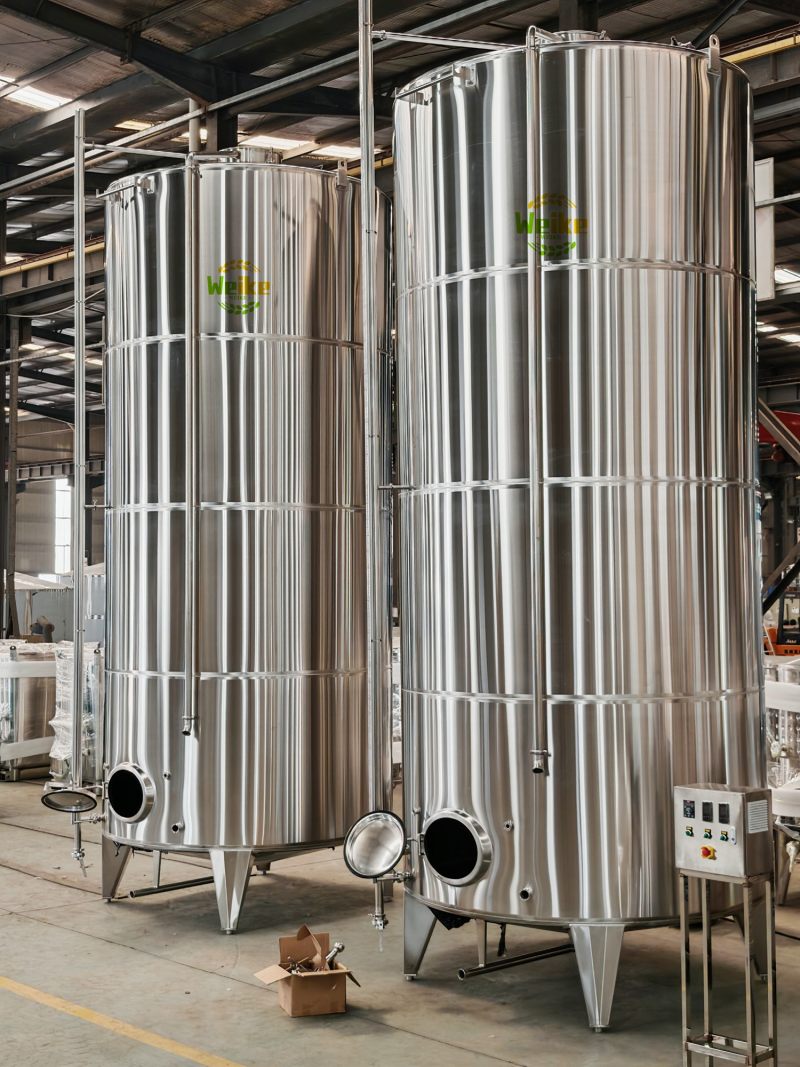
5. Technical Comparison of Processing vs. Storage Tanks
To properly map a facility's capital infrastructure, engineers must evaluate the distinct operational envelopes of processing vs. storage vessels:
6. Downstream Solutions: Bulk Storage & Asset Quality Management
In large-scale commercial downstream storage farms, refined oils are held for extended periods before packaging or shipment. Asset protection within these massive storage installations targets three primary degradation pathways: oxidative rancidity, atmospheric moisture ingress, and ambient thermal shock. To eliminate oxygen contact, industrial storage tanks use automated nitrogen blanketing systems. These systems maintain a precise, low-pressure layer of ultra-pure nitrogen gas within the tank's vapor space (headspace), sustaining a micro-positive pressure envelope ($+20text{–}50 text{ mbar}$) that prevents outside atmospheric air from leaking into the tank.
   [Automated N2 Supply Valve] ──> Opens on Pumping Out (Sustains +20-50 mbar Envelope)
                                      │
   [Tank Vapor Headspace] ────────────┼──> Pure Nitrogen Gas Layer (Blocks Ambient O2)
                                      │
   [Automated Vent Valve]   ──> Opens on Filling In (Vents Overpressure Safely)
[The Mechanics of Nitrogen Blanketing Systems in Large Capacity Industrial Edible Oil Storage Tanks]
Managing these massive volumes requires proactive asset quality protocols to prevent degradation across seasonal shifts. Water accumulation from atmospheric condensation can accelerate hydrolytic rancidity, turning premium neutral triglycerides back into corrosive free fatty acids and shifting the overall batch profile. Industrial operators monitor these risks at the terminal farm scale through integrated sampling ports and automated tank management software, minimizing top-space air contact and handling environmental changes smoothly.[Preventing Oxidation and Acid Value Spikes: Asset Management for Bulk Edible Oil Terminal Tanks]
For high-melting-point lipids like palm oil, palm kernel olein, or fractionated coconut oil, bulk storage introduces significant thermal challenges. Bulk tanks for these specific lipids must feature low-pressure internal steam coils or external electric trace heating pads protected by high-density rockwool insulation. Thermal management systems must deliver a gentle, uniform heat input to maintain the lipid mass just above its clear melting point (40–45C° for standard palm oil) without scorching the product, combined with continuous multi-level resistance temperature detectors (RTDs) to monitor for thermal stratification.[Optimizing High-Melting Point Fats: Customizing Edible Oil Storage Tanks for Palm Oil and Coconut Oil Processing]
7. Logistical Intermodal & Transportation Tank Engineering
Bulk distribution links refining hubs with global consumer packaging facilities. Transporting bulk liquid food products across oceans, railways, and highways requires mobile containers engineered for high mechanical stress and dynamic fluid motion. For global intermodal logistics, the standard solution is the 20-foot ISO tank container. These units consist of a food-grade stainless steel pressure vessel fabricated from high-tensile SS316L securely mounted inside a reinforced structural steel frame, using a triple-barrier bottom discharge valve assembly to eliminate environmental spill risks.
[Tank Interior Layer] ──> [Internal Footvalve] ──> [External Ball Valve] ──> [Blind Flange Cap]
[International Fleet Sourcing: Technical Standards for Intermodal ISO Edible Oil Tank Containers]
When transporting bulk liquids via regional road tankers, fluid dynamics introduce unique safety risks. As a truck accelerates, brakes, or turns, the massive volume of liquid oil inside the tank shifts rapidly, generating immense kinetic energy waves. To mitigate this surge effect, road transport tanks are engineered with internal anti-sloshing baffles—curved, perforated stainless steel plates welded perpendicular to the tank shell. They function as kinetic energy dampeners, breaking up fluid wave velocity and distributing the dynamic forces uniformly across the entire structural shell to preserve vehicle stability and prevent weld fatigue cracking.
[Forward Fluid Surge Wave] ──> [Perforated Baffle Plate] ──> [Fluid Velocity Disrupted & Dissipated]
                                                                        │
[Reduced Mechanical Stress on Welds] <──────────────────────────────────┘
[Mobile Fluid Dynamics: Anti-Sloshing Baffle Engineering in Road Edible Oil Transportation Tanks]
8. Frequently Asked Questions (FAQ)
Q1: How to choose between SS304 and SS316L for different types of edible oils?
The selection between SS304 and SS316L is determined by the Free Fatty Acid ($FFA$) content and the operating temperature of the oil. Crude, unrefined oils contain elevated $FFA$ percentages along with residual moisture.
Q2: What is the optimal nitrogen pressure required for bulk storage tank blanketing to effectively prevent oxidation?
The industry standard for nitrogen blanketing systems uses a low-pressure micro-positive envelope, typically calibrated between +20mbar and +50 mbar.
Q3: Why are anti-sloshing baffles critical for road transport tanks, and how do they impact vehicle safety and tank longevity?
Anti-sloshing baffles are vital for managing the fluid dynamics of bulk liquids in transit. When a road tanker changes speed or direction, unbaffled liquid oil forms a high-velocity surge wave. This shifting mass creates a massive dynamic weight transfer that can destabilize the vehicle's center of gravity and cause rollover accidents. From a mechanical engineering perspective, this fluid surge creates severe stress concentration at the tank's circumferential welds. Installing perforated anti-sloshing baffles forces the liquid through small openings, breaking up the kinetic energy front and distributing forces uniformly across the shell to protect vehicle handling and extend asset longevity.