












NEWS
What Does a Mixing Tank Do in Juice and Soft Drink Production?
What Does a Mixing Tank Do in Juice and Soft Drink Production?
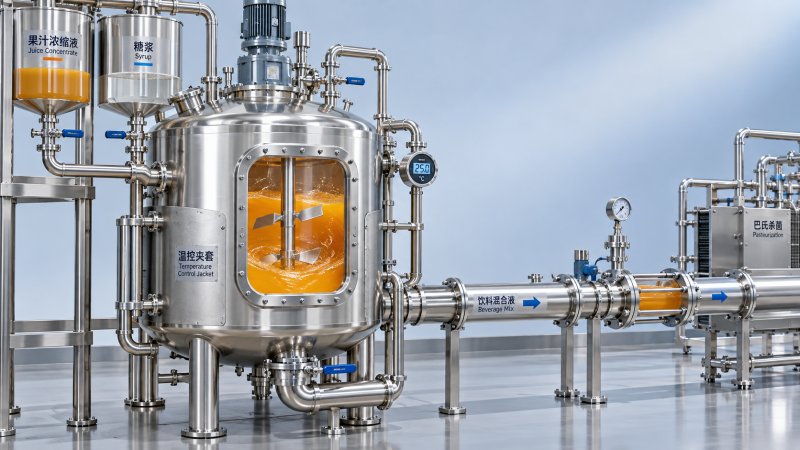
Why does one batch of juice taste balanced while another separates or varies in sweetness? Sometimes the recipe is correct, but the ingredients have not been distributed evenly. In juice and soft drink production, a mixing tank blends water, concentrates, syrups, and other ingredients into a consistent beverage base before downstream processing.
Its job goes beyond stirring. The vessel, agitator, ingredient addition sequence, and temperature control all influence the result. A tank that handles a clear, water-like drink comfortably may struggle with concentrated syrup or a pulp-containing juice. Understanding those differences is more useful than choosing equipment by capacity alone.
Where the Tank Fits into the Production Line
A beverage mixing tank commonly sits between ingredient preparation and processes such as filtration, homogenization, pasteurization, carbonation, or filling. The sequence depends on the formulation and production method; not every drink passes through every stage.
For juice made from concentrate, the tank combines treated water with concentrate and any permitted recipe ingredients. For a soft drink, it may prepare syrup or blend finished syrup with water. Dry sugar might be dissolved in a separate preparation vessel rather than added directly to the final blending tank, especially when dissolution requires heating.
In many carbonated beverage lines, blending happens before carbonation. Ordinary atmospheric mixing equipment should not be assumed suitable for holding a carbonated drink under pressure. If the vessel will handle carbonated product, its pressure rating, fittings, relief arrangements, and operating procedure need specific review.
What Happens Inside: Dissolving, Dispersing, and Keeping Ingredients Moving
These are different tasks. Sugar needs to dissolve. A stabilizer powder needs to disperse without forming lumps and may then require time to hydrate. Fruit pulp needs enough circulation to remain reasonably distributed during processing and transfer. One agitator setting will not necessarily handle all three well.
Consider a syrup-heavy formulation. If dense syrup enters near the bottom and circulation is weak, the upper liquid can remain more dilute. A sample taken from one location may look acceptable while the batch is still uneven. Agitator position, impeller geometry, and tank proportions determine whether liquid moves throughout the vessel or mainly around the impeller.
Powders create another problem. Some hydrocolloids hydrate rapidly at the surface, trapping dry material inside stubborn clumps. Controlled addition, preblending, or a dedicated high-shear dispersion step may be necessary. Simply running a conventional stirrer longer is not always an effective remedy.
There is also a limit to what mixing can achieve. It does not automatically create a stable emulsion, prevent long-term pulp settling, or make a beverage microbiologically safe. Those outcomes depend on formulation and, where required, separate homogenization and validated preservation processes.
More Agitation Is Not Always Better
A visible vortex can look like strong mixing, but it may pull air into the drink. That can increase foaming, complicate level measurement, and expose oxygen-sensitive ingredients to more air. For delicate juice formulations, vigorous surface disturbance may be counterproductive.
Pulp-containing products bring a different trade-off: enough movement to limit settling, but not so much shear that the intended texture changes. During a pause before filling, gentle agitation may be more appropriate than the speed used during ingredient incorporation.
Motor power and rotational speed are therefore incomplete selection criteria. The useful question is whether the proposed impeller produces the required circulation at the actual viscosity and working volume. A partially filled vessel can behave very differently from a full one, particularly if an impeller is no longer adequately submerged.
Temperature matters too. Heating can assist sugar dissolution, while excessive heat or prolonged warm holding may be undesirable for flavor-sensitive ingredients. A jacket provides heating or cooling capability, but performance still depends on the utility supply, heat-transfer area, and mixing conditions.
How Operators Know a Batch Is Ready
A fixed mixing time is convenient, but it should be established through trials rather than guessed. Changes in concentrate temperature, addition rate, or batch size can alter the time needed to reach uniformity.
Depending on the recipe, checks may include soluble solids measured as °Brix, pH, acidity, appearance, and sensory assessment. °Brix alone does not confirm that every component is evenly distributed; in a mixed beverage, it is not a selective measurement of sugar alone.
During commissioning, comparing samples from representative locations or different points during discharge can help reveal uneven blending. Sampling valves must also be used hygienically, with procedures that account for liquid retained in the valve. Otherwise, the sample may not represent the current batch.
Hygienic Design Is Part of Mixing Performance
Stainless steel is common in beverage equipment, but the material label is only part of the assessment. Weld quality, internal finish, drainability, gasket compatibility, and access around the agitator shaft all affect cleaning. The choice between 304, 316, and 316L should reflect the product and cleaning chemistry, not a blanket assumption that one grade suits every application.
A clean-in-place spray device is useful, but its presence does not prove complete cleaning. Impellers, baffles, fittings, and internal surfaces can create areas that receive insufficient cleaning solution. CIP coverage and the cleaning cycle need verification under the intended operating conditions.
This becomes especially noticeable when changing from a pulpy juice to a clear drink. Retained fibers or flavor residues can affect the next batch even when the main vessel wall looks clean.
A storage tank serves a different purpose
Not every stainless steel beverage vessel is a mixing vessel. For example, Shandong Weike Machinery Equipment Co.,Ltd offers 5000L floating lid tanks for wine storage. Their floating lid is intended to reduce the air space above the wine, with options including a cooling jacket, sampling valve, and CIP rotary spray ball. Those features address storage needs; they do not establish suitability for powered blending or pressurized soft drinks. Oxygen exposure still depends on seal condition and handling practices.
Start with the Beverage, Not Just the Tank Size
A useful equipment discussion starts with the recipe: viscosity during each preparation stage, powder additions, pulp content, temperature limits, smallest batch, and largest working batch. Nominal capacity is not the same as usable batch volume; space may be needed for additions, foam, and safe agitation.
Based in Jinan, Shandong, Weike manufactures stainless steel vessels in a factory exceeding 15,000 square meters and provides design, installation, commissioning, and five-year after-sales service. For a beverage project, those capabilities are best applied to checking the entire process, including ingredient charging, cleaning access, and transfer to the next stage.
Before accepting a design, ask how it will demonstrate uniform blending for your actual formulation at both minimum and maximum working volumes. That answer tells you more than tank capacity or motor size alone.