












NEWS
Choosing a Mixing Tank Agitator for High-Viscosity Beverage Syrups
A beverage syrup can appear to move at the surface while remaining poorly mixed near the bottom or jacket wall. The result may be uneven sweetness, slow heating, or localized overheating. For high-viscosity duty, start by comparing a close-clearance anchor with a helical ribbon: an anchor is often suitable when wall renewal and moderate bulk circulation are sufficient, while a ribbon is a stronger candidate when viscous material needs deliberate top-to-bottom turnover.
The choice cannot be made from batch volume and motor power alone. Specify viscosity across the operating temperature range, evaluate tank geometry, and verify available shaft torque at the required speed. Where powders must be wetted or dispersed, a separate dispersing device may be necessary; increasing the speed of a bulk agitator can introduce air without solving the incorporation problem.
Define the syrup duty before comparing quotations
A single viscosity value measured on warm, finished syrup can hide the most demanding operating condition. Cold startup, concentrated intermediate stages, and batches containing gums or suspended solids may impose substantially different loads. Shear-thinning formulations also require measurement conditions to be stated, because apparent viscosity changes with shear rate.
Give equipment suppliers a process envelope rather than one nominal recipe:
- Rheology: viscosity versus temperature, measurement method, and shear-rate dependence where relevant; identify any yield stress or time-dependent behavior.
- Batch limits: minimum and maximum working volume, density, solids content, and whether the agitator must restart after a stoppage.
- Ingredient sequence: liquid charging, sugar addition, gum hydration, concentrate blending, and final dilution.
- Quality limits: acceptable shear exposure, air incorporation, temperature variation, and blending time.
- Thermal duty: heating or cooling requirements, utility conditions, and product temperature limits.
Separate dissolution from suspension or dispersion. Sugar dissolution depends on liquid availability, temperature, and circulation around the crystals. Gum addition can form difficult-to-wet agglomerates. These duties may need different addition methods even when they occur in the same mixing tank.
Anchor or ribbon: compare the circulation pattern
An anchor moves material near the vessel wall and can support heat transfer by renewing that region. However, circumferential motion is not proof of complete blending. Ask how the proposed geometry moves material vertically, especially in a tall vessel or around a deep bottom section.
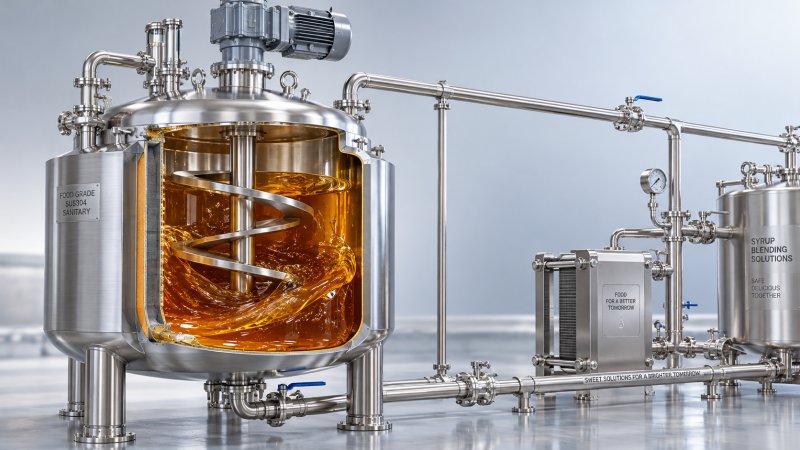
A helical ribbon is intended to establish axial movement alongside a return flow through another part of the vessel. Its suitability depends on the complete arrangement, not merely the presence of a spiral blade. Request a drawing showing ribbon diameter, pitch, clearances, shaft position, and its relationship to the normal liquid level.
Scrapers may help limit buildup on heat-transfer surfaces, but introduce wear components and hygienic details. Confirm their material compatibility, retention method, inspection access, and replacement procedure. Do not assume a scraper-equipped anchor is automatically better than a properly sized noncontact design.
Check torque where the process is hardest
Low-speed torque is a primary selection parameter. Shaft torque equals delivered mechanical power divided by angular speed. A motor’s nameplate power therefore does not, by itself, establish whether the agitator can turn a cold, concentrated batch at the intended operating speed.
Request the continuous output torque, allowable peak torque, gearbox rating, and usable speed range. The assessment should cover acceleration, normal operation, and restarting with settled solids or cooled syrup. A variable-frequency drive provides speed control, but does not make every motor-and-gearbox combination suitable for continuous low-speed service; motor cooling and the available torque envelope still matter.
The supplier should also verify shaft strength and deflection, impeller loading, bearings, seals, and mounting loads. A close-clearance agitator requires allowance for fabrication tolerances, thermal expansion, and movement under load. Motor upgrades cannot compensate for an unsuitable shaft or vessel mounting arrangement.
Match the agitator to the vessel and jacket
Two tanks with the same working volume can need different agitators. A narrow, tall vessel creates a longer vertical circulation path, while a wide vessel changes impeller diameter and loading. Minimum fill level can leave part of a ribbon exposed or prevent a secondary impeller from pumping effectively.
Review bottom geometry, outlet location, and internal fittings together. Conical sections, probes, and drain pockets can create poorly swept regions. Baffles that help a lower-viscosity liquid resist swirling may obstruct a close-clearance assembly or complicate cleaning, so they should not be specified by habit.
For jacketed service, require both a thermal assessment and a mixing assessment. Added jacket area will not eliminate a stagnant product layer. Establish whether the agitator renews material at the wall without exposing heat-sensitive ingredients to unacceptable surface temperatures. Temperature readings from one probe are insufficient to demonstrate batch uniformity during validation.
Keep pressure containment separate from mixing suitability
A beverage line may blend syrup before a separate carbonation or pressure-holding stage. The 1000L sparkling wine pressure tanks illustrate that different duty: the listed configuration includes stainless steel construction, a cooling jacket, an RTD probe, a rotary CIP spray ball, and sealed pressure service for sparkling wine production.
Those features do not establish suitability for high-viscosity syrup mixing. Specialized agitation for riddling or sur lie aging should not be treated as equivalent to an anchor or ribbon. If a pressure vessel is considered for combined duties, obtain a dedicated agitator assessment and confirm the exact allowable pressure, temperature, seal arrangement, and mounting design. Published operating and maximum-pressure figures must be reconciled in the vessel documentation before selection.
Make cleaning part of the mechanical review
Viscous syrup can remain behind scraper attachments, around shaft seals, or beneath poorly drained fittings. Stainless steel grade alone does not establish cleanability. Review weld finish, crevices, elastomers, drainage, and access to product-contact components against the formulation and cleaning chemistry.
A rotary spray ball is not evidence that every agitator surface receives adequate cleaning. Ribbons, hubs, and supports can shadow spray coverage. Require the supplier to explain the cleaning sequence, any necessary agitator rotation, and whether inspection or disassembly is needed. Material selection between 304 and 316 stainless steel should consider ingredient chemistry and cleaning conditions rather than viscosity.
Turn the shortlist into an acceptance test
Compare proposals against the same process envelope. Testing should include the most viscous credible condition, relevant fill levels, and the actual ingredient-addition sequence. A water trial can demonstrate mechanical operation, but cannot validate circulation in concentrated syrup.
- Define blend uniformity using samples from representative upper, middle, and lower locations, with a suitable composition measurement such as temperature-corrected soluble solids.
- Record blending time, speed, product temperature, and drive loading; confirm how measured current relates to torque if it is used as a load indicator.
- Check for residual agglomerates, excessive foam, stagnant regions, and unacceptable thermal variation.
- Validate drainage and cleaning after the demanding recipe, including accessible areas where residue may remain.
Choose the proposal that demonstrates required circulation and cleaning performance within its continuous mechanical limits. Where recipes span both easy-flowing liquids and very viscous concentrates, establish whether one agitator can cover the full range or whether separate bulk-mixing and dispersion functions are justified.