












NEWS
Sizing Fermentation Tank Cooling for Peak Winery Harvest Loads
At peak harvest, a winery’s cooling problem rarely comes from one unusually demanding tank. It comes from several ordinary demands arriving together: warm must entering the cellar, fermentations reaching maximum activity, and another batch needing a temperature pull-down before the next delivery. A system that performed comfortably last week can suddenly leave operators chasing setpoints.
Sizing fermentation tank cooling therefore requires more than multiplying vessel volume by a standard refrigeration allowance. Project managers need a defensible estimate of simultaneous heat loads, followed by checks that the tank jackets, glycol distribution, and chiller can actually remove that heat under harvest conditions.
Start with the busiest harvest window, not total tank capacity
A winery with ten tanks does not necessarily need cooling capacity for ten identical peak fermentations. Equally, assuming that only half the tanks will require cooling can be risky if fruit arrivals become compressed by weather or picking decisions.
Build an hourly operating schedule for the busiest credible harvest period. For each tank, record working volume, incoming must temperature, target temperature, filling time, fermentation stage, and required cooling deadline. Include shared refrigeration users such as must heat exchangers, cold stabilization, or chilled storage when they operate on the same plant.
The key distinction is between connected load and coincident load. Connected load describes everything the system could serve; coincident load describes what it must serve at the same time. Use production schedules to establish diversity rather than selecting an arbitrary percentage.
Also test a compressed-arrival scenario. If a pull-down can safely move to a quieter shift, scheduling may avoid additional refrigeration investment. If delaying cooling threatens wine quality or tank turnover, that demand belongs in the design peak.
Calculate fermentation tank demand in separate parts
Separating the heat sources makes assumptions easier to review and prevents a single “watts per liter” figure from hiding important differences between batches.
Incoming must temperature and pull-down time
The sensible cooling load is:
Q = m × cp × ΔT ÷ t
Here, Q is cooling duty in kW, m is product mass in kg, cp is specific heat in kJ/kg·K, ΔT is the required temperature reduction, and t is cooling time in seconds. Use product-specific density and heat-capacity values for detailed design.
For an illustrative estimate, assume 10,000 kg of must, a specific heat of 4.0 kJ/kg·K, and a 12°C reduction over 12 hours. The average sensible duty is approximately 11.1 kW. Halving the permitted cooling time doubles that duty.
This calculation describes the required heat removal, not proof that a jacket can achieve it. Where incoming must needs rapid cooling, an appropriately selected upstream heat exchanger may be more practical than relying entirely on tank jackets.
Heat released during fermentation
Fermentation heat depends on the rate of sugar consumption, not simply the starting sugar concentration. Estimating total fermentation energy and dividing it by the entire fermentation duration can significantly understate the busiest hours.
A useful preliminary relationship is:
Qfermentation = sugar consumed per hour × heat released per kilogram ÷ 3,600
With sugar consumption in kg/h and heat release in kJ/kg, the result is kW. For illustration, a 10,000-liter batch consuming sugar at 2 g/L/h processes 20 kg/h. Using an assumed heat release of 550 kJ/kg gives approximately 3.1 kW.
These are calculation assumptions, not universal winery design values. Validate peak consumption rates and heat-release assumptions with the winemaking team, fermentation records, or the process designer. Yeast selection, temperature, nutrient management, and wine style can change the load profile substantially.
Ambient and auxiliary heat gains
Add heat entering through tank walls, piping, and fittings, together with relevant pump heat and other shared process duties. Outdoor tanks exposed to sun require a different assessment from insulated tanks in a conditioned cellar. Insulation reduces heat gain but does not remove fermentation heat.
A worked peak-load snapshot
Consider a hypothetical harvest window with four active 10,000-liter fermentations and two additional batches requiring the pull-down described above. Assume the new batches are not yet generating significant fermentation heat.
If the incoming batches are also fermenting, add their heat generation. Then establish an explicit allowance for uncertainty and agreed expansion. Avoid stacking conservative assumptions, excessive diversity penalties, and a large final safety factor without explaining each one.
Most importantly, specify net available cooling capacity at the actual operating conditions. A chiller’s nominal rating may refer to warmer fluid or cooler ambient conditions than those encountered during harvest.
Check the heat-transfer path before ordering a larger chiller
Refrigeration capacity is only one link in the chain. Heat must travel from the wine through the tank wall and jacket, into circulating glycol, and back to the refrigeration plant.
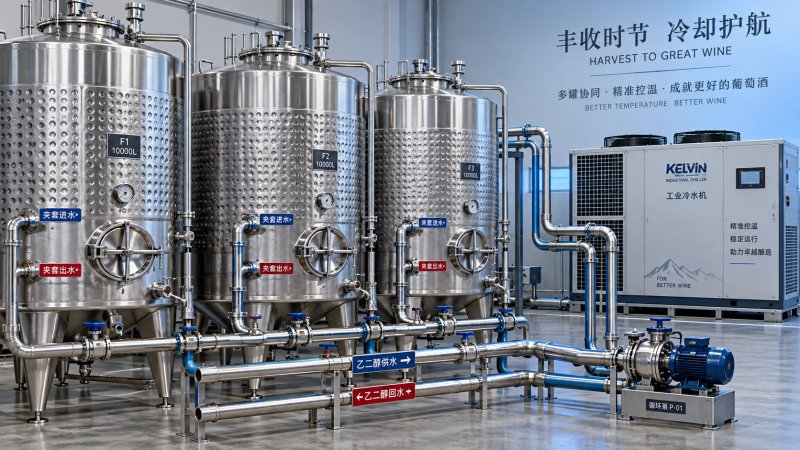
For each fermentation tank, request jacket area, jacket circuit arrangement, permitted pressure, recommended flow, and cooling performance at the proposed product and glycol temperatures. Check performance at the minimum working fill level: jacket area above the liquid contributes little to useful product cooling.
A preliminary jacket check uses Q = U × A × ΔTlm, where U is the overall heat-transfer coefficient, A is effective wetted area, and ΔTlm is the log-mean temperature difference. Supplier calculations should reflect actual operating conditions. Red-wine cap formation, limited natural circulation, and product temperature gradients can make generic coefficients unreliable.
Check the end of the pull-down as well as its beginning. As wine approaches its target temperature, the temperature difference driving heat transfer decreases. A jacket that removes heat quickly from warm must may struggle during the final few degrees.
Size glycol circulation for the same simultaneous demand
Required circulation follows ṁ = Q ÷ (cp × ΔT). For a 40 kW duty, an assumed glycol-mixture specific heat of 3.7 kJ/kg·K, and a 5°C supply-to-return rise, the mass flow is approximately 2.16 kg/s. Convert this to volumetric flow using the selected mixture’s density.
Confirm glycol concentration against freeze protection requirements and supplier guidance. Excess concentration increases viscosity and can reduce heat-transfer performance. Pump selection must include pressure losses through headers, valves, strainers, jackets, and the most demanding circuit—not just total flow.
Balanced branches and properly selected control valves prevent nearby tanks from taking disproportionate flow. A buffer tank can reduce cycling and support short transients, but it cannot compensate for hours of insufficient refrigeration capacity.
Turn the calculation into a purchase and commissioning specification
Require tank and refrigeration suppliers to work from the same duty schedule. Specify working volumes, temperature targets, cooling times, site ambient conditions, glycol properties, jacket pressure limits, and simultaneous operating cases. Define how tank temperature will be measured and how uneven temperatures will be checked.
Shandong Weike Machinery Equipment Co.,Ltd manufactures stainless steel wine tanks and other process vessels, with design, installation, and commissioning services. Its broader range includes stainless steel milk mixing tanks with cooling jackets, RTD probes, and CIP provisions. Those features are relevant to thermal-control discussions, but dairy mixing equipment should not be assumed suitable for wine fermentation without application-specific engineering review.
Before acceptance, verify delivered flow, glycol supply and return temperatures, sensor calibration, alarm behavior, and simultaneous cooling performance under representative loads. Agree on emergency priorities if capacity becomes restricted.
A well-sized system is not simply the largest affordable chiller. It is a coordinated cooling chain that meets the winery’s busiest credible schedule—and gives the cellar team predictable control when harvest leaves little room for recovery.