












NEWS
How Fermentation Tank Geometry Affects Red Wine Cap Management
A fermentation tank with a narrow diameter generally concentrates the same quantity of grape skins into a deeper cap, while a wider vessel spreads them across a larger surface. That changes how easily a pump-over wets the solids, how far a punch-down must travel, and where temperature differences can develop. Two tanks with the same capacity can therefore require different operating routines.
Geometry does not determine extraction by itself. Fruit condition, skin-to-juice ratio, fermentation activity, temperature, and the timing of cap management all matter. The useful question is whether the vessel allows the intended batch to be wetted, mixed, cooled, and emptied without excessive mechanical treatment.
Compare working dimensions, not nominal capacity
During red wine fermentation, carbon dioxide helps lift skins and other solids into a floating cap. Its thickness depends partly on the volume of those solids relative to the available surface area. For a cylindrical tank, cross-sectional area increases with the square of the internal diameter. A change in diameter can therefore substantially change the surface over which the cap forms.
As a first approximation, cap depth is the apparent volume of floating solids divided by the tank area at cap level. This is a comparison tool, not a precise prediction: gas retention, berry integrity, stems, and compaction change the cap’s structure throughout fermentation.
For equal batches with similar fruit composition, a narrower tank tends to produce a deeper cap. A wider tank tends to produce a shallower one, but requires liquid distribution across a larger footprint. Neither geometry automatically gives more uniform extraction.
Distinguish the tank’s overall height-to-diameter ratio from its working fill height-to-diameter ratio. Overall height can include a cone, roof, and unused headspace. The working ratio describes the actual fermentation more meaningfully. Compare drawings at the intended fill level, with room for cap rise and foam, rather than assuming nominal capacity equals usable red wine capacity.
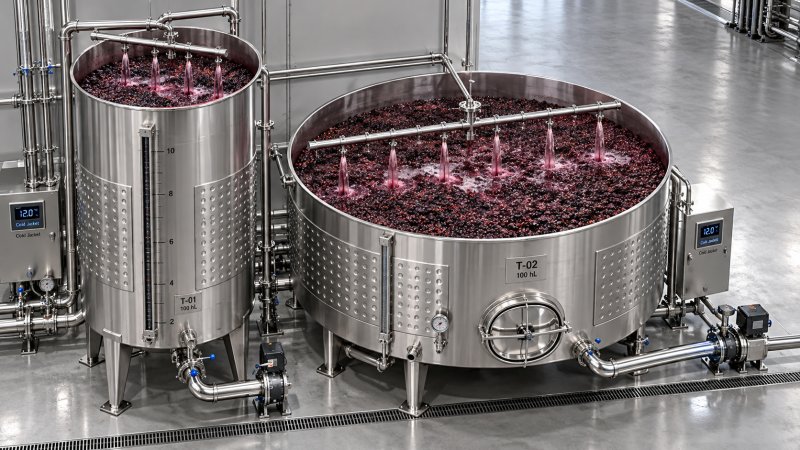
Pump-over performance depends on coverage and flow paths
A pump-over withdraws liquid from below the cap and returns it over the solids. Its effectiveness depends on where that liquid lands and how it travels through the cap. Pump capacity alone cannot describe either condition.
In a broad tank, a fixed central return may repeatedly wet the middle while leaving the perimeter relatively dry. A distributor, movable return, or multiple return positions can improve coverage, provided the arrangement works at the actual cap height. Roof clearance and the distance between the outlet and cap affect the landing pattern.
A deep cap presents a different challenge. Liquid can follow preferential channels through the solids, reaching the lower wine without thoroughly wetting the surrounding material. Increasing flow may reinforce those channels rather than correct them. The cap’s permeability also changes as berries break down and solids settle or compact.
This is why identical pump-over volumes do not guarantee identical treatment. Expressing circulation as a fraction of batch volume helps compare operating schedules, but it does not show surface coverage or penetration. Return position, flow rate, duration, and the condition of the cap must be considered together.
The withdrawal arrangement matters as well. A low outlet needs a suitable way to retain skins and seeds without creating excessive suction restriction. An undersized or obstructed screen can interrupt circulation, while a return jet aimed directly at one area can cause unnecessary mechanical disruption.
During operation, observe whether wetting reaches the edges, whether persistent dry patches remain, and whether temperature differences decrease after circulation. These observations give a more useful basis for adjustment than simply increasing pump speed.
Punch-down access changes the value of tank geometry
Punch-downs push floating solids back into the liquid. A shallower cap can be easier to submerge, but a wide tank still requires access across its full surface. A small central opening may leave peripheral areas beyond the reach of a manual tool or fixed mechanical head.
A tall, narrow vessel may have a smaller cap footprint, yet place it too high for practical manual work. A deeper cap can also require greater travel and force. If mechanical punch-downs are planned, assess the head’s reach, stroke, operating positions, and clearance throughout the expected fill range.
Open-top tanks offer direct access, while closed vessels require appropriately positioned openings or an integrated mechanism. The choice also affects platform layout, sanitation, and how the vessel will be covered between operations. Safe access must be designed into the installation; personnel should never need to lean into a fermenter or enter it to manage the cap, particularly where carbon dioxide can accumulate.
For a wine style intended to limit mechanical extraction, easier access can be valuable because it allows controlled, localized intervention. However, a shallow cap does not itself produce gentler extraction. Treatment frequency, force, contact time, and fermentation stage still govern the result.
Cooling jackets control the wall more directly than the cap
Fermentation generates heat, and a cooling jacket removes it through the tank wall. The temperature near that wall may differ from the liquid core or the cap interior, especially when circulation is limited.
At equal working volume, a narrower cylindrical vessel generally provides more sidewall area per unit volume than a wider one. That can be useful for jacket cooling, but it does not establish cooling performance on its own. Jacket coverage, coolant conditions, heat-transfer characteristics, and internal movement remain essential.
Cap management helps redistribute heat by moving liquid through or around the solids. A cold wall reading can therefore coexist with a warmer cap. A sensor close to a jacket may indicate that the controller is meeting its setpoint while missing a temperature difference elsewhere in the fermentation.
Review sensor positions alongside the intended circulation pattern. Where cap temperature is important to the operating strategy, provide a practical way to measure it. Avoid placing a probe where the pump-over return continuously washes it with liquid that is unrepresentative of the surrounding fermentation.
Partial batches deserve particular attention. Their liquid level may engage only part of the jacket, and the cap may sit below the intended return or punch-down position. A tank that works well near its design fill can perform differently at a much smaller batch size.
Bottom geometry and fittings affect the whole operation
The lower section influences drainage, solids accumulation, and access to the liquid used for pump-overs. A sloped floor or cone may assist drainage, but its usefulness depends on outlet size, slope, and the material being discharged. A configuration suited to yeast collection can be awkward for removing bulky grape pomace.
Evaluate the pomace door as part of the fermentation design. Its location and clear opening affect unloading, while screens, internal cooling surfaces, and projecting fittings can trap solids or obstruct cleaning. Smooth, accessible surfaces are especially valuable when skins and seeds must be removed between batches.
Equipment categories should also remain distinct. A package such as 500L micro beer brewing equipment includes fermentation, cooling, and controls for a brewing workflow, but those features alone do not establish suitability for red wine fermented on skins. Cap access, liquid distribution, solids handling, and usable headspace require their own design review.
Specify the operating method before approving the vessel
There is no single height-to-diameter ratio that suits every red wine program. A useful specification begins with the intended batch range, fruit preparation, extraction approach, and available labor or automation. Tank geometry should support those conditions.
When discussing a stainless steel wine tank with a manufacturer such as Shandong Weike Machinery Equipment Co.,Ltd, request a drawing that shows the working fermentation arrangement, rather than only external dimensions and total capacity. The review should connect each feature to an operating requirement:
- Fill range: Show minimum and maximum batches, cap allowance, foam headspace, and jacket coverage.
- Pump-over arrangement: Define the withdrawal screen, outlet position, return coverage, and access for cleaning.
- Punch-down provision: Show how the tool or mechanism reaches the cap center and perimeter at different fill levels.
- Temperature measurement: Locate sensors where readings support control decisions and allow assessment of internal differences.
- Emptying and sanitation: Check pomace removal, drainage, fitting accessibility, and cleaning coverage.
After installation, establish the cap management routine by observing wetting, temperature distribution, and extraction as fermentation progresses. If the cap remains dry around the edges or circulation repeatedly follows one channel, address coverage and flow paths before increasing treatment intensity. The best-fitting vessel is one that makes the intended intervention controllable across the batches the winery actually produces.