












NEWS
How to prevent settling in a beverage blending tank
How to Prevent Settling in a Beverage Blending Tank
Settling in a beverage blending tank can lead to inconsistent flavor, uneven ingredient distribution, and product quality concerns. For quality control and safety teams, preventing sediment buildup starts with understanding how ingredient properties, agitation, and tank design affect mixing performance. This guide explores practical ways to keep particles suspended, maintain batch consistency, and support reliable, hygienic beverage production.
The goal is not always to eliminate sediment. Some drinks are meant to contain pulp or suspended ingredients, while others require a clear finish. The practical question is whether particles remain distributed as intended from the start of blending through the last container filled.
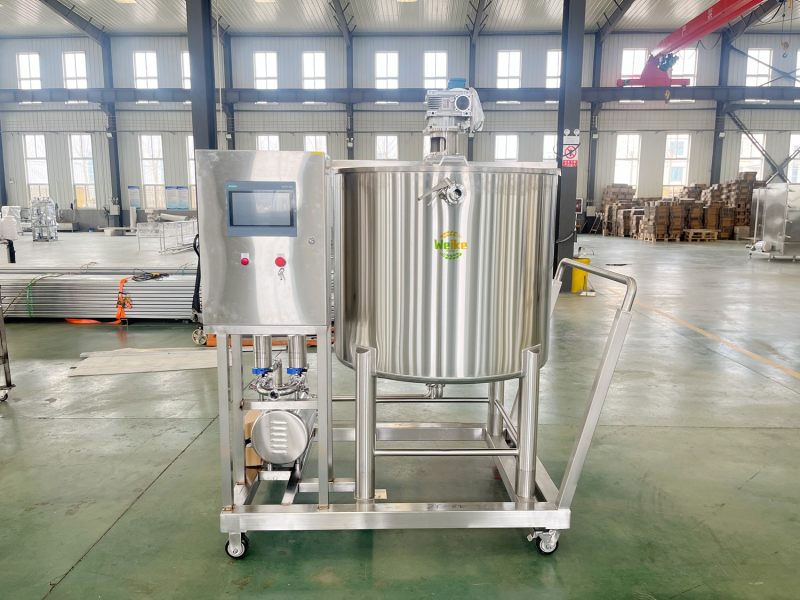
Find out where and when settling occurs
Before changing mixer speed, establish whether the problem develops during ingredient addition, while the batch is waiting, or during transfer to the filler. These are different operating conditions, and a tank that blends well at full volume may not keep solids moving as its level falls.
Compare representative samples from the top, middle and lower portions of the tank where safe sampling points are available. Also compare samples taken at the beginning, middle and end of filling. Depending on the recipe, useful checks may include visual appearance, pulp content, turbidity, soluble solids, flavor or the concentration of a critical ingredient. A soluble-solids reading alone will not necessarily reveal uneven distribution of insoluble particles.
Record agitation settings, product temperature, batch volume and hold time alongside the results. If the tank samples are consistent but the filled product is not, investigate transfer lines, the filler bowl and pauses in the filling cycle before redesigning the vessel.
Match agitation to the product, not just the tank volume
Particle size, density and shape all influence how quickly material settles. Pulp, coffee particles, spice fragments and mineral ingredients may behave differently in the same base liquid. Viscosity also changes the picture: a thicker formulation may slow settling, but it can be harder to circulate effectively.
A mixer must generate enough flow across the vessel bottom to lift settled material and enough circulation through the liquid to prevent it from accumulating again. Impeller type, diameter, position and speed work together with tank geometry. Increasing speed can help, but it is not a universal fix: excessive agitation may draw in air, produce foam, damage delicate particles or create unwanted shear.
For carbonated or oxygen-sensitive beverages, involve the process team before applying an open, vigorous mixing method. The acceptable approach depends on the formulation, dissolved gas targets and pressure-rated equipment. A recirculation loop can supplement in-tank agitation, but its pump and pipework must be suitable for the product; an aggressive pump can alter particle size or introduce other quality problems.
Look for low-flow areas in the vessel
Sediment often collects where flow is weakest: near a flat bottom, around fittings, in corners or beneath an impeller positioned too high. A deep vortex is not proof of good mixing. In some tanks, liquid rotates visibly while material close to the bottom remains undisturbed.
Baffles can improve circulation by reducing bulk rotation, but they also introduce surfaces that must be cleaned. Bottom shape, outlet position and drainability matter as well. Review the complete arrangement at both maximum working volume and the lowest level expected during filling. If the impeller becomes exposed or circulation collapses at low volume, the final portion of a batch may differ from the first.
It is also important to distinguish blending from clarification. A stackable horizontal bright beer tank is intended for beer conditioning and clarity, where allowing fine particles to settle can be useful. Its horizontal layout and cooling features address a different process objective from keeping pulp suspended in a blending vessel. Equipment selected for one duty should not automatically be assumed suitable for the other.
Control ingredient addition and holding conditions
Powders added too quickly can form clumps that resist wetting. Some ingredients also need a defined hydration period or a premix before entering the main batch. Follow the ingredient supplier’s handling guidance and validate the addition sequence against the actual recipe. Adding more mixing energy after clumps have formed may not reliably correct the problem.
Temperature deserves the same attention. Cooling or warming can change viscosity and, for some formulations, alter ingredient stability. Check suspension at the actual blending and filling temperatures rather than relying only on a room-temperature trial. If production schedules require a long hold, test the longest expected hold time, including any planned interruptions.
Continuous gentle agitation may be appropriate for some products; others may tolerate an intermittent cycle. Set the cycle through trials that include the full holding period and filling rate. Define what operators should do after an unplanned stop: for example, assess the batch, re-establish circulation and sample before release rather than assuming the original blend remains uniform.
Make sampling and cleaning part of the solution
Sampling points must produce useful evidence without creating a contamination risk. Use hygienic sampling procedures and account for product retained in a sampling valve or line. When different heights cannot be sampled safely, samples taken over the filling run can help reveal changes, although they do not pinpoint the exact location of the problem.
Settled deposits can also make cleaning less predictable. Check areas behind baffles, around seals, at the outlet and in recirculation pipework. A clean-in-place spray device is only one part of the system: coverage, flow, cleaning chemistry, time and temperature need to be verified for the installed equipment and the product residue. Inspect or test according to the plant’s validated cleaning program before releasing the tank for the next batch.
Any modification to an agitator, internal fitting or recirculation circuit should be reviewed for hygienic design and operating safety. Guard moving parts, isolate energy before maintenance and follow site procedures for confined-space entry. Pressure and relief arrangements require particular attention when working with carbonated products.
Use production trials to set acceptance limits
A useful trial represents the full process, not just a successful blend immediately after mixing. Run the intended batch size, addition sequence, temperature and hold period, then sample across the filling run. Agree in advance on acceptable variation for the properties that matter to the product. If results fall outside those limits, investigate the cause and repeat the trial after changes rather than relying on appearance alone.
When a vessel change is being considered, provide the equipment designer with the formulation characteristics, working-volume range, desired hold time, filling rate and cleaning requirements. Shandong Weike Machinery Equipment Co., Ltd designs, manufactures, installs and commissions stainless steel beverage vessels; discussing those operating details can help determine whether the need is a different mixing arrangement, a recirculation system or a change to the existing process. Confirm the final design and acceptance tests against the specific product and site requirements.