












NEWS
How tank geometry affects beverage blending performance
Tank geometry determines whether an impeller circulates the whole batch or repeatedly moves liquid through only part of it. A beverage blending tank with adequate motor power can still produce slow mixing, concentration differences, excessive air entrainment, or persistent deposits if the vessel shape and internal components are poorly matched.
The relevant geometry is not just the nominal tank capacity. Liquid height at each working volume, vessel diameter, bottom profile, impeller position, and the presence or absence of baffles all influence circulation. Their effects also change with viscosity, solids content, carbonation, and sensitivity to shear.
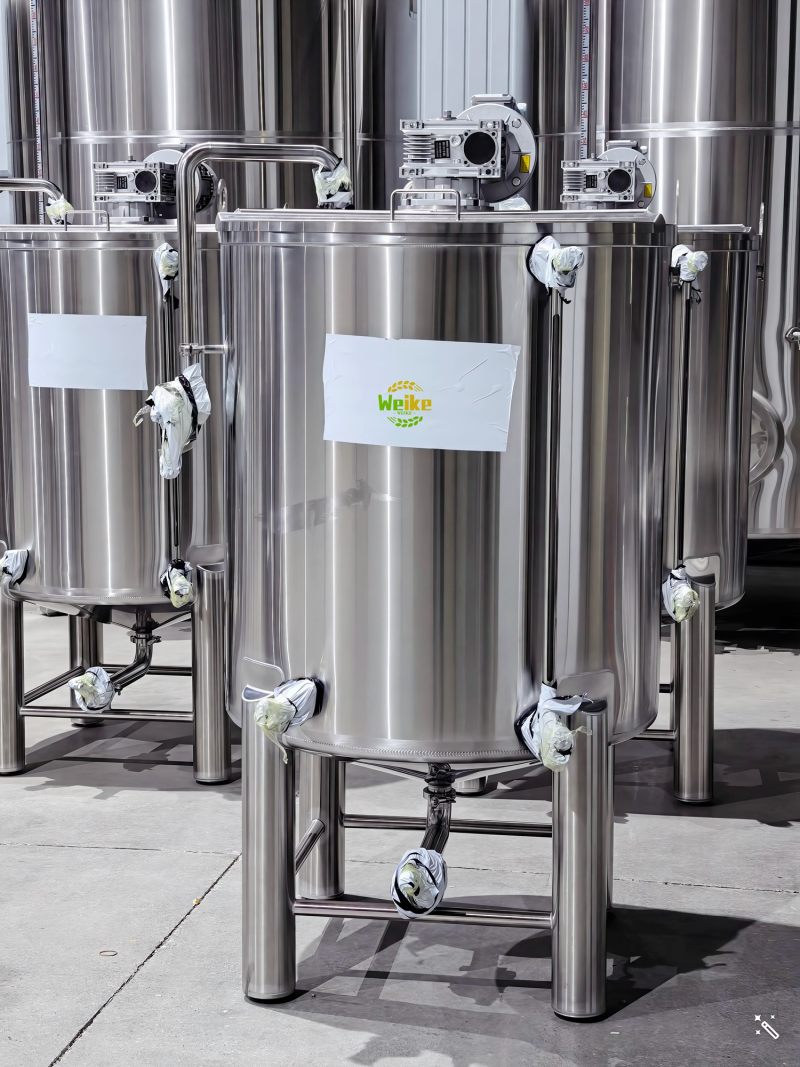
Liquid height and diameter determine the circulation path
The ratio of liquid height to tank diameter, commonly expressed as H/T, is a useful starting point for comparing vessels. Here, H is the actual liquid depth during operation, not the overall height of the tank, and T is the internal diameter. The ratio describes how far flow generated by an impeller must travel vertically relative to the vessel width.
In a tall tank, a single impeller may circulate the region near the bottom effectively while leaving the upper liquid slow to exchange with it. This becomes more consequential when ingredients are added at the top or when the product is viscous. Multiple impellers on one shaft can extend circulation through the liquid column, but their spacing, pumping direction, and interaction must be assessed together; simply adding an impeller does not guarantee uniform flow.
A wide, shallow tank presents a different problem. The impeller may have limited vertical clearance and may draw air from the surface if operated too close to it. Its flow must also reach the vessel wall and return without leaving slow-moving regions near the perimeter or bottom. A design that performs well at its maximum fill level may behave differently at a partial fill, when submergence and H/T both fall.
Tank dimensions alone therefore cannot establish mixing time. Two tanks with the same working volume can need different impeller arrangements and power inputs because their flow paths are different. When comparing proposals, the relevant dimensions are the internal diameter and the minimum and maximum operating liquid levels—not just the external height.
Bottom shape affects both circulation and emptying
A flat bottom can provide a straightforward vessel layout, but the junction between the floor and wall deserves attention. Depending on the impeller flow and product properties, material can collect in low-velocity areas around the perimeter. Rounded transitions make the internal surface easier to clean and change the flow path near the wall, although they do not eliminate the need for adequate local circulation.
A dished or conical bottom can help direct liquid toward a drain. It can also change the effective clearance beneath an impeller and the way downward flow returns into the bulk. A steep cone may improve emptying while creating a deep central region that needs separate consideration for mixing and cleaning. For products containing pulp or suspended particles, an emptying benefit should not be confused with proof that solids remain suspended throughout the batch.
Bottom clearance should be specified against the actual profile, rather than an assumed flat datum. A low impeller can improve movement near the outlet but may also increase localized shear or interact unfavorably with the cone. A higher impeller may improve bulk circulation while leaving settled material below it. The acceptable compromise depends on whether the duty is dissolving ingredients, blending liquids, suspending solids, or gently homogenizing a finished product.
Impellers and baffles work as a system
An axial-flow impeller directs a substantial portion of its flow along the shaft and can support top-to-bottom circulation. A radial-flow impeller sends more flow outward toward the wall, creating a different pattern and potentially stronger local shear near the impeller. Actual performance depends on blade design, speed, clearance, and fluid properties; the flow label alone is not enough to predict beverage quality or mixing time.
Impeller diameter relative to tank diameter affects both reach and operating conditions. A larger impeller running more slowly can be a useful option when bulk circulation is needed without the high tip speed associated with a smaller, faster rotor. It is not automatically gentler in every respect: local shear, power draw, and the product’s exposure time still matter. Speed range and torque should be checked against the most demanding viscosity and fill condition, not just against water.
In an unbaffled vessel with a centrally mounted vertical agitator, liquid can rotate with the impeller rather than exchange efficiently between regions. A vortex may develop, potentially drawing surface gas into the batch. Vertical baffles interrupt this rotational motion and can improve bulk circulation, but they also increase resistance and power demand. Their number, width, clearance, and attachment affect both hydrodynamics and cleanability.
Baffles are not universally desirable. A product sensitive to oxygen pickup, foam, or shear may require a different arrangement, such as an offset or angled agitator, lower operating speed, or a controlled surface. Any alternative should be evaluated for actual circulation rather than assumed to mix well simply because it suppresses a visible vortex.
Variable fill level changes more than capacity
A vessel used across a broad batch-size range must maintain adequate impeller submergence at the lowest level while still circulating the full liquid height at the highest. Low fill can expose an upper impeller, increase surface disturbance, or leave a spray device poorly positioned for the operating configuration. High fill can extend the circulation path beyond what one impeller can handle effectively.
A floating-lid wine vessel illustrates why variable capacity and variable-volume blending are separate design questions. The 2000L variable capacity tanks have a stated diameter of 1,300 mm and use a floating lid to limit headspace during wine storage. Those dimensions do not establish an effective mixing range: an agitator arrangement, lid compatibility, minimum liquid depth, and circulation performance would need separate definition. A floating lid may constrain shaft entry, ingredient addition, cleaning access, and safe movement of the lid.
Product properties change the geometric compromise
For low-viscosity syrups diluted into water, the main question may be how quickly concentrated liquid is transported away from the addition point and distributed through the batch. A surface addition made into a weakly circulating zone can form a local concentration layer even when the liquid appears to be moving. Locating the addition point in a well-circulated region, without causing splashing or air entrainment, can be as important as changing the tank shape.
For pulp-containing juice or other solids-bearing beverages, uniformity includes particle distribution as well as dissolved concentration. Bottom geometry and impeller clearance influence whether particles settle, accumulate around an outlet, or circulate through the vessel. Particle size, density, and fragility matter: the flow needed to suspend heavy particles may damage softer pieces or increase foam in the liquid phase.
For viscous concentrates, circulation can become localized around the impeller while distant material moves slowly. Raising speed may increase heat and shear without proportionately improving exchange throughout the tank. A larger impeller, a different impeller type, additional mixing stages, or a revised dilution sequence may be necessary, subject to verification with the actual formulation.
Carbonated beverages introduce another constraint. Agitation, pressure changes, and free-surface disturbance can promote CO₂ release; open-vortex mixing can also introduce oxygen. Geometry should therefore be considered alongside operating pressure, temperature, headspace control, and the sequence of blending and carbonation. A storage vessel or floating lid should not be assumed suitable for pressurized service without a documented pressure rating and appropriate protection.
How to compare geometric designs on a common basis
A meaningful comparison defines the duty before comparing tank drawings: operating volume range, liquid properties at mixing temperature, ingredient addition sequence, required uniformity, allowable mixing time, and limits on oxygen pickup, foam, or shear. The proposed internal arrangement can then be assessed against the same conditions.
Useful design information includes internal diameter; liquid levels at minimum and maximum volume; bottom profile; impeller diameter, type, speed range, and clearances; baffle dimensions; motor power and torque; and the location of addition and withdrawal points. For a multi-impeller shaft, the positions and pumping directions of each impeller should be shown. Nominal motor power by itself is not evidence that the batch will blend uniformly.
Acceptance criteria should describe the product outcome. For a soluble ingredient, samples from defined locations and times can be compared against an agreed concentration tolerance. A solids-bearing product may require particle-distribution checks as well. Sample locations and the sampling method must avoid creating a misleadingly uniform result near the impeller or outlet. Testing with water can reveal circulation patterns, but it cannot by itself establish performance for a viscous, foaming, or particulate beverage.
Cleaning is part of the same geometry decision. Baffles, shafts, seals, underside surfaces, and floating-lid components can create areas that a rotary spray device does not adequately wet. Spray coverage, drainage, and inspection access need to be evaluated in the installed configuration. A tank that mixes effectively but retains product or cleaning solution in inaccessible regions has not solved the complete blending duty.