












NEWS
How to choose an agitator for a beverage blending tank
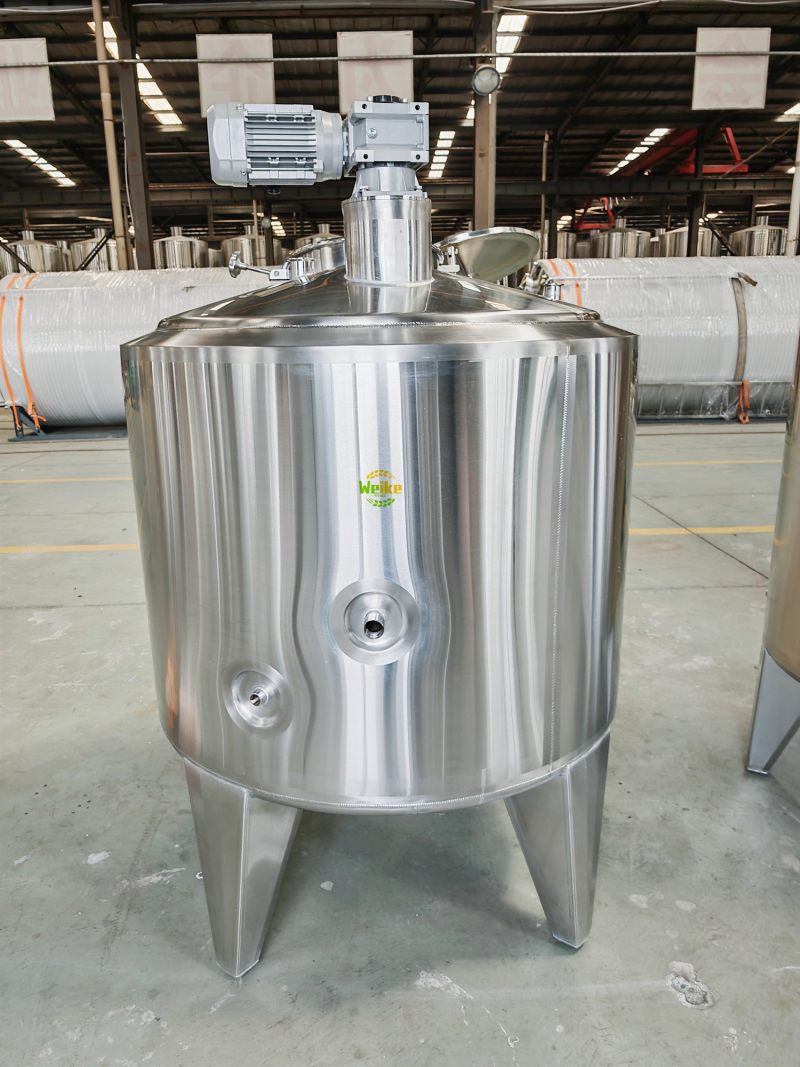
Choosing the right agitator for a beverage blending tank is essential to achieving consistent product quality without excessive shear, aeration, or energy use. The best choice depends on the beverage’s viscosity, ingredients, mixing objectives, tank geometry, and required processing time. From gentle blending of juice to suspending particles or dissolving powders, each application demands a different balance of impeller design, speed, and motor power. This guide explains the key technical factors to evaluate when specifying an agitator for your beverage production process.
Start with the mixing duty, not the motor
A motor rating alone says little about how well a tank will blend. The first question is what must happen inside the vessel: liquids may need to reach a uniform concentration, powders may need to be wetted and dissolved, or fruit particles may need to remain suspended until filling. These duties require different flow patterns and can impose conflicting demands on the product.
For a thin juice blend, the priority may be bulk circulation with minimal surface disturbance. A beverage containing pulp needs sufficient movement near the bottom as well as enough circulation to prevent settling. A viscous syrup may require stronger movement close to the wall, particularly if heating or cooling is involved.
Define the endpoint before comparing equipment. “Well mixed” should translate into an agreed test: for example, samples from several tank locations meeting a specified concentration range within a target time. For particles, the relevant test may be whether the discharge remains acceptably uniform throughout filling, not merely whether the tank looks active.
Match the impeller to the product
Axial-flow impellers, including pitched-blade and hydrofoil designs, move liquid along the shaft direction and are often considered for blending low- to moderate-viscosity beverages. They can generate useful top-to-bottom circulation without relying on extreme speed. Their suitability for particle suspension still depends on particle size, density, concentration, and the tank bottom.
Radial-flow impellers direct more flow outward toward the tank wall and can produce stronger local shear. They may be useful where dispersion is needed, but stronger shear is not automatically desirable for delicate pulp, foaming ingredients, or oxygen-sensitive products. A visible vortex is not proof of effective mixing; it can instead pull gas into the liquid.
Anchor or helical designs are worth evaluating for more viscous products, where a small, fast impeller may circulate only the liquid immediately around it. These larger, slower-moving designs can improve movement near the vessel wall, although clearance, viscosity changes, and cleanability must be reviewed together.
Powder addition deserves separate attention. An agitator that blends liquids may not wet a floating powder quickly enough to prevent lumps. Depending on the formulation and batch size, a dedicated powder induction or high-shear mixing step may be more suitable than increasing the speed of the main tank agitator.
Check the vessel geometry and working volume
Impeller diameter, height above the bottom, shaft position, liquid depth, and vessel shape affect the flow as much as impeller style. A design that performs at a full batch may leave the impeller partly exposed at minimum fill, causing splashing or gas entrainment. A tall liquid column may require more than one impeller to avoid poorly mixed zones.
Baffles can interrupt swirling and improve circulation in some centrally mounted systems, but they also add surfaces that must be cleaned and inspected. For a shear-sensitive or highly viscous product, their value should be assessed rather than assumed. An offset or angled mounting arrangement may be another option, subject to mechanical and process review.
Provide the supplier with both minimum and maximum operating volumes, not just nominal tank capacity. Include the bottom profile, available mounting locations, internal fittings, and any jacketed area that depends on liquid movement for heat transfer.
Control oxygen, foam, and carbon dioxide
Some beverages tolerate vigorous surface movement; others lose quality when exposed to oxygen or excessive foam. For oxidation-sensitive juice, wine, or finished beer, consider how the ingredients enter the tank, whether the vessel can be closed or inerted, and whether the impeller remains submerged throughout the process. A variable-frequency drive can help operators adjust speed, but it does not compensate for poor impeller placement.
Carbonated beverages need additional caution. Agitation, pressure changes, and warm spots can encourage carbon dioxide to leave solution, creating foam and complicating filling. Confirm the operating pressure and temperature, seal arrangement, and relief provisions for the complete vessel. Do not assume that an agitator designed for an atmospheric blending tank is suitable for a pressurized process.
In some stages, mixing is not the objective at all. For example, the 1000L beer conditioning tank is intended for duties such as conditioning, carbonation, and static clarification. Its SUS304 construction and glycol jacket address storage and temperature control; they should not be interpreted as evidence that it includes an agitator. If both blending and clarification are required, assess whether separate vessels or a specifically engineered combined arrangement make more sense.
Size the drive for the hardest operating condition
Ask for an agitator design that covers the most demanding credible condition, which may occur during startup, powder addition, low-temperature processing, or at the highest expected viscosity. Motor power, gearbox torque, shaft strength, and seal selection must be considered together. A motor that can sustain steady operation may still struggle to start a thick batch.
Share viscosity data at the relevant temperatures and, where available, at representative shear rates. Some beverages do not behave like water: apparent viscosity can change as they are mixed. If the formulation is uncertain or contains delicate solids, a pilot trial or supplier test with representative product can reduce the risk of specifying the wrong impeller.
Also check the proposed speed range against the mechanical design. Shaft vibration, impeller loading, and gearbox limitations matter, especially in tall tanks or systems with multiple impellers. Request the basis for the proposed power and torque rather than comparing quotations on motor size alone.
Make cleaning and maintenance part of selection
An agitator adds a shaft, impeller surfaces, a mounting interface, and potentially a mechanical seal to the sanitary design. Review product-contact materials, weld finishes, drainability, and access for inspection. SUS304 is used for many beverage applications, but material and seal compatibility should be confirmed against the formulation, cleaning chemicals, and operating conditions.
For clean-in-place systems, verify that spray devices can reach the underside of the impeller, shaft connection, and areas behind internal fittings. Coverage and cleaning effectiveness need to be validated for the installed arrangement; a spray ball alone does not guarantee that every surface is clean. Consider how the seal will be maintained and whether the drive and shaft can be removed with the available headroom.
What to agree before placing the order
A useful specification combines the recipe and process conditions with a measurable acceptance method. Alongside vessel drawings, provide ingredient order, batch volumes, temperature range, particle characteristics, target mixing time, and limits for foam or oxygen pickup. Agree how samples will be taken and what happens if the specified result is not achieved during commissioning.
Shandong Weike Machinery Equipment Co., Ltd. designs, manufactures, installs, and commissions stainless steel vessels for beverage applications. When discussing a project with a tank manufacturer, involve both the vessel and agitator design teams early: shaft supports, cleaning devices, pressure requirements, and maintenance access are difficult to resolve after the tank layout is fixed. Confirm the scope of commissioning, documentation, spare parts, and after-sales service for the specific order.