












NEWS
Harvesting Yeast from a Conical Beer Fermenter Without Excess Trub
Harvesting Yeast from a Conical Beer Fermenter Without Excess Trub
Harvesting yeast from a conical beer fermenter can reduce brewing costs and support consistent fermentation—but collecting too much trub makes the next pitch harder to control. The challenge is not simply draining the cone. It is removing settled debris, controlling slurry flow, and deciding which fraction is worth keeping. A cleaner-looking crop is useful, but appearance alone cannot confirm yeast health or microbiological purity.
A reliable harvesting routine separates waste removal from yeast collection. It also gives operators clear stopping points, rather than encouraging them to recover every possible litre of slurry.
The cone collects solids; it does not sort them perfectly
Trub includes wort-derived protein material, hop particles, and other settled debris. After fermentation, the cone also contains yeast with varying condition and flocculation behaviour. These materials overlap rather than forming perfectly distinct layers. Strain, wort clarification, dry hopping, temperature changes, and previous dumps all affect what reaches the bottom outlet.
The first discharge often contains compacted debris and yeast that is less desirable for repitching. A later, more uniform fraction may provide a better crop. However, “discard the first portion and keep the middle” is only a starting principle—not proof of quality. Dark beer can produce darker slurry, while pale slurry can still contain contamination or a high proportion of nonviable cells.
If excessive trub repeatedly enters the harvest, review upstream wort separation as well as the fermenter procedure. A bottom valve cannot compensate fully for heavy kettle-solids carryover.
Choose the harvest window around the beer and yeast strain
Use fermentation records to establish timing. For many bottom-harvesting routines, collection follows the required attenuation and maturation checks, once sufficient yeast has settled. There is no universal harvest day: a highly flocculent ale strain and a slower-settling lager strain will not behave identically.
Where the brewery’s validated procedure includes an early trub dump, keep it controlled and limited. Removing too much sediment during active fermentation can also remove useful yeast. Record what was discharged and whether fermentation performance changed afterward.
For heavily dry-hopped beer, harvesting before hop addition is often preferable when fermentation status and the production schedule allow it. Otherwise, hop debris may complicate both separation and cell counting. Cold conditioning can encourage settling, but prolonged storage in the cone is not a substitute for a planned collection window.
Separate the waste dump from the usable crop
Before opening the outlet, prepare a cleaned and sanitized collection vessel, sanitary transfer connections, and a separate waste destination. Clean first, then sanitize using the brewery’s validated chemical concentration and contact time. External valve surfaces and fittings need attention too; a clean tank does not make a dirty hose safe.
Confirm tank pressure, receiver pressure rating, and the approved transfer arrangement. Never transfer pressurized slurry into an unvented, non-pressure-rated container. Keep pressure within equipment limits, manage carbon dioxide exposure, and use suitable ventilation. Cooling or draining must not create an uncontrolled vacuum in the fermenter.
- Open the bottom valve gradually and discharge the initial compacted material to waste. Avoid a sudden full opening that can disturb the sediment bed and pull beer through a narrow channel.
- Observe successive small fractions through a sanitary sight glass or approved sampling arrangement. Look for a transition from debris-rich material to a more consistent yeast slurry.
- Switch to the sanitized collection path without exposing product-contact surfaces. Collect controlled fractions rather than one large, unexamined volume.
- Stop when the discharge becomes substantially thinner, beer loss increases, or unwanted solids reappear. If flow becomes irregular, close the valve and reassess rather than forcing the harvest.
The useful flow rate depends on cone geometry, outlet size, slurry consistency, and pressure differential. A slow, steady discharge generally gives operators more control than a forceful dump. Do not improvise pressure increases to clear a blockage; follow the equipment procedure.
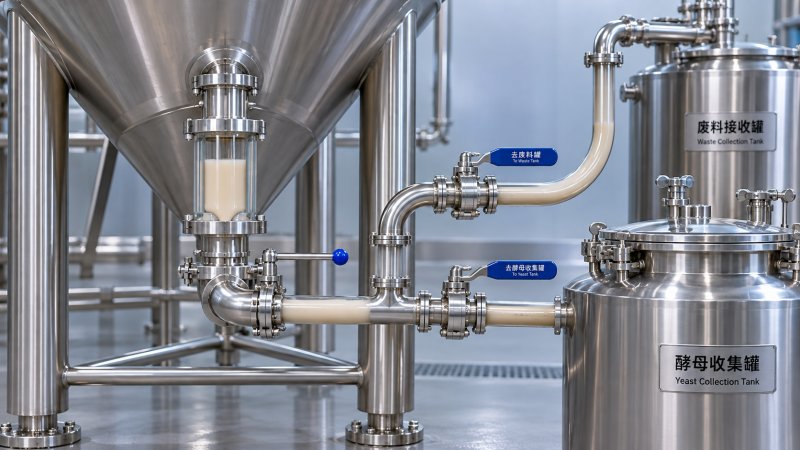
A useful process illustration should show the cone outlet, observation point, waste path, and closed collection vessel. Those connection details matter more than a photograph of the tank exterior.
Judge the crop before calculating the next pitch
Keep the harvested yeast identifiable by strain, source batch, collection time, generation, and storage conditions. Review the source beer’s attenuation, fermentation speed, and sensory results. An unexplained slow fermentation or suspected contamination is a reason to quarantine the crop, even if it looks normal.
Where laboratory capability is available, assess cell concentration, viability, and microbiological purity using established methods. Viability measures living cells; it does not fully describe vitality or likely fermentation performance. Representative sampling matters because dense slurry can settle quickly and produce misleading counts if sampled unevenly.
Calculate the next pitch from viable cell concentration, wort volume, wort strength, and the brewery’s strain-specific target—not slurry volume alone. Excess trub occupies volume without supplying fermenting cells, so two equally sized containers may deliver very different pitches.
Store the crop promptly under the brewery’s validated cold-storage conditions, with safe management of any gas produced. Minimize holding time. Routine water rinsing or acid treatment should not be used as an improvised cure for a poor harvest; additional handling can introduce contamination or damage yeast.
When the equipment limits separation
Repeated bridging, sudden beer breakthrough, or difficult cleaning may indicate a hardware issue. Review cone geometry, outlet bore, valve configuration, drainability, and access for inspection. Ask how the complete bottom assembly is cleaned, not merely whether the vessel has a polished interior. Seals, branches, and fittings can retain residue even when the main shell looks clean.
Shandong Weike Machinery Equipment Co.,Ltd designs, manufactures, installs, and commissions stainless steel vessels for brewing and other food and beverage processes. Its Jinan facility covers over 15,000 square metres, and the company states that it provides five years of after-sales service. For a harvesting application, the practical discussion should centre on sanitary outlet design, pressure limits, cleaning verification, and access to replacement seals.
Its broader range includes Stainless steel Canola Oil storage tanks, offered in SUS304 or SUS316L with customizable designs. These are edible-oil storage vessels, not substitutes for a conical beer fermenter. The relevant overlap is hygienic fabrication; fermentation-specific cooling, pressure control, and yeast outlets require separate engineering confirmation.
For the next harvest, record the waste fraction, accepted crop, cell-count results, and subsequent fermentation performance. Use that record to refine valve control and collection timing. The goal is not the largest harvest—it is enough suitable yeast for a predictable next fermentation, without unnecessary solids or beer loss.