












NEWS
Beer Fermenter Pressure Ratings: What to Verify Before Spunding
A beer fermenter is suitable for spunding only when its documented pressure limits, installed components, and pressure protection support the intended operating conditions. Stainless steel construction, a sealed lid, or a successful batch under pressure cannot establish that suitability. If the vessel’s identity and allowable working pressure cannot be traced to reliable documentation, retaining fermentation-generated CO₂ should remain outside its approved operating procedure.
For quality control and safety teams, the decision rests on three checks: what pressure the complete assembly can withstand, how excess pressure will be relieved, and whether fermentation, cooling, transfer, and cleaning remain within the approved limits. The spunding setpoint is one input to that review; it is not the vessel’s pressure rating.
Establish what the pressure rating actually covers
Start with the vessel nameplate and its supporting records. Match the serial number or equipment identifier to the manufacturer’s documentation. The records should establish the allowable pressure at the relevant temperature, the design basis, and any restrictions on service. Confirm whether pressure values are gauge or absolute, and keep units consistent across the operating procedure, instruments, and valve specifications.
Several numbers may appear in a quotation or equipment file: design pressure, maximum allowable working pressure, test pressure, and recommended operating pressure. They serve different purposes. A pressure test demonstrates performance under specified test conditions; its test pressure does not authorize routine operation at that value. Where terminology differs between standards or manufacturers, obtain a written explanation of the permitted operating limit.
The rating must also cover the configuration installed in the brewery. A vessel shell may have documented pressure capability while a replacement lid, manway closure, sight glass, or added fitting has a lower limit. Review the complete pressure boundary, including connections to equipment that will experience the same pressure. Ratings for clamps, gaskets, and ferrules depend on the assembly and service conditions; a component’s material grade alone is insufficient.
- Vessel records: identification, allowable pressure and temperature, applicable design standard, and inspection or conformity documents.
- Closure and fittings: pressure suitability of the manway, lid, clamps, valves, sight glasses, instrument connections, and seals.
- Separate pressure spaces: independent limits for the product chamber and cooling jacket, including any restrictions on pressure differences between them.
- Equipment history: repairs, welded additions, replacement parts, corrosion, deformation, or other changes that may affect the original rating.
Hygienic design and pressure integrity require separate evidence. A polished interior, food-contact suitability, or clean-in-place capability can support sanitation, but none establishes permission to retain CO₂. An atmospheric storage vessel cannot be converted into a pressure-rated fermenter simply by fitting a spunding valve.
Read certification in the context of the installation
A statement such as “certified tank” is incomplete unless it identifies the standard, the equipment covered, and the supporting documentation. ASME Boiler and Pressure Vessel Code Section VIII and the European Pressure Equipment Directive are examples of frameworks that may be relevant, depending on the destination and equipment classification. They have different roles: a construction code and a regulatory conformity framework should not be treated as interchangeable labels.
For a brewery, the practical question is whether the supplied documentation satisfies the requirements applicable at the installation site. Construction certification may need to be accompanied by registration, installation examination, or periodic inspection under local rules. A conformity mark on one accessory does not establish conformity of the entire fermenter assembly.
Ask for documents tied to the specific vessel rather than a general company certificate. Depending on the applicable framework, the evidence may include a manufacturer’s data report, declaration of conformity, material traceability, welding records, examination records, and pressure-test documentation. The required package varies; collecting every possible certificate is less useful than establishing which requirements apply and whether the records satisfy them.
Changes after delivery deserve the same scrutiny. Adding a welded port, altering a closure, or replacing a pressure accessory can affect the original design assumptions. Have the responsible manufacturer or a suitably qualified pressure-equipment specialist assess changes before returning the vessel to pressure service.
Separate pressure control from overpressure protection
The spunding valve controls fermentation pressure by releasing gas around an adjustable setpoint. The pressure relief device protects the equipment when pressure control fails or cannot handle the gas flow. A brewery should not assume that a spunding valve fulfills both functions unless its documented design, capacity, and acceptance under the applicable requirements explicitly support that use.
The operating setpoint needs sufficient separation from the protective relief setting to accommodate control variation and process fluctuations. The protective setting must comply with the vessel’s allowable limit and governing requirements. Any permitted pressure accumulation during relief belongs to the applicable engineering rules; it should never be treated as extra operating headroom.
Relief capacity matters as much as opening pressure. A valve that opens at the correct pressure may still be inadequate if it cannot discharge the credible incoming flow. Review fermentation gas generation, connected CO₂ supplies, regulator failure, and other applicable pressure sources. Capacity selection should use the relevant relief-device data and engineering method, including discharge conditions and backpressure.
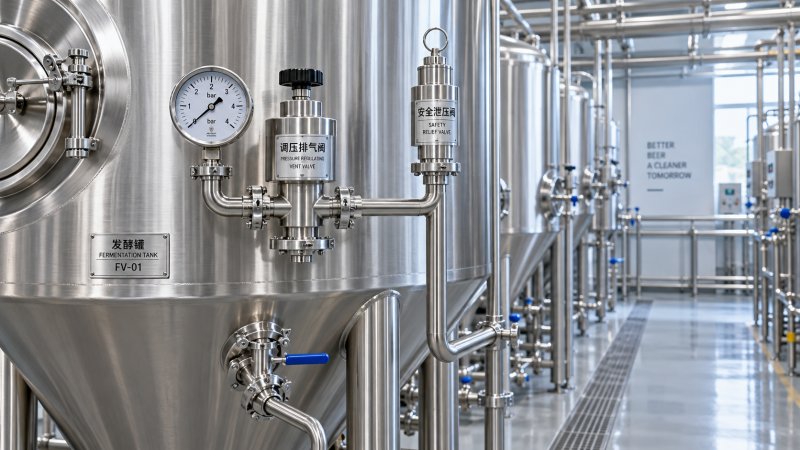
Follow the entire relief path from the vessel connection to the discharge point. Foam, yeast, hop material, dried deposits, or cleaning residues can obstruct a small passage. An isolation valve can also defeat protection if its position is not controlled through an accepted arrangement. Discharge piping must support the device’s operation and route released CO₂ safely; an extension hose is not automatically harmless.
Maintenance should follow the device manufacturer’s instructions and applicable inspection requirements. Keep records of identification, setting, examination, servicing, and replacement. A clean appearance does not demonstrate correct opening pressure or discharge capacity. Avoid improvised compressed-gas tests: pneumatic testing introduces stored-energy hazards and requires a controlled procedure.
Approve the whole operating cycle before the first spunded batch
Pressure suitability can change during a batch even when the spunding setpoint stays fixed. Cooling increases CO₂ dissolution and can reduce headspace pressure. Draining or pumping out beer can also create vacuum if gas cannot enter adequately. A vessel rated for positive pressure may have little or no allowable vacuum, so cold crashing and transfer need their own protection strategy.
Check the documented vacuum limit and the suitability of any vacuum relief device or controlled gas supply. Where product quality requires oxygen exclusion, address that requirement within the approved pressure and vacuum arrangement. An unprotected sealed vessel should not become the method for preserving an oxygen-free headspace.
Cleaning introduces another set of conditions. Temperature changes, steam condensation, chemical compatibility, and jacket operation may impose loads outside fermentation conditions. Procedures should specify depressurization and safe isolation before opening closures or dismantling fittings, with a reliable means of establishing that trapped pressure has been released.
Quality control also has a role in setting the operating window. Retaining CO₂ can affect fermentation behavior and carbonation, so pressure schedules should be assessed alongside yeast performance, attenuation, temperature, and the intended beer specification. Meeting the vessel’s mechanical limits does not by itself validate the brewing process.
Before release to production, record the approved pressure range, spunding setting, relief arrangement, vacuum safeguards, instrument checks, and operator response to abnormal pressure. Gauge calibration must be appropriate to the operating range, and operators need clear instructions for a rising pressure trend, blocked venting, or disagreement between instruments.
A complete approval record should let the next shift answer three questions without interpretation: what limit applies to this installed vessel, what protects it if pressure control fails, and what action is required when operation leaves the approved range. If any answer depends on an undocumented assumption, resolve that gap before closing the fermenter for spunding.