












NEWS
Beer Fermenter Sizing: Matching Working Volume to Brewhouse Output
Size a beer fermenter around the cold wort delivered to the vessel, the intended number of brews per fill, and the headspace required by the fermentation process. A nominal capacity alone cannot establish whether a tank fits the brewhouse. The specification must identify both the usable liquid volume and the total internal volume, with enough detail to confirm cooling performance at the planned fill levels.
Start with measured transfer volumes across the recipes that will use the tank. Then assess the filling schedule and the time each vessel remains occupied. These two calculations determine different things: how large each fermenter needs to be, and how many fermenters production requires.
Establish the volume that actually reaches the fermenter
Brewhouse capacity labels can refer to kettle volume, hot wort output, or a target batch size. None should automatically become the fermenter working-volume requirement. Wort retained with trub, liquid left in transfer lines, and temperature-related volume changes create differences between these figures.
Use a consistent measurement point: cold wort delivered after the heat exchanger, expressed at a stated temperature. If that volume is measured directly, do not subtract upstream transfer losses again. Where only kettle measurements are available, reconcile them with downstream delivery before selecting a tank.
Recipe variation matters. A heavily hopped wort can leave more liquid with kettle solids, while a different brew length or gravity target changes the amount delivered. Establish the expected range rather than relying on one successful brew. The upper end governs capacity; the lower end tests whether the tank can control temperature during smaller fills.
Required liquid capacity = cold wort per brew × brews per fill + subsequent liquid additions.
Subsequent additions include yeast slurry and any planned liquid ingredients that materially increase volume. Packaged beer yield belongs in a separate calculation: yeast removal, sampling, and downstream losses reduce saleable output, but they do not reduce the initial space required for fermentation.
Translate working volume into total vessel capacity
Ask what the quoted capacity includes. A designation such as “20 hL fermenter” could describe working volume or total internal volume. Drawings should identify the liquid level corresponding to the specified working volume, including liquid held in the cone. External dimensions do not establish usable capacity.
Headspace must accommodate foam and fermentation gas without allowing product to obstruct the gas outlet. Its requirement changes with yeast behavior, wort composition, fermentation temperature, and the intended pressure regime. An aggressive fermentation and a restrained fermentation do not necessarily justify the same maximum fill level.
When headspace is expressed as a fraction of total volume, use:
Total internal volume = required liquid volume ÷ (1 − headspace fraction).
For an illustrative calculation, suppose each brew delivers 1,000 L of cold wort and the fermenter receives two brews. Ignoring additions for this example, the liquid requirement is 2,000 L. If the process specification reserves 20% of total volume as headspace, total internal volume must be at least 2,500 L. These assumed values demonstrate the calculation; they are not a universal fermentation allowance.
The percentage basis matters. Adding 20% to 2,000 L produces a 2,400 L tank, where the empty space represents only 16.7% of total volume. State explicitly whether an allowance is a percentage of liquid volume or total tank volume.
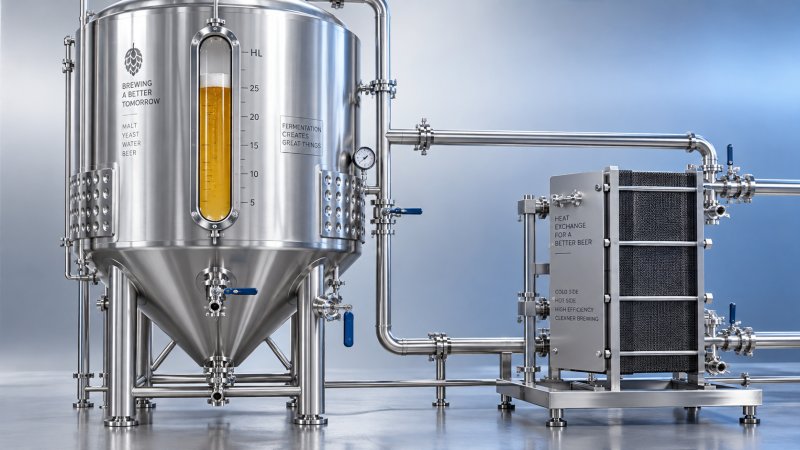
Confirm how the upper liquid level relates to the gas outlet, spray device, and other internal fittings. Extra shell volume is useful only when the vessel layout preserves the required fermentation clearance. Foam control also requires suitable gas-handling arrangements; headspace alone cannot compensate for a restricted blow-off path.
Multiple-batch filling changes the operating envelope
A fermenter holding two brews reduces the number of vessels needed for a given production volume, but it ties tank utilization to the ability to deliver compatible brews within an acceptable filling window. A delayed second brew leaves the tank partially filled while fermentation conditions are already changing.
Define the maximum interval between transfers alongside yeast pitching and wort aeration procedures. Later additions introduce fresh wort into a vessel containing developing fermentation. Their temperature, oxygen input, and timing therefore need a defined process basis. Filling across separate production days requires assessment beyond simply doubling the brewhouse output.
The first brew must also reach enough cooling surface for temperature control. A tank designed around a full two-brew charge might perform poorly at half fill if the liquid sits below much of the jacket. Request the minimum supported operating volume and identify which jacket zones remain effective at that level.
Compare the arrangements against the production schedule:
Calculate tank count from the complete occupancy cycle
Fermentation duration alone understates vessel occupancy. Include filling, fermentation, any maturation performed in the same tank, cooling, transfer, cleaning, and preparation for the next fill. Where beer moves to a separate conditioning vessel, use the actual fermenter release point.
Baseline tank count = fermenter fills per week × occupancy days ÷ 7. Round upward, then test the result against a calendar. Average capacity does not reveal conflicts between scheduled brew days and tank release times.
For example, four brews per week combined into two-brew fills create two fermenter fills weekly. With an assumed 21-day occupancy, six tanks provide the theoretical steady-state capacity. That calculation includes no spare capacity for an extended fermentation, maintenance, or a delayed transfer. A workable schedule must show when each tank becomes clean and available.
For a mixed beer portfolio, calculate occupancy by recipe and intended tank assignment. A long-residence beer can block a large vessel needed for several shorter cycles. Increasing individual tank size will not resolve that conflict if compatible brews cannot be grouped or downstream storage delays tank release.
Require drawings and performance data that support the volume claim
Two vessels with the same working volume can differ in height, diameter, cone geometry, and jacket area. A taller liquid column changes hydrostatic pressure at the bottom. Geometry also affects yeast collection and the relationship between liquid level and cooling surfaces. Increasing capacity therefore requires more than scaling the volume label.
Cooling assessment should cover fermentation heat removal and the intended cooling-down schedule. Specify glycol supply conditions, available flow, jacket zoning, and the minimum and maximum fills. A cooling claim established at full volume does not demonstrate control during a single-brew fill in a larger vessel.
Stainless construction, polished interiors, and cleaning fittings also do not establish fermentation suitability. A plant vegetable edible oil storage tank can include a glycol jacket, conical discharge, and CIP cleaning ball, yet those features alone establish neither fermentation headspace nor suitability for the intended pressure duty. Storage-vessel specifications cannot substitute for a fermenter's defined operating envelope.
The final sizing specification should connect the required cold-wort volume to a marked working level, reserved headspace, supported minimum fill, and maximum filling interval. Include pressure and vacuum design limits consistent with fermentation, cooling, transfer, and cleaning conditions. Installation drawings must also show clearance for access and fittings: sufficient tank volume is of little practical value if the proposed vessel cannot be installed or serviced in the available space.