












NEWS
Beer Fermenter Not Reaching Cold-Crash Temperature? Trace the Cause
Beer Fermenter Not Reaching Cold-Crash Temperature? Trace the Cause
When a beer fermenter fails to reach its cold-crash temperature, extending the cooling cycle may hide the fault rather than solve it. Effective troubleshooting starts with separating refrigeration capacity issues from glycol flow restrictions, temperature-sensor errors, and poor heat transfer at the tank jacket. Before adjusting setpoints or replacing components, trace the cooling path from the chiller to the fermenter and verify what the temperature readings actually represent.
The useful question is not simply, “Why is the beer warm?” It is, “Where does the available cooling stop reaching the beer?” A tank that cools normally at fermentation temperature but stalls near its cold-crash target can have a different problem from one that barely cools at all.
Confirm the temperature before chasing the cooling system
Record the target, displayed beer temperature, cooling demand, batch volume, starting temperature, and elapsed cooling time. Note whether the temperature is still falling slowly or has reached a stable plateau. Compare against previous batches only when fill level, starting conditions, and simultaneous cooling loads are reasonably similar.
Check the controller reading against a calibrated reference using a hygienic, approved measurement method. A cold sample can warm during collection, so a casual sample reading is not automatically a reliable calibration check. Inspect the RTD wiring, controller input configuration, probe insertion, and thermowell condition. Poor thermal contact or a probe positioned above the liquid level can misrepresent the batch temperature.
Also verify that the controller actually requests cooling. An incorrect operating mode, output assignment, interlock, or deadband can leave the valve closed even though the displayed temperature exceeds the intended target.
Before intrusive work: isolate electrical energy and depressurize the relevant circuit according to site procedures. Cooling beer can reduce tank pressure through gas contraction and increased CO₂ dissolution. Confirm the approved pressure or vacuum protection arrangement; do not improvise by opening a manway or bypassing protective devices.
Find out whether the fault is shared or local
If several tanks struggle at the same time, investigate the common chiller, glycol reservoir, circulation pump, and distribution header. If one fermenter stalls while comparable tanks cool normally, its branch piping, control valve, jacket circuit, or sensor deserves closer attention. This distinction narrows the search, although it does not prove the cause.
Measure glycol temperature at the chiller outlet and at the affected tank inlet while cooling is demanded. Add the jacket outlet reading and, where available, actual branch flow. Measurements should reflect the circulating fluid; uninsulated pipe-surface readings can be distorted by room temperature and poor sensor contact.
Follow the physical circuit: reservoir, pump, supply header, branch valve, jacket inlet, jacket outlet, and return header. Confirm that the installed routing matches the approved drawing, including any separate jacket zones.
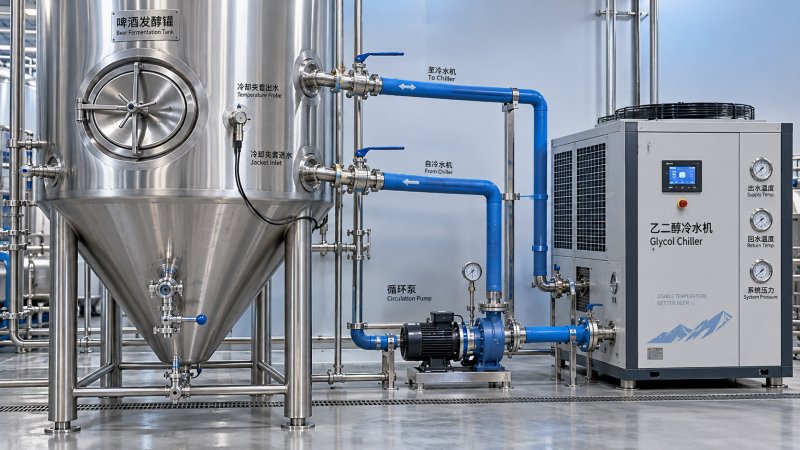
Glycol reaching the jacket must be colder than the intended beer temperature by a sufficient margin to transfer heat. As beer approaches the glycol temperature, cooling slows. There is no universal supply-temperature setting: check the tank design, chiller operating limits, glycol properties, and risk of localized beer freezing.
Separate refrigeration capacity from glycol delivery
A chiller that maintains its supply setpoint under light demand may lose ground when several tanks enter cold crash together. Check whether the reservoir temperature rises during the problem period and whether the refrigeration system runs continuously without recovering. Review capacity at the actual glycol temperature and ambient conditions—not merely the nominal rating.
Inspect condenser cleanliness, airflow clearance, fan operation, and recorded alarms. Refrigerant-circuit diagnosis belongs with qualified refrigeration personnel. Where production permits, staggering cooling loads can help test whether simultaneous demand is the limiting factor; it does not establish that the chiller is correctly sized.
If supply glycol remains suitably cold but the beer fermenter stalls, check delivery:
- Confirm the control valve physically opens, rather than relying only on the controller output indicator.
- Inspect isolation valves, strainers, hoses, and check valves for restrictions or incorrect installation.
- Compare pump performance with the required flow and system resistance; a running motor does not prove adequate circulation.
- Check for trapped air using the system’s approved filling and venting procedure.
- Measure glycol concentration with an instrument suitable for the glycol type.
Excessive glycol concentration increases viscosity and can reduce flow and heat-transfer performance. Insufficient concentration risks freezing at the operating conditions. Adjust against the fluid supplier’s data and equipment requirements, not a generic percentage.
Read jacket temperatures together with flow
The glycol temperature rise across the jacket is useful, but it is not a diagnosis by itself. Heat removal depends on mass flow, fluid heat capacity, and the inlet-to-outlet temperature difference. A large difference may accompany low flow; a small difference may indicate high flow, little remaining heat load, or weak heat transfer. Without flow information and beer-temperature context, either reading can mislead.
If inlet glycol is cold and circulation is verified, examine the tank side. Is the filled volume in contact with enough active jacket area? Are all intended jacket zones operating? Has insulation become wet or damaged? Does the probe sit near a cooled wall rather than represent the bulk liquid? Internal deposits and temperature stratification also deserve consideration, particularly when performance has changed from the tank’s established baseline.
Do not introduce agitation or recirculation casually to test stratification. Any intervention must account for sanitation, oxygen pickup, carbonation, pressure, and the approved brewing process.
The same distinction between sensing and cooling applies to other jacketed beverage vessels. For example, the 5000L stainless steel sparkling wine tanks list a cooling jacket, RTD probe, and bimetallic thermometer. These features provide control and measurement points, but do not by themselves establish cooling capacity or prove uniform product temperature. Sparkling-wine pressure specifications must not be transferred to a beer fermenter.
Verify the repair under the conditions that caused the fault
After correction, trend beer temperature, glycol supply and return temperatures, valve demand, and available flow readings through the cooling cycle. Test under representative production demand. Reaching the target once during a quiet shift is weak evidence if the original failure occurred with multiple tanks cooling.
For manufacturer support, send the tank serial number, piping drawing, batch conditions, controller settings, alarm history, and timestamped measurements. Shandong Weike Machinery Equipment Co.,Ltd, based in Jinan, Shandong, manufactures stainless steel brewing and beverage vessels in a factory exceeding 15,000 square meters. Its design, installation, and commissioning scope makes the original jacket and utility requirements relevant reference documents; its stated five-year after-sales service should be checked against the applicable project terms.
Close the maintenance record with the measured cause and verification result—not simply “setpoint lowered.” That record should show whether the limiting factor was refrigeration capacity, glycol delivery, heat transfer, or measurement, so the next cooling failure starts with evidence rather than another adjustment.