












NEWS
Beer Fermenter Expansion Costs: Glycol, Floor Space, and Installation
A beer fermenter expansion budget should cover the installed, commissioned tank and the infrastructure needed to run it at the intended production schedule. The vessel price leaves several costs unresolved: glycol capacity, distribution pipework, usable floor space, delivery access, electrical connections, and commissioning. An economical tank quotation can become an expensive expansion when these items are priced after the order.
Start with the required working volume, fermentation schedule, and cold-crash target. These define the cooling demand and installation scope more reliably than nominal tank capacity alone. Separate the budget into equipment, site work, and production interruption so that supplier quotations can be compared on the same basis.
Build the budget around a defined installation scope
A quotation described as a “complete fermenter” does not necessarily include the components needed to connect it to an existing brewery. Temperature controls, glycol valves, pressure fittings, insulation, delivery, and installation can sit in different parts of the commercial offer. Record what is included, what requires a separate price, and what must be supplied on site.
Keep optional upgrades separate from work required for the tank to operate. A larger glycol header reserved for future vessels is an expansion choice; replacing an undersized branch needed for the new fermenter is part of the current installation cost.
Glycol capacity: cold crashing changes the calculation
Fermentation temperature control and cold crashing place different demands on the cooling system. Holding beer near its fermentation setpoint requires removal of fermentation heat and heat entering from the surroundings. Cold crashing adds the load of lowering the batch temperature within a specified period. A chiller that handles steady fermentation can struggle when several tanks begin cooling together.
Use a production schedule to identify the peak overlapping load. Include existing fermenters, the proposed vessel, and other equipment connected to the same glycol loop. The relevant scenario is the busiest intended operating period, including seasonal ambient conditions, rather than every tank’s maximum demand added together without regard to timing.
For the batch pull-down calculation, the basic relationship is heat removed = liquid mass × specific heat capacity × temperature reduction. Dividing that energy by the allowed cooling time gives the average batch cooling load. Vessel cooling, heat gain, and other simultaneous loads must then be considered. Jacket heat-transfer performance also limits how quickly the beer can cool, even when the chiller has spare capacity.
Compare chiller output at the intended glycol supply temperature and ambient conditions. A headline capacity quoted under different conditions does not establish available duty at the brewery. Specify glycol type and concentration as well: increasing concentration changes viscosity and heat-transfer performance, which affects pumping and cooling calculations.
For shared beverage production, a jacketed vessel such as 500L Kombucha tea tanks, specified for fermentation at 22–28°C, illustrates why equal tank volumes do not establish equal cooling loads. Its temperature-control requirements differ from beer cold crashing. Any shared-loop calculation needs each vessel’s process temperatures and operating schedule; that specification alone does not establish suitability for beer fermentation.
Distribution upgrades can cost more than expected
Available refrigeration capacity does not guarantee adequate flow through the new jacket. Longer pipe runs, small branches, restrictive valves, and additional fittings increase pressure loss. Compare the required jacket flow with the pump’s available duty at the expanded system’s operating point.
The connection budget should include isolation valves, suitable control valves, supply and return piping, supports, insulation, and commissioning adjustments. Pipe insulation needs a continuous vapor barrier where condensation is expected. Gaps around valves and fittings create dripping and wet insulation, adding maintenance work after startup.
Floor space includes the route in and the space around the tank
The tank diameter is only part of its installed footprint. Allow room for manway opening, valve operation, sampling, yeast discharge, hose connections, and maintenance. Low outlets need enough clearance for their fittings and the intended collection arrangement. A vessel that fits tightly between existing tanks can still obstruct cleaning or routine transfers.
Assess vertical clearance with the tank’s full assembly drawing. Top fittings, pressure-relief devices, cleaning connections, and access requirements extend above the vessel shell. Overhead glycol pipes, cable trays, beams, and ventilation ducts can interfere with the final position or the lifting operation.
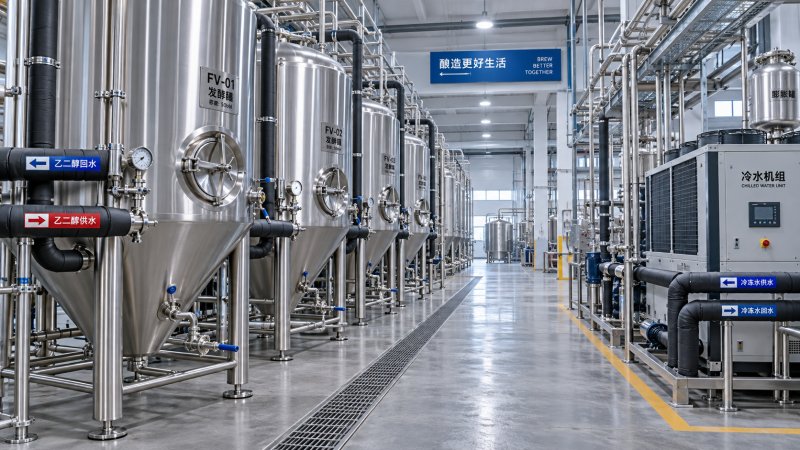
A layout drawing should show the delivery route and service clearances alongside the final tank position. Measure door openings, turns, ramps, and obstructions against the shipping dimensions. Confirm which fittings can be removed for transport and whether the tank can be brought upright safely inside the building.
Floor assessment must use loaded operating weight, including liquid and attached equipment. Legs create concentrated loads, so total weight divided by the overall footprint is insufficient to assess local support. Slab condition, leg positions, anchoring requirements, and nearby drains can change the site work required.
Drainage also affects placement. Long hoses crossing working aisles complicate cleaning and transfers, while cleaning discharge must reach a suitable drain without persistent pooling. Moving the vessel closer to drainage can reduce hose handling but increase glycol pipe length; both consequences belong in the layout comparison.
Installation costs depend on access and connection boundaries
Freight and unloading should be priced separately unless the quotation explicitly includes both. Establish who supplies the lifting equipment, rigging, and positioning work, and confirm the lifting arrangements before delivery. Restricted access can require a different vehicle or lifting method from the one assumed in the initial freight estimate.
Utility interfaces deserve the same precision. Confirm connection sizes and standards, electrical supply requirements, control wiring, and responsibility for integrating temperature control. A threaded fitting, flange, or sanitary connection described only by nominal size can still be incompatible with the existing installation. Late adapters add cost and sometimes reduce maintenance clearance.
Cleaning connections require adequate flow, pressure, and a workable return path. An installed rotary spray ball does not establish that the existing cleaning system can supply it correctly. Pressure-control and relief arrangements also need confirmation against the vessel’s documented operating limits; the presence of a spunding valve alone does not establish the tank’s allowable pressure.
Where installation requires opening an existing glycol loop or modifying shared utilities, define the shutdown window before assigning labor costs. Restricted working hours, temporary connections, draining and refilling the loop, and restoring insulation all affect the installation allowance.
Make commissioning part of the quoted result
Commissioning should demonstrate that the installation meets agreed operating requirements. Define acceptance conditions for connection integrity, sensor readings, control response, drainage, and jacket flow. Verify the glycol system under a stated representative load. An empty tank reaching a setpoint provides limited evidence of full-batch cold-crash performance.
Record the boundary between vessel performance and site infrastructure performance in the quotation. If a cooling target is specified, document the batch volume, starting temperature, target temperature, available glycol conditions, and permitted cooling time. Those details make the expansion price reviewable and give a practical basis for resolving performance issues before the tank enters production.