












NEWS
How to budget for a 2000L stainless steel mixing tank installation
Budgeting for a 2000L stainless steel mixing tank involves more than approving the purchase price. Installation, utilities, transport, commissioning and ongoing maintenance can all affect the total investment. For finance teams in the beverage industry, the challenge is to identify those costs before the project reaches the purchase-order stage—and to understand which assumptions could change the final amount.
A useful approval budget connects the tank specification with the work needed to put it into production. It should also make clear what the supplier will deliver, what the site team must arrange and what remains uncertain.
Start with the installed cost, not the tank quotation
A vessel price is an important starting point, but it rarely represents the full amount needed to produce the first saleable batch. A quotation may cover the tank and agitator while excluding freight, unloading, electrical connection or site commissioning. Another supplier may include some of those items, making a direct price comparison misleading.
Build the approval request around the following cost categories:
- Equipment: vessel, agitator, motor, controls and specified fittings.
- Delivery: packing, freight, insurance, import charges where applicable and unloading.
- Site preparation: access modifications, floor assessment, drainage and utility extensions.
- Installation: positioning, pipework, electrical work, insulation and integration with existing equipment.
- Commissioning: testing, cleaning, operator training and initial production trials.
- Ongoing ownership: energy, cleaning supplies, maintenance, spare parts and service support.
Keep contingency separate from these line items. It should address identified uncertainties, not compensate for an incomplete scope. For example, if the route into the production room has not yet been checked, record that as an open issue and seek a rigging estimate before approval.
Which specifications have the greatest budget impact?
A 2000L capacity alone is not enough to define a mixing system. The beverage, batch recipe, cleaning method and production schedule all influence the design—and therefore the cost.
Mixing duty and usable volume
Water-like juice blends, syrup concentrates and drinks containing suspended ingredients do not necessarily need the same agitator. Viscosity, solids content and the desired mixing time affect impeller selection, motor sizing and controls. Discuss the range of recipes with the supplier rather than specifying the vessel from nominal capacity alone.
Also confirm whether 2000L means total vessel volume or the intended working volume. Headspace may be needed for agitation, foaming or additions during processing. A mismatch here can lead to smaller-than-planned batches or an expensive change after ordering.
Materials, cleaning and temperature control
Stainless steel grade, internal finish and sanitary fitting requirements should reflect the product and cleaning chemicals. Ask suppliers to explain where 304 or 316L stainless steel is proposed and why. The lowest initial material cost may not be the best choice if it falls short of the application’s corrosion-resistance requirements.
A clean-in-place spray device, jacket, insulation, temperature probes and automated valves can add to the capital cost. They may also reduce manual work or support a required process. Finance reviewers should ask which features are essential on day one, which can be added later and whether future upgrades require changes to the vessel design.
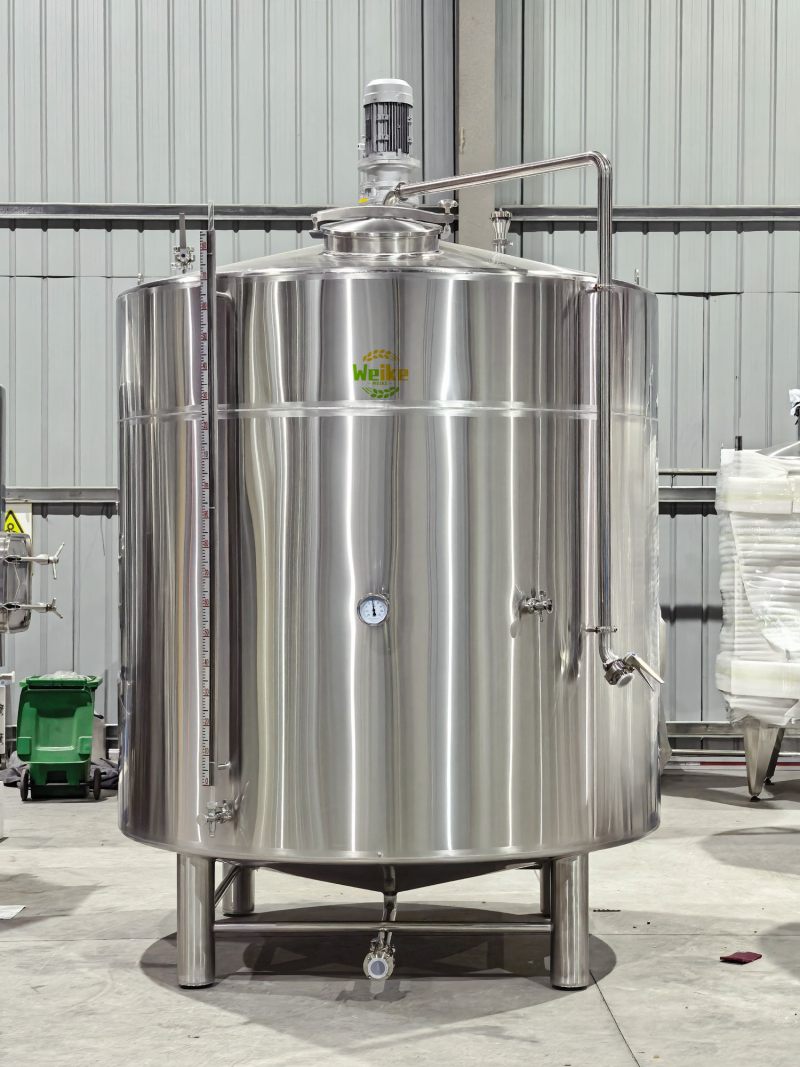
For perspective, Weike’s plant corn oil storage tank illustrates how storage applications can call for features such as temperature control, a closed structure and a CIP cleaning ball. It is a different application from beverage mixing; its listed 20000L model and oil-storage features should not be treated as specifications or pricing for a 2000L mixer. The relevant lesson is to budget for the actual process rather than assume every stainless steel vessel has the same scope.
Check the installation path before approving the project
A tank that looks straightforward on a drawing may be difficult to move through an existing plant. Measure doorways, corridors and ceiling height, allowing for the motor, legs and lifting equipment. Confirm the operating position as well as the delivery route: the team will need access for cleaning, inspection and maintenance.
Ask a qualified local contractor to review the floor loading and anchoring requirements. The assessment should consider the filled vessel, not just its empty shipping weight. Where the tank connects to existing lines, check whether pumps, valves and pipework can accommodate the new process and cleaning flow.
Utility costs deserve the same scrutiny. The motor and control panel need a suitable electrical supply; a jacketed vessel may also require heating or cooling capacity. Depending on the design, there may be requirements for water, drainage, compressed air or other services. Request connection points and utility loads from the equipment supplier early enough for local contractors to quote their work.
Make supplier quotes comparable
Send the same basic scope to each bidder: product description, working volume, recipe characteristics, desired mixing duty, material preferences, cleaning method and required delivery location. Then compare the responses against an inclusion-and-exclusion schedule, not just the final figure.
Acceptance criteria are especially valuable. Agree in advance what must be demonstrated before the project is signed off, such as satisfactory mechanical operation, leak checks and control functions. If mixing performance must be verified with a particular recipe, define the test conditions and responsibilities with the supplier. This protects both the production team’s expectations and the finance team’s payment controls.
Look beyond commissioning to the cost of ownership
Once the vessel is running, operating costs depend on how often it is used and cleaned. Estimate electricity for mixing and any heating or cooling, along with water, cleaning chemicals, labor and wastewater handling. Maintenance planning should cover accessible wear parts, seals, sensors and the likely effect of downtime on the production schedule.
It can be tempting to defer spare parts to keep the initial request lower. Instead, ask the maintenance team which components are critical and how quickly replacements can be sourced. Compare the cost of holding selected spares with the operational risk of waiting for them.
Supplier support should also be assessed in practical terms. Shandong Weike Machinery Equipment Co., Ltd designs, manufactures, installs and commissions stainless steel vessels for beverage and other food applications and states that it provides five years of after-sales service. Before including that support in an approval decision, request the written terms, including coverage, exclusions, parts and travel responsibilities.
A practical approval test
Before releasing funds, ask the project owner to reconcile three figures: the quoted equipment price, the estimated installed cost and the expected ownership cost. Each should have a named source and a clear list of assumptions. Flag unresolved items—such as utility capacity, freight responsibilities or recipe testing—alongside an owner and a date for resolution.
The best budget is not necessarily the one with the lowest initial total. It is the one that gives decision-makers a reliable view of what must be spent to make the tank useful, safe to operate and maintainable throughout its service life.